

 Apple Podcasts
 Spotify
 YouTube
 Amazon Music
 Castbox
 RSS Feed
 Overcast
 PocketCasts
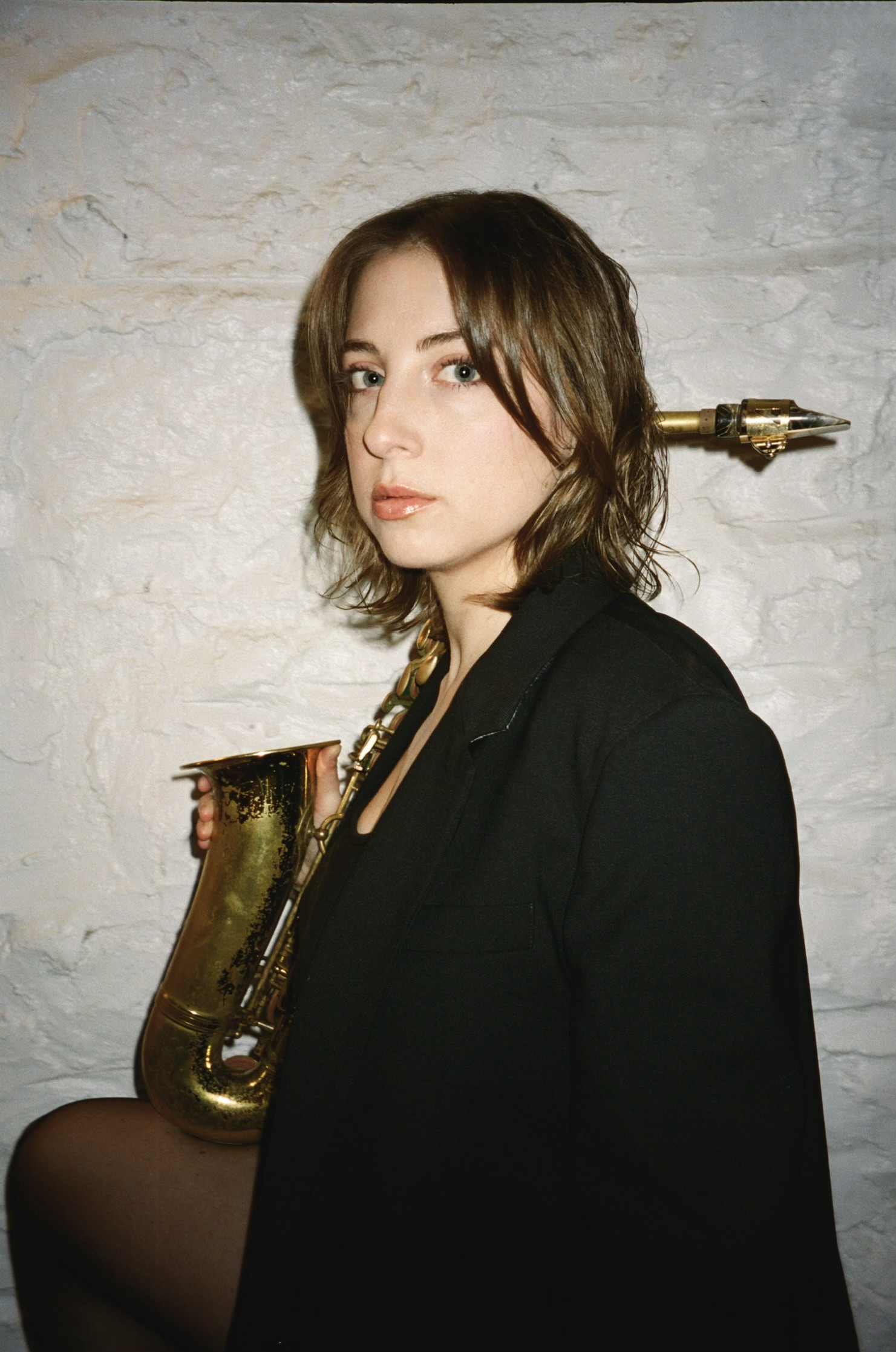
 Alden Hellmuth: Saxophone Tethered to a Galaxy of Bass
Trained in the Jackie McLean tradition and later mentored by Herbie Hancock, Hellmuth explains how 'Tether' turns trust between bandmates into the record's actual structure.
This week, we’re putting The Tonearm’s needle on saxophonist and composer Alden Hellmuth.
Alden grew up in Hartford, studying in the Jackie McLean tradition, and now works out of New York City. Her new album is called Tether, and it features a band centered on two bass players, rounded out by drums, piano, and trumpet. Alden wrote music for the ensemble that keeps them all tied together, no matter how loud or free it gets.
We talked about our shared background in Connecticut, what she took from studying with Herbie Hancock, and how she writes for the specific people in the room.
(The musical excerpts heard in the interview are from Alden Hellmuth’s Tether)
Dig Deeper
• Visit Alden Hellmuth at aldenhellmuth.com and follow her on Instagram and YouTube
• Purchase Alden Hellmuth’s album Tether from LEITER, Bandcamp, or Qobuz, and listen on your streaming platform of choice.
Collaborators:
• Logan Kane, bassist
• Miller Wrenn, bassist
• Justin Brown, drummer
• Paul Cornish, pianist, featured guest
• Yakiv Tsvietinskyi, trumpeter, featured guest
Label:
• LEITER, the Berlin label co-founded by Nils Frahm
Education and Mentorship:
• Herbie Hancock Institute of Jazz Performance at UCLA
• Jackie McLean Institute of Jazz at the Hartt School
Musical References:
• Jackie McLean, saxophonist and longtime Hartt faculty member
• Joe Morris, guitarist/improviser Hellmuth credits as an early gateway into improvised music
• Steve Lehman, saxophonist and composer, cited mentor
• Deerhoof, Breakup Song (2012)
• Otoboke Beaver, Japanese punk band
Venues:
• Real Art Ways, Hartford
• Non Plus Ultra, Los Angeles
(This transcript has been lightly edited for clarity.)
Lawrence: Tell me about the Hartford area. The gravitational pull for me as a kid, especially, was New Haven, because I was much closer. I grew up as a teenager listening to a lot of mainstream music—I was a classic rock kid. I'd just started to get into jazz in high school, so we would go to the Civic Center to see shows.
I remember going to see some really interesting music at the Real Art Ways Festival over the years—I saw Sonny Sharrock and Marc Ribot. I'm curious about the music that was in the air for you as a young person, either specific to Hartford or just what you were pressing play on.
Alden: I grew up in Hartford, slash Rocky Hill, but I did all my schooling in Hartford, in the Learning Corridor, across from Trinity.
It's funny, because looking back, I feel like even Middletown—although I would go there all the time to get dinner with my family—something about the music scenes never crossed over. I think also it's just that the teachers I had in Hartford made it feel very insular. It was this little bubble of Jackie McLean students. There are a lot of students of Jackie McLean out in the world, but a significant number of them ended up teaching at places like Hartt and the Greater Hartford Academy of the Arts and Artist Collective, which is where I spent most of my time. It made sense to me as a young musician that I was listening to some later Jackie, early Jackie, everything Jackie McLean was connected to. When I moved to New York especially, it felt like this door had just been ripped open. I was like, there's so much more.
It's interesting when you're in a community like that: it feels like there's one vision of what the music is supposed to look like, or what they believe it looks like. It doesn't leave a lot of room for exploring outside of the tradition they have there. Jackie is responsible for a massive community of musicians, and it's really beautiful, but at the same time I felt like I missed a lot of opportunities, because there are these amazing scenes in Connecticut—at Wesleyan, Anthony Braxton, Tyshawn Sorey, who I think was there around the same time I was in college. Looking back, I wish I had branched out a bit more, but I also think the path I've taken means I could only be where I'm at because of the experiences I had. It's really interesting, too, because Connecticut is so small.
Lawrence: Your comment about Middletown is interesting to me as well, because I remember learning about what was going on there, whether it was the incredible Indian classical music happening at Wesleyan or, obviously, the Braxton connection. To have grown up not that far from it and to realize it was there—I feel lucky that I discovered it in my early twenties, but I wish I had known about it even sooner. It was incredible to be able to drive out there and see an evening of Indian classical music in the middle of Connecticut. It was very impactful on a young me.
Alden: That's what I feel like I really missed, that opportunity to go see those things, to go see that kind of music. I knew about Real Art Ways, and I loved it for the cinema and the art. I did used to go to New Haven to see Joe Morris play, and I really credit that as my dipping my toe into improvised music, because watching him play was one of those times where you see something and the wires all cross. I thought, it's all there—this is something that really excites me.
Lawrence: Oh, that's beautiful.
Alden: And then I started to find my own way in twentieth- and twenty-first-century new music, and it really wasn't until I moved to New York that I felt like that door fully opened. I went way back and discovered that I had totally missed the Anthony Braxton connection that was just down the street from me.
Lawrence: When you talk about the Jackie McLean universe of people, the pedagogy, some of the attitudes, I hear all of the respect that you have there. I don't hear any of the light critique as a negative in any way. When you're in an environment like that, it provides an interesting role, because it gives you an "anti"—it gives you something to frame against, and that can be very positive when you're developing any kind of outlook, artistic or otherwise. Did that give you something to define against or push back against? Can you talk about that a little bit?
Alden: Oh, absolutely. When I moved to New York and that door opened, I found something I really loved, and I ran toward it. I thought, I'm never looking back, I want to run forward in this direction. Especially when I went to Europe and started working with an even wider range of contemporary artists, artists from a completely different lineage than what I had known my entire life up until then, I thought, I'm never looking back. It was this very "anti" feeling that I had. But it's funny, because very quickly I realized how it's all connected in a circle.
Lawrence: That's great.
Alden: Everything is always connected, especially in jazz and in music in general. It was a really beautiful wire-crossing moment in my brain, where I realized that my upbringing in this particular tradition connected me to the music in a very particular way—completely full circle, going back even to Charlie Parker and realizing that Charlie Parker is one of the freest, greatest improvisers of all time. Being able to connect those dots, to cross those wires in my brain, was really fulfilling, and it made me feel less "anti" about my upbringing in that community. Some of the later Jackie McLean albums are pretty out there.
Lawrence: I love the spirit of integration, or reconciliation, that realization of the cycle of the lineage and the deep connection between it all. Especially when you talk to more artists, you start to see that in what people listen to, what they came up through. I would almost think your experience is a bit unique, not typical, in terms of coming up through such a distinct silo, such an artist-rooted version of that. It's interesting.
Alden: Oh, absolutely. I totally resonate with that.
Lawrence: The word Tether is fascinating to me, because it implies this rootedness and connectedness, but it also limits—if you're tethered, there's an outer limit to how far you can go. I'm curious about that dichotomy. Is Tether holding things together for you, or is Tether holding things in place? Will you play etymologist with me, semantics and all?
Alden: Yeah, absolutely. I actually think about it more as the band members being tethered to each other. They can move as a unit, and move within—they're like a little galaxy. Within the galaxy, the planets shift and move, and then within the greater thing that is whatever we want to call space, the galaxy moves and shifts. It's really this idea that even when you're in that outer realm of improvised music, where there may not be something to ground you, like a harmony or a melody—even in completely free improvised music, there's always a tether that runs between the instrumentalists, whether it's through having played together for a long time, coming up in the same way, or studying the same kind of music: a shared language, a shared understanding. I just love that idea, especially in jazz, because that's something we talk about so often, that it's this shared language that transcends cultures and languages—it's just music. It really pulls people together in a way where you can just say, do you want to play this song? And then everybody can improvise and play over it. I think that's such a beautiful thing.
Lawrence: That's really interesting. Your articulation there lands for me and colors some of the next questions I was intending to ask, or makes me see them a little differently. I wanted to talk about a couple of the pieces—this is a little reductive, but I was hearing some of the music in a couple of different buckets, groupings, sort of. The first was around composition: some of the compositions are more defined, more structured, more notated, and then there's the part where it's free. Other pieces seem more improvised, more of the other kind of composition, however we want to call it—maybe you have better words than I do. I'm really curious about that experience for you as the composer and as the leader. The specificity of the first type of composition, and the direction that gives the players, versus the handing over of a lot of the decisions as a composer—how do you think about that? How do you experience it? How do you trust it?
Alden: That's exactly it, trust is so important. I write for whoever I'm playing with, and I think that defines my compositional process entirely: I fully trust the people I'm making music with. My favorite type of music is the kind where you have to listen and think, is this written, or is this being improvised? What's happening here? How did they move from this section to the next, come together, and then come apart?
I said this the other day and realized it's kind of a beautiful analogy: you're taking all these threads from all these musicians, like different colors. You set the pattern and weave them together in the composition, and then what I love is to pull all the threads apart—you don't know whose thread is whose anymore. But to take that mess of threads and pull it back together, to pull this completely new woven structure out of the process, is so magical to me. That comes from being in a band for a long time. You can do that completely improvisationally too—the Second Quintet is a great example of this. Peter Evans's band is one of my favorite examples too, where suddenly they're playing in unison and you're like, whoa, how did we even get here? It's this magical thing, and I think I'm going for that. I'm constantly trying to figure out how much information to give the musicians to achieve it, because you don't want to overwrite and you don't want to underwrite—you want to create a space where people feel like they can be themselves, and know that you, as a composer, trust them to be themselves. That's really important to me, and a lot of my compositional process revolves around that.
And I think also, for this record, I was going in all directions compositionally, because I had just finished the program here in LA, the Herbie Hancock Institute. During those two years we studied composition with Billy Childs, Ambrose, a wide range of voices, and Herbie himself. It was an incredible experience to hear all these voices and processes, so I had all of these ideas and thought, let's just try them all.
Lawrence: Could you tell me a little about some of those experiences at the institute? Or not even necessarily experiences, but maybe some insights, takeaways, aha moments. Was it revelatory, or was it building on what you already knew? How would you define that two-year experience?
Alden: It's hard to define. I think some of the greatest takeaways from that experience were just being in the same room with people I truly love and admire—Ambrose is such an incredible mentor, and our conversations meant so much to me, still mean so much to me. There are endless things I learned from just talking with him, and I'm eternally grateful for his mentorship. Being in the room with Herbie Hancock is a very special thing too. He's eighty-five now—or, I think he just had his birthday, so maybe he's eighty-six in May.
Just understanding that there is no ego in music for him, and that that's the ultimate goal—he's more concerned with being a human. Music is just this channel of expression, and the simplification of that takes a sort of weight off your shoulders, because being a musician can be so challenging. A friend said this to me just this morning, that you're screaming for love through your instrument. People get to point at you and say things about what you did, when you're just like, this is what I love, this is what I'm doing, please love me (laughter). It's a really vulnerable thing, and we can be burdened by that a lot of the time. Then there's the industry on top of that, and it can feel really heavy.
To meet someone like Herbie, to play with someone like Herbie, where there's just this inherent lightness to existence and being, to music itself and music creation, is beautiful. Understanding that there's a ton of work and discipline required to be there and to be your best, but not feeling so burdened by it, not feeling such a heavy weight—understanding that everything you're doing is working toward this wonderful thing that words literally cannot express, because that's the magic of music.
Lawrence: It's really interesting that at his age and life stage, he's choosing to spend time on pedagogy and mentoring, sharing back with people earlier in their journey. I wouldn't take that as a given.
Alden: Yeah, I feel so lucky. We had just had our first meeting with him, and we played "Dolphin Dance," I think. I was grilling him about my favorite records, like Speak Like a Child—how did you, how did you, how did you. It's funny, because anyone who's been around him knows that when you ask him a question, he'll say, "I don't know, it was great," and that's his response to "how was it recording with these incredible people?" He's just so light, and he wants to talk about technology.
So we had just met him. He was playing some big concert, I think an LA jazz festival, in this giant theater. I had gotten in and was sitting in one of the front rows because I had asked Leonel to put me on the list, and then all of a sudden I'm in VIP up toward the front. Herbie gets up on the mic and starts talking to the audience a little bit, and then he looks down at me and goes, "Oh"—on the mic, in front of thousands of people—"hey." And I was like, me? He goes, "Oh, sorry, this is just my student Alden." It was just one of those moments where I thought, Herbie Hancock knows who I am, that's insane. I sunk in my chair. This is so unbelievably surreal to me. Then he came back, and we did a bunch of tours together, and I got to know him more personally. He's just such a special, special person. It's still so surreal that he even knows who I am and took the time to share his wisdom and his joy of music with us.
Lawrence: It's funny, because a lot of that comes across even though I've never spoken with him. Coming out of COVID, the first two concerts I took my son to were the Rolling Stones and Herbie Hancock. He said, "These guys are in their eighties, this makes no sense whatsoever." And I said, "No, the only sense it makes is that they're doing what they're supposed to be doing, and that's why they're doing it." It's a bit mystical, but it's not that complicated.
Alden: Right, it's not that complicated.
Lawrence: No. He kept turning to me during the show, about Herbie—he was like, "He's eighty." I said, "Yeah, I know, I'm in my fifties and I can't do that." (laughter)
Alden: My favorite is that every concert he loves to shock people—he'll take his keytar and do a little jump, or when he goes offstage he'll do a little jump, and everyone always cheers. I think that's so funny, because he's really in such great health. I feel like he plays into that, like, you guys are going to love this.
Lawrence: When it comes to presenting your bandmates with the overwritten and underwritten pieces, is the band pre-screened in terms of, these are people who can handle either way? Or are there people who are more comfortable in one context or the other? Do you need people who can do both?
Alden: Yeah, ideally, yes, you need people who can do both. It's kind of a problem in modern jazz in particular, that at this point the music has been so influenced by so many genres, coming from so many directions. You have to play a lot of different styles in a lot of different bands, you have to understand the language, and it's really interesting to me how that has evolved, where it requires a lot now.
My band in New York, with Yvonne, Tim, and Canoa, are excellent examples—they can nail a part, but then they can lose it and improvise while still being locked into the heart of the song. They're just amazing musicians, that's just what it is. When I moved to LA, I very quickly found that Logan is one of the most working bass players in Los Angeles and can play everything on bass, while Miller is an amazing improviser who creates the coolest sounds and has some really incredible compositional ideas, coming from a completely different direction than Logan. But again, to talk about that circle that exists in this music, it's all connected in a way, and I think that's the beautiful thing. I admired both of the bass players on this record very much, as friends and as musicians.
The whole project came from a bill that Miller had asked me to be a part of, that Logan was also on, and I thought how funny it would be if I had both of them and we did a double bass quartet—also knowing that they occupied two very different spaces sonically. It was just one of those moments where I thought, that actually makes a lot of sense, let's do it. It's not even just the way that they play, it's also the timbre of their instruments—they're so different, and I think that's so special. I cannot imagine doing this project with any other bass players. I recently did a show in New York with two different bass players, and it was amazing and so fun to play with different people, but for what I envisioned for this project, I really cannot imagine making this record without Logan and Miller. It's just so about who they are.
Lawrence: The obvious thing that has to be asked about this record is the two bass players. I wanted to ask about how they don't end up crowding each other, or crowding the music. A lot of times, when I prepare for a discussion with an artist, especially one whose work I'm not deeply familiar with, I try to listen to the latest record without any context—I don't read the press release, I don't want to know much going in. I wasn't aware of the two bass players, I didn't really pick up on it. When I read that, I thought, wow, that's crazy, and I went back and listened to it and thought, okay, yeah, that makes more sense now. They very specifically weren't stepping all over each other or crowding the music. Did you know that going in?
Alden: Yeah. Honestly, this project was my outlet. It's funny, because I felt like I was writing more seriously for other projects while I was in the program, and this was my fun opportunity to explore. I realized that it was becoming something bigger—they really helped shape an idea into something much, much bigger. I feel very grateful that they both came into my life and inspired this whole record.
Lawrence: The other thing about this record is it doesn't feel in any way like a blowing session for the sax player. Everybody's got a lot of space, and I'm very taken with the engineering of the record—you can hear the breath and the keys, and I really love that in a record. Philosophically, or even temperamentally, what does that say about you? What are you looking for? Because you aren't just looking for a platform to play over.
Alden: No, absolutely not. Music is about the ensemble, so much about the people I'm playing with. I want their voices to shine—that's why I'm making music with them, because I love their voices. It's not all about me as the leader, it's about the collective thing we come up with, and I think that's really important.
I also want to shout out Laura, the engineer who did this project. She worked her magic, that's for sure, because two basses is no easy feat. She really saw the vision, understood it, and nailed it. We were in UCLA's very pristine, beautiful, state-of-the-art studio, and everyone was isolated—I had the big room, which was really fun, because all of the reverb you hear is pretty much natural. She also captured all the breath and the keys and everything. Laura did an amazing job with the record. This project is something we've been doing at DIY shows, in a random, basement-y, punkish vibe. She even understood that, and I think she captured that sound perfectly. It sounds imperfect in a lot of ways, but it's also done perfectly, if that makes sense.
Lawrence: Yeah. It's not sterile.
Alden: Exactly. I think that's the magic of jazz. With modern recording techniques, we kind of lost sight of that a little in those older jazz records—there are squeaks and squawks and clanks and all sorts of things that make it beautiful and magical. It's not the perfect mix, but it works, and you can hear people talking or laughing in the background. I think the joy of music is something you've got to let people in on, and I think that's one way to do it: giving them access to all of the sounds, the count-offs, the laughing, the yelling, the wooing.
Lawrence: Because the music can be so intellectual, or at least when it's technically proficient, there can be an inaccessibility to a listener. I don't think this record is guilty of that, but there's some music that's dense, where it's like, what's my entry point? Sometimes the entry point is the count-off—oh, okay, I hear where the groove is. Or you hear that laugh after somebody takes a solo. Those little moments provide entry points, I think, for people of varying ear-development levels.
Alden: Oh, absolutely. It takes that weight off, especially in dense music. I love this track by another mentor of mine, Steve Lehman. At the end of the track, I think Craig Taborn hits a major chord in an almost comical ending, and then you just hear them burst out laughing. It invites the listeners in on the joke, and I think that's really important. You get that with live experiences a lot, but recorded music less so.
Lawrence: A lot of our conversation—and I know our listeners won't be able to tell, but a lot of your body language, too—you smile a lot, your tone is very upbeat. I'm curious about the role of conflict in a musical environment. How do you navigate it? Are you seeking to minimize conflict, or do you harness it for creativity? I can't imagine it's always easy.
Alden: No, of course not. It's rarely easy—there's a lot of work and a lot of turmoil. It also says something about where I'm at in general. On my first record, I explored a lot of that idea of conflict and tension. That was the whole point of that record: I had a lot of feelings and a lot of tension happening in my life, and I translated that into exploring dissonance and opening a door in a certain direction. Once I started stepping through that door and kept going down the path, the path became clearer as I walked down it, and with some perspective now, I can look back and be grateful for everything. That gratitude is really important, and it totally uplifts your whole being. Ultimately, I'm just really grateful to be able to make music, to share these experiences, to have had the experience I've had. That gratitude, that perspective, is what really brings everything together. That's not to say there isn't conflict or tension, but I think where I'm at in my life currently is just this endless gratitude and perspective.
Lawrence: You alluded to the different types of rooms, how some of this music was played in DIY or punk-adjacent places. I love talking with artists about the role of place in their music—that could be as broad as the city, the macro environment an artist is in, or specific recording studios and performance spaces. It's always fun to talk to people who record at the Village Vanguard, because they've all got great stories and different perspectives. What is the role of place for you, and how do you think the music comes out differently?
Alden: Oh, absolutely. I really think our very first gig, the bill that Miller asked me to be a part of that inspired this whole project, really defined what I envisioned for it. I also think the city of LA really defined the direction, because our first gig was at this very DIY space called Non Plus Ultra. It's a funky, fun, amazing place to play in downtown LA. As soon as I saw the space, I thought, this project needs to go in this direction, I need to write for this space—which is kind of backwards, but again, this was my outlet at the time, when I was in grad school, so I was having a lot of fun with it. I think it's all alignment, everything coming together.
My walk from the music school to my grad housing was about thirty minutes, and I would spend that time listening to whatever, if I wanted to check out a new record. Driving in LA is horrendous and takes a very long time, so there was a lot of time I spent alone, thinking, listening, learning, developing ideas, questioning things. At that particular moment in my life, I was revisiting Breakup Song by Deerhoof, which I remember hearing in high school, and my mind was blown, because the reason I love music is when albums are totally unexpected and surprise you. That album hit all the marks—production, songwriting, everything was unexpected, and I just fell in love with it. I was revisiting that record at the time, and I was also listening to a lot of Japanese punk—I had recently discovered this band Otoboke Beaver, so I credit a lot of the sound to that era of my life. Playing that gig at Non Plus Ultra, having that be our first gig, was really defining for the sound. I was just having fun, writing these songs that at the time felt totally left of what I was doing and working on. But it's funny, because again, it's just full circle.
Lawrence: It makes its way in. I don't like to make too much of binaries, but I hear a lot of polarity in some of the things we're talking about. One thing that strikes me is that some of these spaces, these types of music, are not as concerned with—or are even suspicious of—polish, tidiness, and order, in a way that's different from conservatory training, which might be looking for a certain type of precision, or at least proficiency. Different values, different aspirations in the music. How does that fit into all of this? It feels like it's in the air in what we're talking about.
Alden: I feel very grateful that, despite having gone to Hartt—and that whole conversation we had before about the community that existed in the tradition I was brought up in, especially the later Jackie McLean mentality—it did not hold value in perfectionism. I never really had that teacher who was like, you have to take the perfect solo.
Lawrence: That's great.
Alden: I was surrounded by people—Abraham Burton and Renee McLean, and then later Ambrose and Walter Smith—all these people who were pushing me to search. On my own, as a perfectionist, I found a way—when I came to UCLA I started studying with a classical saxophonist to really get my stuff together on saxophone. It's this self-discipline that's met with this search. People reward the search, and I feel very lucky that I grew up and studied in places where the search was always the goal—that greater thing, like the Sonny Rollins on the bridge type of thing.
Lawrence: I love that. You couldn't have made that up. That's such a cool part of his story. Not even lore or legend, it's real, it's part of his story, he did that. It's so crazy. I love it in every way.
Alden: The search is what drives music. That's the magic of it.
Lawrence: Could you tell me the significance, if any, of the label the record is on, and the fit there?
Alden: I feel very lucky that this label has taken this project on and supported it. For a while I was pitching to different labels, and I kind of knew that this wasn't as straightforward a jazz record as some of my previous work, or just the band itself—when somebody hears it's two basses, it's non-traditional. I feel very lucky that LEITER took this project on, because they promote a lot of non-traditional music, non-traditional jazz, people who are reaching into other genres, crossing all of these—there are no boxes. I feel like it's really found a home there, which is really special. I'm super grateful that they really love the record, and that's all you really want from a label at the end of the day, for them to really like the record. I think they really do, and that means more than anything—having a team that really believes in you.
Lawrence: Without that enthusiasm, the project isn't good. No bueno (laughter). Before I let you go—you said you write, you compose for the players. I don't want to hold you to that too rigidly, but I'm curious, as you start to think about how long you live with a project, when it starts to turn into the next one. Given that you compose for the people you're hoping to perform and record the work with, what do you take from this that you can bring to that? How do you build on the body of work, or the learning from the experience, when you're thinking about different people?
Alden: It's interesting, because I've already started to play this music in a completely different context, which has been a lot of fun. Bringing this music to my band in New York, it's completely different, but I also think it's really special, because the energy of the project is understood—I've played with those people previously, so they still understand where I'm coming from. It sounds completely different, but it still captures the spirit of the record. Just playing this music in that context has already inspired me to start writing for this band in New York, because now I'm based in New York, and unfortunately I just can't fly two bassists out everywhere I go, even though I'd love to, and Justin Brown is just impossibly busy. It's already taking shape in this new live experience, and I think that's inspiring me to write in a new direction, to shift it for that context. It's an evolution of an evolution.
Lawrence: When compositions can be performed in a variety of different contexts, or even instrumentations, that speaks to the sturdiness of the composition. There's something validating in that, I think. I wonder, have you encountered works of your own that you cannot transpose to other environments?
Alden: Yeah. Actually, there's one song from this record that I haven't really played since—we tried it once, and even still, it just didn't hit quite the same. That's "Face the Wall," which was the first song I wrote for this project, and I think it's going to stay there. It's going to stay in this state of, this was a time in my life, I recorded it, I captured it, and it will never be recreated. I think that's kind of special and beautiful.
All of the other songs translate really well into a different context, open up in a different way. But that song in particular, I haven't been able to recreate, even recreate from when we first played it—that first show. There was something there. I wish I had a recording of it, but I don't. It's one of those songs I don't think I'll ever play unless it's with that band live, which I still do tour with when I come to the West Coast and it's more feasible. I think it very much has to do with the bass players too—they get it, they understand that song, because it's really written for them at the end of the day. It's truly only them.
Lawrence: That's amazing, I love that. Thank you so much for your positivity, and for your flexibility with the rescheduling. Thank you, overall.
Alden: Thanks for having me, and thanks for listening to the record.
Musician
Alden Hellmuth is a saxophonist, composer, and improviser based in New York City. A graduate of the Herbie Hancock Institute, she received the 2025 German Jazz Prize for Debut Album of the Year (International) for her album Good Intentions (Fresh Sound Records) and has performed internationally at major venues and festivals including the NYC Winter Jazz Festival, Hollywood Bowl and Blue Note Jazz Festival, International Jazz Day (Morocco and Abu Dhabi), The Jazz Gallery, and Blue Note NYC. Alden has been recognized with numerous honors, including New Music USA’s Next Jazz Legacy (2026), Chamber Music America’s Performance Plus Grant (2025), ASCAP’s Herb Alpert Young Jazz Composer Award (2024), and the Focusyear Fellowship (2021-22). As an artist, Alden seeks expression through freedom, intuition, and a deep commitment to her craft.