

 Apple Podcasts

 Spotify

 YouTube

 Amazon Music

 Castbox

 RSS Feed

 Overcast

 PocketCasts
Charlotte Greve: Everything She Loves, Under Her Own Name
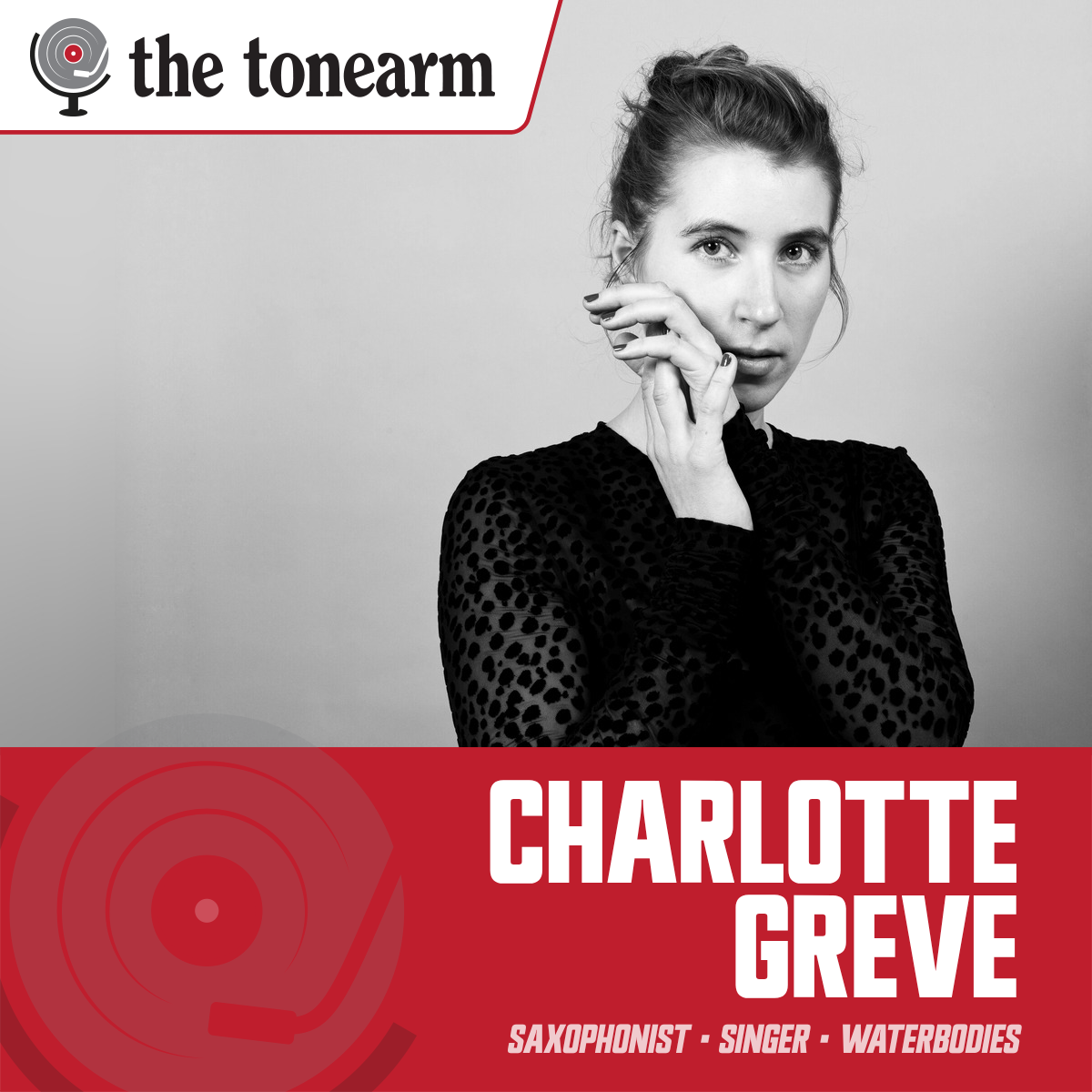
The Brooklyn saxophonist, composer, and singer joins us to discuss 'Waterbodies,' her tenth album, which brings '80s power ballads, an orchestra, and a choir back to the one long saxophone tone where all her music starts.
This week we’re putting The Tonearm’s needle on saxophonist, composer, and singer Charlotte Greve.
Waterbodies, out now, is her tenth album but the first under her own name. She wrote it while expecting her daughter.
We talk about her love of ’80s power ballads, what Shahzad Ismaily brought as producer, and the work deadline driven by childbirth.
(The musical excerpts heard in the interview are from Charlotte Greve’s Waterbodies)
Dig Deeper
• Visit Charlotte Greve at charlottegreve.de and follow on Instagram, YouTube, and Facebook
• Purchase Waterbodies from Bandcamp or Qobuz and listen on your streaming platform of choice.
Live:
• Waterbodies and Kaoru Watanabe’s The Arch release show, Public Records, Brooklyn, October 14
Coverage:
• Charlotte Greve – Membranes (Various Small Flames)
• Charlotte Greve, Waterbodies (FEMMUSIC)
People and Places:
• Shahzad Ismaily
• Seth Manchester and Machines with Magnets (Take Magazine)
• Kaoru Watanabe, The Arch (New Amsterdam)
• John Hollenbeck (McGill University)
• Laura Veirs’s Kaleidoscope Creativity Cards (Tape Op)
• Oblique Strategies
From The Tonearm:
• Caroline Davis: The Saxophone Reimagined in the Fallows
• Ghost Notes from Wyoming — Caroline Davis’s ‘Fallows’
• Laura Veirs Alone in the Temple of Bloom
(This transcript has been lightly edited for clarity.)
Lawrence Peryer: Before we jump into the specifics around the new record, I wanted to talk a little bit about some of your history, and I'm curious about your journey to New York. What's your story with coming to New York? What's the why for you? Did it live up to what you were hoping when you got here?
Charlotte Greve: It definitely did. I've been here for fourteen years now, and it made a huge impact on the way that I work and the way that music went for me. My whole journey was extremely influenced by this place. I had visited New York twice before moving here, the first time for two months and the second time for one month.
Both times I was feeling a certain non-laziness, if that makes sense. Just a lot of activity, a lot of energy, not only in the music scene, but from the city itself. And of course, seeing all the musicians, hearing all the musicians, knowing how much energy and time and care is going into the music.
I moved here because I was feeling on both visits that it's really good for me to be surrounded by this kind of energy that is very alive and very "just do it." Just keep doing stuff. So in that way, it has been living up to my expectations or hopes.
Initially I was going to come for one year and not even finish the master's degree, because I didn't really come for the degree, I just wanted the experience. Then I was like, "I'm going to finish the master's. Oh, I'm going to do a year of OPT," it's called. Because I'm German, you need a visa and everything.
"Well, let me do an artist visa." And then five artist visas later, I'm like, "I have to do another one." But I always said, "No, I will go back if it stops making sense being here." If I have to pick up a job that I don't want to do just in order to make ends meet, and if music doesn't have enough room anymore, for whatever reason, I don't want to live here.
That doesn't make sense to me, and I try to stay with that rule because life changes, and the economy changes, and the music economy is definitely not easier than fourteen years ago. So far so good. Still here. Still doing the thing.
Lawrence: That's wonderful. I was there for about twenty years. I'm from Connecticut originally. I understand what you mean about the energy. I wasn't necessarily ready to leave when I left, but I have so many friends and colleagues who, when it's your time, if you stay past your time, it's very uncomfortable, because it's not an easy place to be. For how wonderful it is, there are days where it feels like the city's fighting you.
Charlotte: I mean, it's a love-hate relationship. I think most people will agree we love it, and then we're like, "This place," you know? And the next day it's like, "I love New York. It's so amazing."
But I feel like the love-hate relationship is a very honest relationship with this place, too. It's extreme. There's extreme love and extreme hate happening several times a week.
Lawrence: Yeah, especially when the twenty-minute subway ride turns into two hours and you're late already. Happens every time.
I think of Germany in particular as being very open to, and having a particularly vibrant, electroacoustic music scene, people blending electronics with their acoustic instruments. How did you find that openness when you came to New York? And has the appetite for that type of music or collaboration changed at all since you've been there?
Charlotte: When I came here, I was mostly just, quote-unquote, playing contemporary instrumental jazz. I wrote my own music, and I kind of did that. What I found most helpful coming here is that nobody cares what you do. Nobody cares. You can just do what you want to do. You can experiment. In the best and in the worst sense, nobody cares.
That's just how it felt, because the scene is so much bigger. I came from Berlin, and it's a big scene, and it's also changed so much since I left. And I was really young, and I was kind of in this corner of, "Oh, she's doing just this one thing." I came here and I realized, "Oh, I'm interested in a lot of other things as well."
Introducing electronics into my setup was just one of them, and starting singing and doing a bunch of singer-songwriter things, collaborating and stuff. I felt more openness here in terms of trying out different things and challenging yourself with different things.
Maybe it was similar in Berlin already at the time, but for me personally, I didn't have that experience. Coming here was a liberating thing for me.
Lawrence: It's interesting, because from where you are today and with this record, I don't think of you as doing only one thing. It's kind of a hallmark of this album. And I have to ask, I'm so curious, where does the love for '80s pop and the power ballad come from?
Charlotte: The love for this type of music has always been there. Maybe as a twelve-year-old, I had this cassette that my mom originally owned. It was called Power and Soul, and it had Anita Baker, Whitney Houston, all these amazing singers. It was basically a cassette of power ballads from the late '80s, early '90s.
I was so into it, and I listened to it a lot, just this one cassette, and that's actually true for a lot of my influences. There were certain records where I was like, "I'm just listening to this now. This is the thing." So the music that's coming out of my brain now, and that ended up on this record, accumulated over many years, starting from a young age. I went the jazz path through the school system, doing a bachelor's degree in jazz performance and a master's degree in jazz performance.
The music that I played live with my own bands was very much focused in that way, and when that ended, I was finding different outlets to use the influences that had been there but didn't have a lot of space in the music I was making. So yes, they've always been around.
Lawrence: Maybe some of the obvious commonalities or traits of that music are certainly drama, melodrama, but also melody, a real commitment to melody. So it doesn't surprise me that you wouldn't abandon that.
Charlotte: Yes, and that's the thing. It's all very connected. I'm very curious to hear how this record sounds to other ears, because so far only three singles are out. But once it's all out, whether people can hear the connection, or if it's more like, "This is not a record. This is just an accumulation of songs." To me personally, it's all the same, really, and it's all so connected and so close to each other. The music is showing different faces of the same thing.
Lawrence: In some of the material that I was sent to prepare, I don't know if you said it exactly this way, but what struck me was that this record seemed to be not a culmination, but a real expansive view of your world, backwards and forwards and now. This is who you are and where you are.
Charlotte: Yes, exactly. That's exactly how it is. That's why it's the most personal record I've ever made, and a very vulnerable presentation of where I'm at right now.
Lawrence: Were you previously more guarded or reserved?
Charlotte: I think I made nine records as a leader, and they were more one thing. Six records were with my first-ever professional band, Lisbeth Quartett, which is a saxophone quartet, jazz, contemporary, some people would say Euro jazz. That was the first place where I found my voice on the instrument, on the saxophone, and the first place where I was really composing.
But that band is one thing, and there's a certain thing that we do really well, so those records are in that vein. And then the other three records were also more just one thing. None of the records had my actual name, although it was all my music, and that was also a big thing.
I wasn't ready to say, "This is my name." I always wanted it to be the band. It's about the band. It's about the project or the collaboration. Even the choir piece, the whole thing, obviously my name is there because I wrote the whole thing, but I was like, "No, no, it has to have this project name."
That's just how I felt for all this time, and then I was like, "You know what? The next record is just going to have my name, and if it's going to have my name, it has to have this whole array of things on it," because that's the most honest representation of what I think I am as a composer, as an artist, as a player, as a performer.
Lawrence: Tell me about the collaboration with Shahzad. How did that come to pass, and what did that collaboration bring to this?
Charlotte: When I first had this idea of making a record like this that has all these different things on it, I was very aware of the danger of making it sound random and not connected, and I said, "If I'm doing it, I need someone who I trust fully to help me bring it all together."
I had worked with Shahzad on different projects in the last few years, where he was producing another person's project and I was playing in the band, or he asked me to do a lot of overdubbing for other artists he was producing. We played a bunch together, so we've really been sharing a lot of music, and a lot of the same understanding of how we make music and how we approach things. I feel really close to him, and I really trusted him with this record.
We had long talks. I sent him all the demos, and I was like, "Do you want to work on this and help me find a uniting thing?" He was up for it, and it was so helpful, because I already had a clear vision, but he would say one tiny thing that I would never have thought about. He would be like, "I think this drum machine needs this certain delay. This is what we have to do."
And I wouldn't have heard it. I didn't know that that's what it needed. Something tiny, and suddenly, "Oh, my God, that's the track." So it was a subtle thing in every little moment. We did the basic tracking, but hadn't done any overdubs, and then we went back and forth.
It's like, "Okay, so how do we approach the next step of post-production?" And he would be like, "This track needs to stay, let's say, fully acoustic. Think of overdubs you can do with more acoustic instruments that sound like synthesizers but aren't synthesizers." Stuff like that. Eventually we did add a synthesizer to that track, which was him playing the Moog. But it was taking these little steps together and finding points of connection between all these different songs.
Lawrence: Really what you'd hope a producer could do, right?
Charlotte: Totally. I think it's one thing if it's one body of work written around the same time and then you have a producer. But this was like, "Look, it's going to be pretty contrasting moments, but how can we find some through lines sonically together?"
I really needed his bird's-eye view, sort of, in order not to lose myself in details, or in, "Well, I really want this on this song," when it would not have connected as well with the rest. So I was really happy to have him there.
Lawrence: That makes a lot of sense. A moment ago you used the word "vision." In your vision for a piece, how early do you know what's going to be saxophone versus synthesizer versus voice? Do you hear a melody in a sound, or do you have to go find the sound that matches the melody? I'm so intrigued by that.
Charlotte: It really depends on how I start the song, on how I start writing. A few of these songs, I would say four at least, came out of a challenge organized by musician friends of mine to write a song every day.
They did it for a whole week and asked me if I wanted to be part of the group, and I said, "I can only do four days, but I'll do four days of the week." I wrote four songs in four days, and they're all on the record. And every day I said, "I can't do the same as yesterday. Today I'm going to start with the words."
That song "Lighter Blue" was basically a poem, because I was like, "I want to experiment with having the words first and then see, by reading them like a poem, if I can hear a rhythm, if I can hear a melody in the rhythm." So going that way, versus jamming on the piano or the keyboard and singing random lines, which I also do a lot, versus "I just want to play the saxophone in the most comfortable way I can imagine."
That was the very first song on the record, called "The Well," which is me just playing the saxophone, many, many long tones, and that's the original demo that's on the record. That was late at night on this bench I'm sitting on in the living room. It was so late, and I had to go to a rehearsal the next morning, and I was like, "I have to do my song." I couldn't wake the neighbors, so I was playing pretty quietly. There were also some synthesizers. But it depends where I start.
Lawrence: It's funny you bring up "Lighter Blue." I was going to ask you about it later, so thank you for getting there. I have to ask, though: you talked about those four days, a song a day. How much of the day is that?
Charlotte: Back then it was between one hour and seven hours, depending on the kind of day you have. I did it again now. Now I hosted it, and I had ten amazing people doing it, and we did only four days, because that's how much I could do. Now I'm also a mom. I have a kid and everything, so everything had to be done very fast.
But back then I didn't have a kid, so I had more time, and it could be many hours. And then you also record the song and produce it a little bit, as much as you can, and send it to everybody.
Lawrence: That's an amazing exercise.
Charlotte: It's so great. It's the best. It's very community-building, encouraging each other to show up to the group and deliver something, and then you can draw inspiration from there. That song "Olive Tree" was also written in an hour and a half.
Lawrence: Wow. Well, the other thing about that is you don't have enough time to second-guess yourself. If you have to send a quick demo to everybody, you're just doing it.
Charlotte: You have to do it, yes. And I really need that kind of pressure, otherwise I don't do anything. That's how it is.
Lawrence: So you brought it up. Tell me about making a record while you're gestating two things.
Charlotte: Certainly intense. It was really special. I think it's in the press release: I told one of my close friends, "I am pregnant, and also, at some point, by the way, I want to make this record."
She's like, "You're making this record now. You go home now, and you're calling the people that you want to go to the studio with." And I was like, "No, I can do it over the next... there's no rush." And she's like, "There's actually a big rush, which is that you're having a baby in a few months." I'm forever grateful to her, because she was very right.
I did a bunch of overdubs and mixing and stuff later, but just getting the tracking done. And the thing that can happen in pregnancy sometimes, or what happened to me, is that I was very relaxed. It's like your body is being told, "It's fine. I can give birth. That's totally fine."
So my brain was super relaxed, and in the studio, hyperfocused. Very focused. I could do things I couldn't do before, which was really interesting, because somehow I was able to focus only on the music and not think, "Is it good? Is it bad?" No second-guessing, because again, not a ton of time. I just had to get this record done.
That was a really amazing experience. Also emotionally, because the baby's already there, chilling. We did a bunch of playing the synthesizer and singing at once, and kept a lot of those tracks, which I normally would have redone.
Lawrence: Beautiful.
Charlotte: And on the two songs that Charlotte Jacobs is on, an amazing singer who is in my band, and we sing a lot together, Shahzad was like, "We have to keep the live vocal from the live band tracking." And we're like, "No, but it's not perfect." Otherwise you would do a whole vocal day, which I did for a lot of the other stuff.
He was like, "Yes, but the way you're singing together with the band in the moment, in the studio, we have to capture that, and I don't care if it's not perfect." And I was like, "Okay. I trust you."
Lawrence: Do you have any sense as to whether the baby recognizes the music?
Charlotte: I mean, no. She's just into music.
Lawrence: Isn't that fun to watch through the eyes of your child, how they gravitate toward music? It's incredible.
Charlotte: It's so good. And she has very distinct taste. The other day she had a meltdown because she hated the record we were listening to, and we were like, "What's going on? We're eating. It's all your favorite things to eat. What's your problem?" At one point we're like, "Do you not like this album?"
She does recognize... Because I had to listen to all the test pressings for the vinyl and stuff, she recognizes my voice and when I play saxophone, and she says, "Mama," and that's so nice.
Lawrence: That's beautiful.
Charlotte: And she likes the solos. There's this track, "Membranes," and the saxophone solo is at the end, and she would say, "Ofo," which means saxophone. So I always had to scroll to the end of the song where the solo is happening. So she has very distinct needs musically.
Lawrence: What's behind that title? That was something else in my notes. I was curious what the title means to you, and more broadly, do titles matter to you, or are you one of these performers who just throws titles on things?
Charlotte: No, titles definitely matter. They're part of the composition. "Membranes" was the working title of the whole record, because I was looking for imagery in the natural world, or biology, that somehow represents a certain fluency between things, some sort of wall situation and some sort of liquid that goes back and forth.
I came across the membrane of a cell and how it's semipermeable: it goes one way, but not really the other. I looked at images, and it really resonated with me, this idea that there is fluency, but there are also walls, literal walls that are halfway open.
It was helping me visualize what I'm trying to do with this record. So the working title of the record was originally Membranes, and later I changed it. The song is exactly about this thing of many different hearts in one breast, musically, and not only musically: also personally wanting to do many different things at once, and how can I bring that all together, all these needs and all these wishes.
Lawrence: Earlier I had asked how you choose which of your instruments you're going to use, what's a synth versus a sax versus a voice. I'm curious about that same question as it relates to the players you choose. Are the players interchangeable, or did these performances have to be these people?
Charlotte: The players are in part interchangeable. I wanted to have as many people as possible from my musical universe, the most important ones, if you will, on the record. But there are also two people on the record who were more recent collaborations, where I was like, "I think with them these songs would be perfect. These new songs with these guys would be great."
And then my oldest band, Lisbeth Quartett, is also on there, with the track "Swim." So it's a mix of people I've been playing with for a long time and people I just started collaborating with, and these different bands come from different periods and also from different places.
I did this orchestra project in Germany, in my hometown, and I was using folks from Berlin and from Rotterdam to play with the orchestra. So it made sense for me to do those tracks with that same band, because they knew the arrangements and they knew how it sounds. So they're in part interchangeable, because at some point you want to go on tour, and you can't go on tour with five different bands.
I would say the singing with Charlotte is not interchangeable, because we worked on it a lot together to find the unison sound of the two voices especially, so that's pretty specific.
Lawrence: Tell me a little bit about the relationship between the saxophone and the voice. Do you learn things about playing from singing, and vice versa? Obviously they both incorporate the breath, but I'm curious how much more there is to that.
Charlotte: They definitely help each other, I would say. When I started singing, I had to learn to stay loose. I'm still working on it. With the saxophone, the way I play uses a good amount of force, I'd say, in terms of breath, and a pretty hard setup, an open mouthpiece and a hard reed and all that.
With singing, you want to not push out the air. So it's definitely been a journey to learn singing and to incorporate it into my practice. But musically, they're so connected. I also sing a lot when I compose for saxophone. When I play saxophone, the feeling of the tone in my throat informs the way I think about any tone production, especially singing.
Basically, I think a lot about how it sounds to sustain a single note, how it feels on the horn, and how it should feel singing any melody. So there's a lot of connection there.
Lawrence: Does the singing breath originate from a different place physically than the horn breath?
Charlotte: No, they come from the same place, but on the saxophone the air comes out with more speed and more impact and more pressure than with the voice, ideally. But everybody has a slightly different technique, too, and I try to focus on the tone and what happens in the throat. So it really helps me both ways.
Lawrence: For such a personal, vulnerable record, it sounds like you also gave a lot of control away. It sounds like you were very open to input and guidance and suggestion. There's a version of this where you could have said, "I need to make this statement that is all mine, and I don't want to hear anything, and I'm going to go very tunnel." One, are you ever like that? And two, you mentioned trust, but I'm curious how far it extended. Do you sit in on mixes? Did you choose the sequencing?
Charlotte: Oh, yes. Shahzad was there to produce, but it was more like guidance. And there were also plenty of moments where I said, "No, no, I'm going to do more takes of this," where he was like, "Let's move on. This was perfect." And I said, "No, we're not moving on. I'm going to do seventeen more takes if I have to."
It was open guidance, sort of, helping bring it to life, but I already came with "This is what I want," a long list of that. For mixing, I did it as I did with my last few records, with Seth Manchester in Rhode Island, and there was a lot of back and forth and a lot of collaboration.
I went to the studio, and I was there for the mixes, and then Shahzad got the mixes and had some input. But I was there every step of the way, basically, with a full-on vision for the record. Then for the details, and in order to string it all together, that's where Shahzad came in.
Lawrence: Tell me about the sequencing, because I always find it interesting, especially in the creative music realm. To me, sequencing and narrative are the same thing. I wonder if you could unpack that a little bit for me.
Charlotte: The original sequence was different. This is, I think, the third version, the final version. It came to me one by one, and in the beginning it wasn't so easy, because there are a bunch of songs that are quite slow, or ballad-y. But they ended up in different places, and it was important to me for the first statement to be the saxophone, a synth drone with mostly the saxophone on top.
That first song, "The Well," is really what the name says. Everything is coming out of that thing: how I play over a drone with the saxophone. That's where all my music comes from, pretty much. Years ago, I wrote a piece called "Original Source" for my quartet, Lisbeth Quartett, and it also originated in one single long drone.
In order to understand the record, I think the first song is the starting point for all of this other stuff, be it a choir thing, be it an orchestra, be it an indie pop–adjacent thing. It all originates in listening to one note and imagining melodies on top of that note. So it was really important to me to have that as the opening statement.
Originally, one of the orchestra pieces was the last song, and then I said, "No, it has to end with a saxophone-centric piece too, to bookend it." So I put "Scorpio," which is saxophone and a choir, at the end, which to me is kind of like an afterthought. After all this stuff, all these emotions, the big feelings and the rhythms and the busyness and the sparseness, it ends with a very contemplative afterthought of, "We did it. We watched the movie. We listened to the movie." Because I think of the record a little bit as a film, where different scenes are happening.
Years ago, I watched a film, and I don't remember which one it was, but I remember the scene of a person going through different rooms and opening doors, and behind a door there would be a super random thing, like goats. He closes the door, goes to the next door, opens it, and it's just water.
It was kind of a psychedelic scene, and this is how I felt about this record. Different scenes are coming and happening, and we're in this world now, but we're still part of the same movie.
Lawrence: So in "Wave," you sing about "trying to escape the big water coming." I don't think of this music as ominous necessarily, but that line feels ominous to me. What's the big water? And why escape it?
Charlotte: That song came out of a feeling of putting off things. It could be work. It could be other things. You know you have to approach it, you have to take care of it, and it's really important, but you're procrastinating to the extent that you physically feel like you're drowning. The internet also plays a part in it, how we're all slowly being eaten alive by the internet and social media. Literally all my friends are addicted to whatever it is.
It could be music content, but anything, very mindless stuff. Let's say, "Oh, I wanted to practice, or write a new song or a piece, or take care of important life things," and I just kept going, "Oh, I have to do this, now I have to do this." And then at some point it feels like you're being swallowed by a big wave.
So that is the big water coming to push you all the way down, so that you physically feel terrible. And only in that moment was I able to get up and say, "I'm doing it." Then suddenly I had hyperfocus to do something that actually made me extremely happy, but that I hadn't been able to approach.
Lawrence: It's interesting that that's the story you tell, because I wanted to ask you if there was a piece on the record that gave you the most trouble, or that you really had to work at, and what the trouble was. What does that kind of conflict look like for you during the process?
Charlotte: Do you have a guess which piece could have given me the most trouble?
Lawrence: I'm embarrassed to say, but I was going to say maybe "Own Lap," because the solution was the orchestra.
Charlotte: No, you shouldn't be embarrassed.
Lawrence: It's a dramatic flourish.
Charlotte: It's so dramatic. No, not that one. But that's okay. It's just interesting to me. The hardest piece of all time was "Desert Song."
Lawrence: Oh, okay.
Charlotte: And now you will understand why. Just notice a million different parts and moments. It's like, "Okay, now I'm going to add this, and now I'm going to add this. And then this happens, and then we have a four-on-the-floor disco moment that then goes into a jam."
Lawrence: Yes, that makes sense.
Charlotte: So many different things happening. I had been commissioned to write an evening-length program for orchestra and my band, and also a choir in parts. A huge project that was really amazing to do, but I had never written for orchestra before.
So I ordered a book on instrumentation and read it at my table, and kind of learned how to do this thing. I literally studied by myself with a little book and a pencil, going, "The oboe, the cello, the range." Orchestration, instrumentation, the whole thing, arranging. I had done some of it at school, but not really, and definitely not for orchestra.
It was very overwhelming, but I did it. It was all done. It went well. I came home and I was feeling so empty. I was like, "I can never write music ever again. I'm just dead inside." There's a deck of cards by the songwriter and artist Laura Veirs called Creativity Cards. It's for writers and for composers.
And I was like, "I'm just going to draw a few cards from this deck, because I'm so empty I don't know what to do." But I wanted to write a new song for my band. And the card said, "Write a song that includes the desert in some way." I was like, "This is crazy," because I feel like I'm the desert. I feel so empty. There was nothing, there was no inspiration, there was no life anymore, just exhaustion, really.
At the time I thought I was going to learn guitar, which I didn't, but I had a guitar here from my neighbor downstairs, and I found this major triad. I was like, "Oh my God, I found a triad." That's how the song started, and then all these different parts happened. Then I brought it to the band, and it didn't quite work, and then I changed it, and then I made a new demo. It was that kind of song.
Lawrence: Wow. That makes so much more sense now.
Charlotte: You're like, "Oh yes, that one." But now I like it. Now I'm just embracing the different moments and the eeriness of it and stuff. But making it was a pain.
Lawrence: You talked about the cards. As you were explaining them, it reminded me of the Oblique Strategy cards, the Brian Eno cards. Do you often use those types of prompts? Clearly it sounds like you find them useful.
Charlotte: I find them useful every once in a while. There was also a phase where I did my own song a day just by myself. I was like, "I'm going to write a little something every day with these cards."
That was really just an exercise. I wrote a lot of stupid stuff, but that's kind of the idea: just do it and only give yourself thirty minutes. That's the exercise Laura gives with these cards. Take three cards from the deck, write for thirty minutes, and try to make it as complete as possible. It was good to have a creative practice.
That's something that is really hard for me, and now that I have more jobs to do, it's even harder to keep it up. Practicing writing, staying connected to your ideas, your vision that's ever-changing, booking the tour, finding the gigs. Where is the money? You have to pay your musicians.
To stay connected to your creativity is really hard, and the cards were helpful for that.
Lawrence: I've talked to a lot of artists who use varying types of prompts, whether it's something generative or whatever. Everybody has different tools, and oftentimes they shift over the course of a process. But a lot of artists tell me that they only use those when they're trying to solve a problem or break an impasse.
The only time I've really heard from artists who talk about using them more proactively is at the beginning of a project, where they decide that a project's going to be governed by some kind of rules, that it's going to be process music to an extent. Have you ever done a project like that, where you assign rules for yourself at the beginning?
Charlotte: No, I haven't. It's more in little moments. My teacher in Berlin at the time, John Hollenbeck, who I did some composition lessons with, talked about the end of the honeymoon phase. When you first start writing music, it's like, "Wow, look at what I wrote. This is amazing. It has a melody and chords," and it's just the most amazing thing ever, and you're so inspired, and you keep writing stuff. And then that phase is over, and you repeat yourself. You keep writing the same song, sort of, or you write something that somebody else wrote that you heard. He talked about making parameters for yourself, making rules for yourself, in order to break that cycle. I did that for sure, but I never did a whole project using that.
It's more like you said: when you hit a roadblock, how can I get out of it? How can I stay in the process of making something, of getting something on the page?
Lawrence: Not dissimilar from how you chose to use a producer for this project.
Charlotte: Totally. Just some guidance. When you already have lots of ideas, sometimes it's good to have somebody rein them in a little bit, or broaden them, to go more all in on something.
Lawrence: I wanted to ask about the live presentation of this music. It seems like there are so many different directions you could take it. If you had the budget, you could do it on a grand scale, but there's also some intimacy in the music. I'm curious about the ensemble you're looking at. Tell me a little bit about what one could expect if they see you perform this music.
Charlotte: This is a great question, and that's exactly where I'm at right now, sitting with the record and figuring out how I'm going to do these shows. We'll have a New York release show, and then I'm going to go over to Germany and play some shows there. So it's going to be a couple of different scenarios, essentially.
One scenario is I play solo. I have a whole solo set where I use the saxophone and a very simple pedalboard that has a delay, a reverb, and a looper. Very simple. And my synthesizer sometimes. Sometimes also without a synthesizer; then it's just saxophone and voice through the pedalboard. I did that a lot before, and most of this music works like that.
I added a sampler to my setup where I trigger little bits and pieces from the record, but only parts where I don't have to play to a click, because that doesn't feel like what I want to do right now. Essentially, the rule for making these live sets is that they always have to put the live experience and the improvisational experience front and center, so that you can still play the song or play the section.
But the sampler will be there to hint at some of these sonic worlds, which has been super helpful. I'm just getting into that. So there's the solo set. Sometimes I play piano in the solo set, too, but otherwise it's saxophone, voice, pedalboard, synth, and sampler.
Lawrence: No symphony?
Charlotte: No symphony this time. Give me a call if you're free, anywhere, and I'll come to you. And then the band in Europe is going to be with Charlotte Jacobs. She's going to sing and play synth. I will play synth and sing, have the sampler, and play saxophone, of course.
Lawrence: Oh, nice.
Charlotte: And a bass player and a drummer. That's it. Quartet. Boom. That's how we play those shows.
And then the New York show is going to be a special show, because I said, "You know what? We're going to have a celebration and have the core band in New York." My core band in New York is Charlotte Jacobs, Baz Donald on drums, and Joshua Crumbly on bass. That's the core. But then we add two guests: Kaoru Watanabe, who I'm sharing the night with, an amazing flute player and drummer. He's going to play some flute moments.
And Manuel Schmiedel, an amazing keyboard player and pianist. He's going to be there for extra synths. He's also on the record. And there are going to be ten women singing on two pieces. So it'll be a feast.
Lawrence: And that's October 14?
Charlotte: Yes.
Lawrence: What venue?
Charlotte: At Public Records.
Lawrence: Great. I think this is going to drop October 11, so it'll be great timing.
Charlotte: Oh, yes. That's wonderful. Come to the show. It'll be a special one. It'll also not happen again in this exact same way, but I'm very excited, and I've been working out all the ins and outs of all these songs.
Because, exactly what you're saying, I think it's what many people who book venues maybe also expect. They're like, "Okay, but how is this going to sound live, though?" And I can say that the spirit of the record will be 100 percent there, but there will be live versions, and that's what I personally want to hear when I go to a show. I don't want to hear the exact record. I'm just not interested in that. Then I'd rather listen to the record.
Lawrence: Wonderful. Thank you for making time to do this. It's great to talk with you.
Charlotte: You too. Thank you so much, Lawrence.
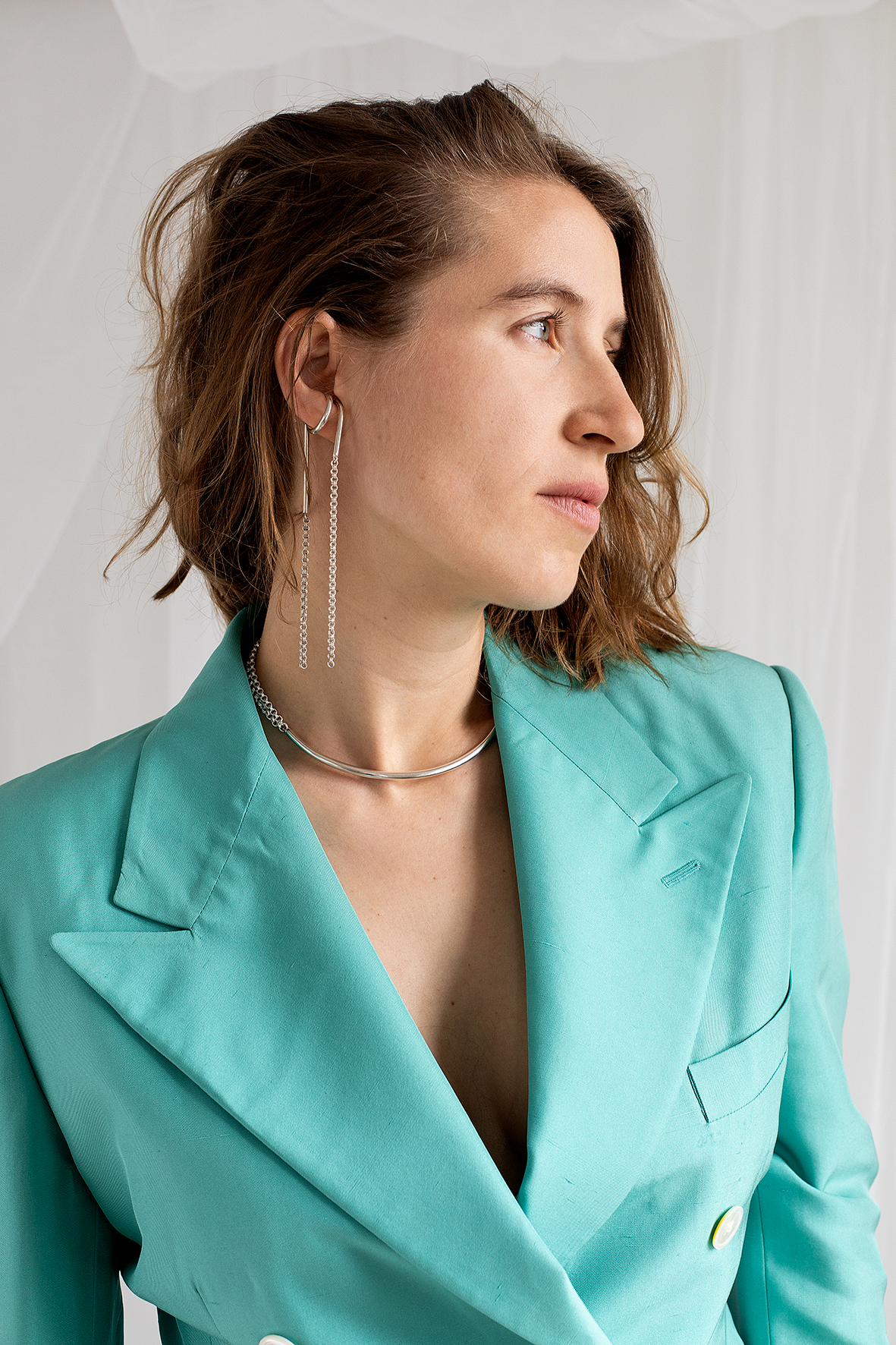
saxophonist/composer/ singer
Charlotte Greve is a Brooklyn-based alto saxophonist, composer, and singer originally from Germany. She has released nine albums as a leader, two of which received the Echo Jazz Prize. In 2022 she was awarded “Artist of the year” at the German Jazz Prize. Charlotte's large scale multi genre piece “Sediments We Move” was released on New Amsterdam and Figureight Records in October 2021 and received significant attention, such as “Best 25 classical tracks of 2021” (NYT), "5 Classical Albums to Hear Right Now”(NYT).
Charlotte has received several composition commissions over the past years and recently premiered Breathe, a co-composed piece for the award-winning vocal ensemble Lorelei.
As a woodwind player and singer she is an active side person across genres and continues to collaborate with musicians such as Laura Veirs, Chris Morrissey, Shahzad Ismaily and others.