

 Apple Podcasts
 Spotify
 YouTube
 Amazon Music
 Castbox
 RSS Feed
 Overcast
 PocketCasts
 Danalogue: Telling the Future Through Old Machines
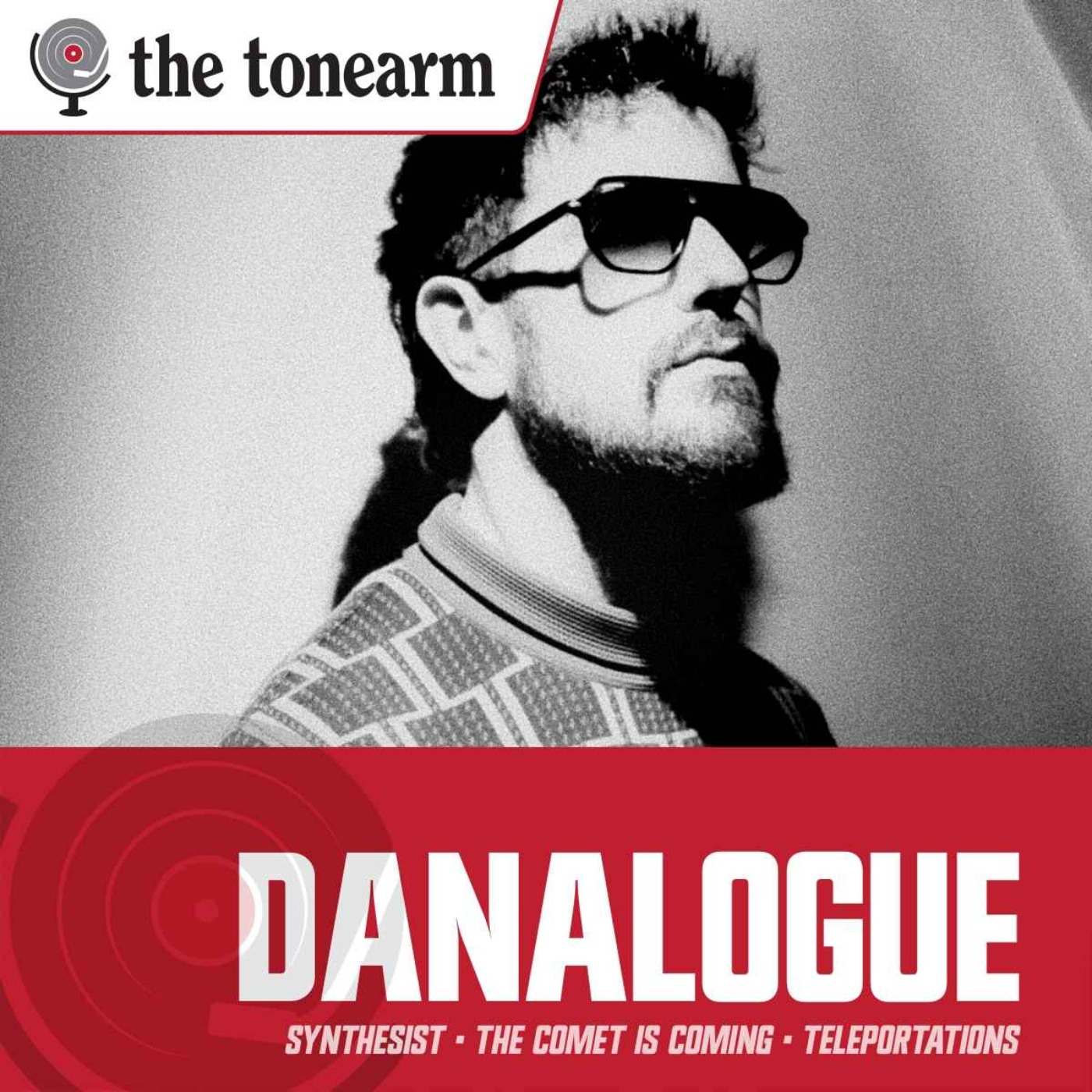
On his debut solo album, 'Teleportations,' the synthesist, producer, and founding member of The Comet Is Coming turns grief and upheaval into a science-fictional voyage built entirely from analog machines.
This week we’re putting The Tonearm’s needle on synthesist and producer Danalogue.
Danalogue is a founding member of The Comet Is Coming and half of Soccer96, and he’s recently released his debut solo album, Teleportations. The record imagines grief and upheaval as a science-fictional voyage and was sparked by a chance encounter with the artist Moebius that grew into an imagined civilization.
We talk about recording alone, with no one else’s voice in the room; why he calls his editing process a “distilled vodka”; and why he still believes imagination is the first step toward hope.
(The musical excerpts heard in the interview are from Danalogue’s Teleportations)
Dig Deeper
• Visit Danalogue on Bandcamp and follow on Instagram
• Purchase Danalogue’s Teleportations from Castles in Space, Bandcamp, or Qobuz, and listen on your streaming platform of choice
• Watch Danalogue playing live at Total Refreshment Centre
Bands and Projects:
• The Comet Is Coming
• Soccer96
• Flock
Label and Studio:
• Castles in Space (label)
• Total Refreshment Centre
Collaborators:
• Alabaster DePlume
• Snapped Ankles
Instruments:
• Roland Juno-60 (Vintage Synth Explorer)
• Roland SH-09 (Vintage Synth Explorer)
Cultural References:
• Moebius (Jean Giraud) — the comics artist behind the album’s origin
• Robert Anton Wilson, Cosmic Trigger (Hilaritas Press)
• C-Smash VRS with Ken Ishii — the VR game he scored (NME feature)
(This transcript has been lightly edited for clarity.)
Lawrence Peryer: I wanted to start by asking you about a couple of recent experiences of yours. Over the years you've played big festival environments as well as clubs and everything in between. I wanted to ask you about taking your music, and specifically this music—this sort of emotionally narrative music. What's the difference between a place like the Brighton Festival and your own album release show, in a smaller place with your own crowd? Do you experience it differently? Do you present it differently? I'm just curious about that.
Danalogue: Yeah, that's a good question, and I definitely thought about it a lot coming into the album launch show. With festivals—I've done them for many years, obviously with The Comet Is Coming and Soccer96—I have an idea in my head about what kind of show I want to bring for the crowd, and it depends on what time you're playing as well. I became very accustomed to playing between ten, eleven, midnight, putting on a very propulsive show, something that feels like that nighttime energy.
I love playing a high-energy show in general, but obviously the album also leans into a bit more of a calmer, more ambient sound here and there. So for the album launch, I definitely wanted to bring out some of those tracks. It felt vulnerable. It feels chunky and muscular when you've got a kick drum coming through, and it feels like you're protected by this wall of sub energy and people are dancing. So it's a very visual cue that people are enjoying what you're doing. Whereas if you're playing a more gentle thing, someone might be really enjoying it but kind of dreaming away, drifting away in their mind, so it's less obvious if people are having a great time. So that was an interesting adjustment.
Danalogue: But having spoken to people afterward, it had mixed reviews. My manager just loved the really propulsive, energetic stuff and wasn't so into the ambient. But some of my friends really enjoyed the gradual climax, where you very slowly build the dynamic and the speed and the intensity up as the show progresses. So you have the benefit of that home crowd, that album launch crowd, being behind you all the way—supporting maybe your more winding pathway across the set.
Lawrence: So much of how I think about your body of work to date, leading up to this project, has really been about either group environments, or collaborating, or producing—sharing in, or being part of, other artists and their contributions, in some cases helping them realize their vision. What do you take from those experiences that you can apply here, when it's all you?
Danalogue: I hadn't thought about that, actually, but it's definitely a hugely different experience. I'm quite an intuitive, natural kind of person, so in the moment, on all the records I've made, it's just felt very effortless and easygoing in the relationship with the different artists I work with. I've been blessed to work with some great ones as well, so you can really trust them and what they're going to bring, and you can trust yourself.
One of the things that's been very different working solo is that you don't have any affirmative voices around you. One of the greatest things about collaborating is everyone kind of gassing each other up—as we say in England; I don't know if you say that in the States—but you're supporting each other verbally, you know? "Wow, that was a great riff," or, "Yeah, we should definitely do this, this new section is sick." But when you're on your own, it's almost like you learn how to be that affirmative voice for yourself, which I think is quite a therapeutic process. It's like, oh, I have to learn to be my own positive cheerleader.
I think my role, especially with me and Betamax when we're producing—I'm more the "let's keep going on this a little bit longer, keep tweaking it, I think it can be better," which doesn't come from a negative place. It's more discerning, like, I really want to get the maximum amount of juice out of this that I can. So I think Max—Betamax—is often the "yeah, no, this is awesome, I'm down; from the early demo, this is good to go." So I feel like we've become left brain, right brain a little bit, having made so many records together. I just have a method of making albums, and I did that in collaborations, and I thought that method would be great for working solo too. So there are things that have carried through and things that have just had to change naturally.
Lawrence: It's interesting you went to "method," because I was thinking about that as well—how does process change? I have this mental image of an artist walking into the studio in the context of a group recording, or producing someone: there's a certain energy, there are bodies in the room, it's a thing. And then the other scenario is you're somewhat solitary, and to your point earlier, there's nobody saying, "Oh, good morning, great to see you, man, we're going to kick it today. How was your night?" You have to self-start. It strikes me as very different modes of operating. So it's interesting to hear you say that even methodology can carry over.
Danalogue: Yeah, I totally feel what you're saying. And I find, if I'm meeting someone at the studio, you'd better bloody turn up on time as well. Whereas if you're working on your own, you can be a bit late, you know? There's something about your responsibility to show up for yourself. Again, as much as it's a musical process, I think it's also a therapeutic process. It's like learning that you are enough, and you can look after yourself too, and it's worthy to do.
Process, for me—ever since about 2007, I came up with this thing. Loads of people have done it, I didn't invent it, but I just realized what was best for me. Rather than sitting down with a pen and paper and thinking about theory—"there's an A chord, and I think we should go here"—I much prefer just playing long-form for many hours until I get into more of a hypnotic trance, reaching for things a bit more intuitively, taking risks here and there. I'd be like, "Oh, try this, or try that." And sometimes the best bits of music would come after quite a few hours, once you'd really stopped thinking too much.
But with that method, you end up with reams and reams of recording. It's almost like when people make films: they make loads of takes, loads and loads of footage, and eventually an editor has to get involved and distill it down and find a narrative, both between the tracks and as an album as a whole. It's quite a long-winded process, but you do a lot of the composition on the back end, rather than writing a piece of music and then recording it in the studio and it's kind of done.
So you almost do the recording first and the writing second. For some reason, that just felt a little bit rebellious and a little bit exciting. Because if you come up with something good, it's so exciting, thinking, "We walked into the studio today, we didn't know we were going to get this." It also came out of recording a lot of demos onto a phone, and then being like, "Damn it, that was a really great performance, but it's on a phone, we can't really put it out." So I was thinking, if you set up the studio like it's a professional recording date, and you jam like when we're recording rehearsals onto our phone, then when you hit play and record to tape, you're like, "Well, it sounds like a record." And then it's just going to need a bit of sorting out, maybe some overdubs. That works great for Comet, and it works great for Soccer, and then I basically did the same as Danalogue solo. I just recorded lots and lots and kept going, and then did a lot of post-production to knit it all into place, bring the room together.
Lawrence: When you record in such quantity like that, you use the analogy of a filmmaker who shoots a lot of takes. I'm assuming—correct me if I'm wrong—that you also have to play the role of the editor. I'm curious how you go back and find the good bits. Are you leaving markers along the way, or are you like, "Now I have to go back and listen to seven hours' worth of stuff to find the fifteen minutes I liked"?
Danalogue: Yeah, the second one.
Lawrence: (laughter) I'm sorry.
Danalogue: No, but it's great. I think the key is to leave it for a few months. I remember reading a Charles Bukowski thing—he used to write stuff, then put it in a drawer for six months, lock it, and come back. And when he reads it, it's different; he almost reads it as if it's somebody else. So you can have a bit of a third-person perspective. It's quite good to leave it for a few months on a hard drive somewhere safe, and then switch it back on. Sometimes you've forgotten half the stuff, and you're like, "Whoa, I forgot about that bit, that bit's really cool."
And then I go really fast. I put markers in, and I slice everything up, color-code it, and write very simple, sparing notes on each one. I make some quick decisions, make a very rough mix of everything, and make a bounce. So now you've got a kind of six-disc album—the long list. And then you can listen to that on the tube or on trains, when you're traveling around, and try to listen to it like a record. You very quickly work out which bits you like the most. And once you make a short list of those, then the real fun starts—then you're going to really start slicing into those, because those tracks might be twenty, thirty minutes long, so there's another editing process. So it's this multi-stage, cooking-down distillation process—like triple-distilled vodka or something.
Lawrence: I would think that gap in time also allows some of the heat of the moment to wear off. You might find something you thought was wonderful, or thought wasn't working, and take some of that emotion out of it, come back to it a bit more objectively.
Danalogue: Totally. And sometimes there might be a little slice of something that was great that you moved past very quickly, and you might want to take that and loop it—like, "Oh, actually that bit was great, let's make that into a tape loop and make it the foundation for a whole other track." It might go off in a different direction. And it might be something you'd really thought was going to be the best track, and you work on it and work on it, and then you realize it has to be left on the cutting room floor. A lot of great things have to be destroyed. (laughter)
Lawrence: I like that line.
Danalogue: Yeah. Have to destroy a lot of lovely things. And some things don't make the record. But there's one track on the record that was the last one I made—a track called "Arrival at Rho Ophiuchi"—and I made it in about a couple of hours. I just felt like there was something missing from the record that I really wanted to do. That's the last track I did; it happened in the last couple of months before I finished. Most of it's done in that method—like maybe "Moebius Triptych," that was a classic example of the method—but some of them I just did in one sitting as well. I try not to have too many rules when you're making stuff.
Lawrence: Of course. I'm always fascinated by the use of narrative in instrumental music. Given what you've told me about how you work, at what point in this project did you have the concept for this arc, this journey the record was going to take? Hearing you speak, it wouldn't be clear to me how those two things reconcile, or how they emerged and came together. Could you tell me about that a little bit?
Danalogue: Yeah, sure. For this one, I had quite a vision of the sound world right at the beginning, but the overarching narrative—the order of the tracks, and some of the astral projection ideas running through it—came more near the end. Sometimes your process of making the record reveals itself at the end. You've made loads of stuff, and then you can sit back and look at it and go, "Oh, that's what I was trying to say," because it's so abstract. If it's instrumental, there are no clear storytelling lyrics, so it's quite abstract. When you stand back and look at it, you suddenly realize what you've made.
But there was also a really fundamental building block to it. When I first started the record—it was probably about ten years ago, in a studio in Paris—it was kind of an amazing story, really. I bumped into a guy on a train in France and had a coffee with him, and he invited me. He'd been promoting The Comet Is Coming in France, and he bumped into me on this train. We had a little espresso, and he said, "Why don't you come to my synth studio? I've got twenty-one synths—it's called 21 Filters—and it's down a little spiral staircase in a basement. It's basically an office, I think, but it's got a bed and a shower and twenty-one synths. Come and stay for a week, I'll give you an incredible deal." Which I did.
And that week, I recorded a lot of stuff I didn't like for three days. I was like, "Dammit, this was meant to be the week of making an album." I was making a lot of stuff that didn't feel that good, or didn't feel fresh, or felt like I was trying too hard. It was hard to say why it wasn't going great. But I went on a walk to freshen up, and I went past this French comic book shop. They're really good with their cool comics, the French, and for the first time ever, I saw this book by Moebius—this guy called Jean Giraud, or Moebius. He's an incredible sci-fi, fantasy illustrator, and he's famous for helping with the art design on some big movies—I think like Alien, the first one, and things like Tron, all those classic eighties sci-fi films. He had his hand in the background, working on those.
He has these incredible books, and there was this cover in the comic bookstore—this scene on an alien planet—and I was absolutely blown away by it. I was like, "This album has to be almost like the soundtrack to another civilization on another world." I tried to take a picture of it, but as I took the picture through the glass, my phone ran out of battery, which was quite poetic somehow.
Lawrence: It really is.
Danalogue: I spent a while trying to find it, just writing keywords on the internet, and I did eventually find it. So, this guy Moebius. As soon as I had that, I went back to the studio, and it freed me from an earthly grounding. The narrative started—the seed of it was there—where I realized I wanted to embrace that part of my character, that part of myself that wants to do a bit of world-building outside the current reality, and really embrace that side and not be afraid of it. Lean into it even more. So that's the embryonic part of it.
Lawrence: Are you a science fiction writer who just happens to play music? (laughter)
Danalogue: That's a good question. Maybe I need to write a book. I did write a little thing, which is on the back cover—or in the inner sleeve—of the record, for "Earth Remembrance Day," the last track. I certainly love the intention of a lot of science fiction.
Lawrence: Do you have a preference, or even a conception, of how that bit of narrative you wrote interacts with the music for the listener? Like, if you could control it, would you say, "Listen to the music, then read the piece," or "read the piece, then listen to the music," or do them both together? That's how I want it experienced. Do you even go that far, or is it just out in the world—whatever happens, happens?
Danalogue: I'd probably say the latter. I've heard from a few people that they find the piece of writing quite depressing. (laughter) I didn't mean it that way. If you haven't read it, it's basically a story about a future organism that's a little bit connected to earth—like a twenty-five percent carbon-based life form. We're going far into the future, millions of years, and every now and then, every Kepler cycle, they come back to earth through a kind of astral-projection meditation, just to look at it. But the earth is now long gone; it's just a burning red husk. And they come to visit earth in order to remember what not to do—if you are the custodians of a planet that's got access to this beautiful universal web of consciousness.
A few people have said, "Oh, I listened to this song and it sounded really uplifting and optimistic and hopeful," and then, "Hopefully we won't need this remembrance day, and we'll do better here on the planet." And I'm like, well, kind of—that is the point. That is the hope. But that's a story just for that track, really. It kind of feels like there could be a short story for each track, perhaps.
Lawrence: Hearing you articulate that—whether it's the encounter with Moebius, or what you just described, and some of the language you've used around the narrative on the record—it feels very reminiscent to me of the mid-century science fiction that inspired a lot of artists in the sixties. It was a very specific, maybe post-war view of speculative fiction: imagining possible worlds, definitely ecological overtones, or nuclear-age overtones. I feel we're in that realm now. Some parapsychological elements.
Danalogue: Yeah. Time definitely has a funny way of working in cycles. The period you're talking about, I guess you'd have the Cold War, right, with the constant fear of nuclear apocalypse. And I feel like now we're in a time of great global upheaval and military intervention, and the politics of fear a lot of the time. People often think of science fiction as Star Trek, lots of lights blinking away, and robots, and R2-D2 and Darth Vader—all of that stuff, which is really entertaining and great. But oftentimes, within the veneer of the entertainment side of science fiction, and how marvelous and fun the imagination of it all is, there's always a deeper undertone.
Which is: to imagine a human collective that has managed to mobilize and collaborate across race—normally in sci-fi, like Uhura in Star Trek, who had the first interracial kiss on television in the sixties—and outside of that, you get into species cooperation between different aliens and humans all working together, perhaps on some galactic ship. Even that idea, that you could coordinate and collaborate and work together on such a huge project, would require a lot of improvement to how we're doing things now. It would require us not to waste energy on killing each other. It would probably require great technological advancement. And you can imagine what that would mean for how we look after our own planet and ourselves.
To have that kind of hopeful imagination, just as a thought experiment, is kind of beautiful—to keep open what possibilities we might have as a human race down the line, without it being some billionaire trying to go and mine Mars or the moon. There's got to be a more interesting way of looking at exploration.
Lawrence: You're touching on something I wanted to ask you about—the idea that losing the capacity to imagine is basically losing hope. That's really what you're talking about here. It even translates into a lot of aphorisms, or self-help language that borrows from the mystical world: "If you can see it, you can be it. If you can imagine it, you can do it." This idea of maybe not dismissing what's possible before you explore what's possible. I'm curious how you articulate that relationship between imagination and hope, and the role creativity plays in building possible futures.
Danalogue: I've taken it slightly less from the self-help aphorism—though I totally get the connection—and more as a kind of manifestation, almost, which I'm down with. But it comes more from a perspective of: if you accept the world as it is, and that's your whole reality, then you can never change anything. So it comes more from a revolutionary perspective, and also from one where it's always the imaginative people who can start to change things in society.
I think it probably comes from some awful stuff that happens in our country. In England, a few years ago, the government decided it was okay to pump sewage into all of the water. You guys might not know this—
Lawrence: I think we invented it. (laughter)
Danalogue: Thanks, guys. Well, it took imagination to think of that as well. But the imagination there is, "We can make loads more money if we don't put up any red tape, and you can just pump." So now, all around the British Isles—which used to have not immaculate, but pretty nice little swimming spots—they're all on red alert, filled with pollution and basically toilet stuff. It's meant that a generation of children can't go on lovely little swims in the river or the sea. So what I'm talking about is: if you just accept that, like a lot of people, and go, "Well, that's just the way it is, can't change that, it's just the government"—I think what it comes from is being pissed off that if you just accept everything you're given, whatever the narrative is in the news, then life will probably just get incrementally worse.
Whereas if you can imagine a better way of doing things—in the sewage example, just remember how it was literally twenty years ago, when they had a system in place, and go, "Can we go back to that, please?" I think imagination of a better future is the first step to action. I'd also combine it with a feeling that maybe I imagine less than when I was a kid. It's something that happens naturally as you get older. When you're a kid, you can just—I used to imagine tons of stuff all the time, little stories and characters. By practicing imagining, or imagining new worlds, I find it really refreshing and invigorating, and it gives me a youthful playfulness that I felt I was maybe losing as I crossed the threshold of forty. I just love using music almost as a tool to create these imaginary worlds in my mind. It's a bit like that, really.
Lawrence: It's fascinating you go there, because—just being a music nerd, talking to friends about music—there's always this wonder about the classic rock generation: they're old and still out there, whether it's Dylan or McCartney or Mick Jagger. Doesn't it seem obvious that there's a connection between living the creative life and longevity? Yes, it doesn't hurt to have the wealth to buy the best care money can buy, but there's still genetics at play—not everybody can outrun the reaper for that long. It's fascinating to me. I feel like we should be studying the connection between their life of creativity and their longevity, because to me it seems pretty obvious. Why doesn't Dylan stop? Because when he stops, he dies. Duh, you know? (laughter) So to me it resonates with the point you're making: of course you're tapping into this harnessing of wonder that the life of the arts and creativity allows—that childlike connection. It's health, in a real, profound way.
Danalogue: Totally. Playing on stage probably helps these guys too—the adrenaline. And there's something to be said about being lucky enough to do what you love for a living. I just think, yeah, the end of imagination is the end of hope itself. Because if you can't imagine something better, then you're stuck with what you've got. And that's a daily process—even if that means looking around my studio and being like, "My God, I can imagine this being a bit tidier." (laughter)
Lawrence: I'm going through that right now, actually, in my living space. I really don't feel like cleaning.
Danalogue: You have to imagine first, Lawrence, and then you can hope.
Lawrence: Imagine how nice it will be when everything's in its place. (laughter) Another topic I love to talk about with creative people is the use and usefulness of self-imposed constraint and limitation. That seems to manifest with you, with your synth setup. That limitation seems to be important. And yet, in the context of this music and this record, nothing feels small. I'm struggling to articulate the question, except to ask if you could talk a little bit about how the self-imposed limitations of the two-synth setup result in such an expansive final work.
Danalogue: Well, on this album I did end up using a few more synths, especially at that one in Paris, where you had twenty-one-odd synths. But I've spent the majority of my career playing the SH-09 mono synth and the Juno. Both of those synths can make a hell of a lot of sounds, and that's what first drew me to synthesis, right at the beginning, when I realized that—rather than a Casio keyboard, where you press the flute sound, or the piano sound, or the organ sound—on these analog synths you could tweak all these faders and dials and create your own sounds. And depending on the circuitry of that particular unit, there's a sound palette, and it varies from synth to synth.
I particularly fell in love with the sound of this Roland Juno-60 and the SH-09. So, say on track two, "Mother of Mars," that's all sounds made on the Juno. There are a lot of different sounds on there, all made from one synth. Within one synth you can do so many different things with the enveloping and the filtering—I don't want to get too nerdy, but you can even make drum sounds on the synths if you want. There's a limitation to just using a couple of synths. I did augment that for this record—there are drum machines in there, and some SH-101, some Jupiter, a few different things going on—but I certainly don't have an endless archive.
The thing about working on computers—a few down the years, Lawrence, quite a few people have tried to convince me I should move to computer software, especially when they see me carrying my heavy equipment on tour, getting on planes with all these huge boxes—because they say, "You've got every synth ever made on your computer, you can just download them; you won't just have the Juno-60, you'll also have Oberheims and Moogs and all this stuff." But the self-imposed limitation of only owning a couple means I don't go into choice paralysis, which I really struggle with. I'd be like, "Ooh, is this sound going to be better? Is this one?" But because I've got my synths, I'm now just focused on how I get to know that one synth. It's almost like getting married to one person rather than having hundreds of girlfriends. You get deeper and deeper in love with your partner.
I still work out new sounds on my synth—after twenty years, I still go, "Oh my God, I've never done that before, that's incredible," and then I'll write five tunes using that setting. So that's what I mean by the limitation. It stops you thinking of endless options in terms of the sound, and maybe starts me thinking of other things. On this record, I was really thinking about emotion, and trying to translate what I was feeling and going through into chords, and then into structures. I could play pianos and organs as well, but I don't—not yet. I might do a piano album down the line. But definitely, having this limitation, it feels like a nice sound world that's kind of mine. It feels like my sonic identity, that you could draw a line through, all the way back through The Comet Is Coming, all the way back through Soccer96, back through Flock, back through different records I've done down the years. That's quite satisfying—that I can go back and listen to something from 2012 and be like, "Oh yeah, that's the same keyboard I play today," but I was playing it in a completely different way at the time.
Lawrence: I don't think I fully appreciated, when you were speaking earlier, that the Paris material actually survived through to finished form on this record. That's amazing. So you really have been carrying this around for a while.
Danalogue: Yeah, man. There have been a few different studios I've worked in. I think there are five tracks left on the record. I could have released a record just of that Paris session, but to be honest, I'm really glad I didn't—by the time I finished this album, there were definitely some tracks from that session that I'm glad I haven't put out. So it's kind of become like a best-of. I've been doing it this way because I was touring a lot, and when we weren't touring with The Comet Is Coming, I was producing and mixing records. I did like three records with Snapped Ankles—a kind of psych rock, kosmische, electronic band—and I did a couple more Soccer records.
And then, when we weren't on tour with Comet, we were making the Comet records, which was a huge post-production deal for me—like four or five months per record. So I had myself a little bit on the back burner. But I also feel like now is the perfect time, because I was always about to go on tour, or about to take on a production job. So what I did, after Comet Is Coming finished for a bit, I just shut the door and said, "No more jobs." And I refused a couple of records, which is kind of crazy to do when you're self-employed. I actually started meaningful work on this record about two years ago, but I had, as you say, all of this material from down the years to pull from. So it's like a best-of bits of Paris. There are bits recorded in London, bits recorded in Margate, down on the south coast of England. It's all come together, really, in the last year or so.
Lawrence: You mentioned some of the other gigs, the other opportunities you turned down so you could focus on your own music. What's the experience for you of working on something—for a game, or for somebody else's project, if that's not too inelegant a way to say it—when you have a very discrete role: "provide music for X, Y, Z"? Are you happy—you're a working musician, it's work for hire—or how do you bring your artistry to that when it's not necessarily your overall vision, and maybe you don't even control how the music gets used in the end? How does that affect you?
Danalogue: With a computer game, I was just thrilled, because I played computer games a lot when I was a kid—it's been a bit of an inspiration, computer game music in general. This one was a game in space, based on an old Japanese game called Cosmic Smash. And I was like, if anyone's going to do the soundtrack to something called Cosmic Smash, in virtual reality, with planets and stars all around—and they specifically wanted me to make music the way I make it, they were just saying, "Do your thing"—I thought it was a fantastic opportunity. I loved the guy who was making the game; he was a real creative, vivid thinker, so I thought, "This is going to be really fun."
Then, working on other people's albums—like when I worked with Alabaster DePlume. When he first moved to London, he came into the Total Refreshment Centre, and we spent a couple of years hanging out after hours. I'd finish in the studio at about two in the morning, and so would he, and we'd meet up, have a couple of beers, and chat about art and politics. And then he said, "Do you want to co-produce my next album?" I loved that, because it was almost like trying to get inside the soul of someone's music and amplify it to the maximum capacity. Being a producer is just making loads of decisions, and if I can make the right decisions that help elevate their music to the next level—and if they've asked me, they usually want me to make the kind of decisions I make for my own music, and maybe add synths the way I would to my own music.
As much as you're facilitating them to realize their vision, you're also being invited to bring yourself to the party, to bring your vibe. So it's a lovely dance between trying to breathe out the soul of their sound while also bringing your vibe to the party. I think I made a mistake early on, when I got asked to produce stuff—I didn't bring myself enough, I didn't play enough synths on other people's stuff. What I've been enjoying, as I've got a bit more confident with my sound, is—if someone's asked you, they often really want you to do your thing.
Lawrence: Yeah, they ask you for you.
Danalogue: Yeah. And so it's a really interesting balance. But I absolutely love it. With Alabaster, we even did some of the stuff I do, where we record long open jams and then cut them together. I think he hadn't done that at the time, so it was kind of like, "Oh, wow, this is cool." And working with Snapped Ankles, it was great to bring my mixing skills in and really use effects creatively, put them in a kind of meta space. So yeah, I'd never done a fully solo album, and that felt like an elephant in my room, so to speak. I thought, "It's about time; I've got to see what I can do completely on my own."
Lawrence: When we were first speaking about the live performance, you used the word "vulnerability." One of the tracks I wanted to ask you about was "Far Beyond the Sun." How rooted in reality is that song for you?
Danalogue: It's completely not rooted in reality, I don't think. But it depends on reality. I just think there are so many different realities going on all the time, and we're only normally accessing the one that makes survival sense—the one that evolution has made sure our brain is locked into, a lot of the time, for survival. There are so many different dimensions going on around us all the time, but it's just not very useful for us to see them, because it wouldn't help us eat or sleep or be safe or make provisions for the future. So I think that track came out of an imagination of the afterlife, really.
And how the afterlife is kind of gatekept by monotheistic religion quite a lot—they tell us what it's going to be: heaven and hell, St. Peter at the pearly gates. Or the reaction to that, the atheist one, would be, "Well, there's nothing, it's just dark, it's just black, it's just boring." I was playing with the idea of what I would do. It's not even anything new—loads of cultures have had this—but I thought about the physical space out there, outer space, with all the stars and planets being a huge physical manifestation of all the souls that have left earth, flying through space. You go far beyond the sun, far beyond that, through as many galaxies as you want, and you naturally gravitate to the resonant souls, the treasured souls you'd met here on earth.
And it's a way of helping with the grieving process, because we all lose people in our lives, don't we? And it's tremendously sad. I just think it's fun to think about meeting them again.
Lawrence: It's beautiful.
Danalogue: Or even meeting people—this gets into more realms of fantasy—but I started to do this meditation practice, connecting to a kind of benevolent alien in a Sirius system. It's like a cool kind of game. I don't know if you've read Cosmic Trigger by Robert Anton Wilson.
Lawrence: I was just about to ask you—have you read much Robert Anton Wilson? He's one of my thought heroes, and as a young man, he really helped me learn how to think about the world. The idea of "maybe" is very big in my life. Maybe. I try not to make assumptions or assertions. So Cosmic Trigger is important to me.
Danalogue: Cosmic Trigger, yeah. Chapel Perilous. It's like—if you live as if something is true for a month, see how your life changes, whether that means Buddhism or Catholicism or becoming a Jedi or whatever. So I was doing this specific meditation practice, connecting to a benevolent being, and the lyrics of that song are, you know, "I look far beyond the sun, and I'll see you there." I just think it'd be cool to meet that person. But I don't know. It is reality, and it is not, at the same time.
Lawrence: Not yet, maybe. (laughter)
Danalogue: We'll see.
Lawrence: Yeah, that's right. Well, you've just opened up a door that we could spend another hour on, and maybe we'll get to it at some point. I really appreciate your time; it's been lovely talking with you, and I've really enjoyed listening to the record. So thank you.
Danalogue: Thanks a lot, Lawrence. Thanks a lot for your questions, your warmth—it's been great. Your curiosity is a very, very nice engagement, man.
Synthesist, record producer
London based producer and synthesist Danalogue is renowned for his world-building productions as a founding member of The Comet Is Coming and Soccer 96. As an integral part of the Total Refreshment Centre artist community, he has been a pivotal figure on the London new music scene for the past decade.
Danalogue’s creative universe is rooted in a youthful preoccupation with science-fiction and the philosophical musings of psychedelic psychonauts such as Terence McKenna and the planetary scientist Carl Sagan. His music is inspired by the work of synth pioneers such as Mort Garson, Isao Tomita, George Duke and Wendy Carlos, with the Danalogue sound remaining firmly anchored in his preferred choice of instrumentation. Two classic synths from the late 70s and early 80s, the Roland SH-09 and Juno-60, form the basis of every record Danalogue has made.
“There’s a joy in the limitation, by forging a sound built fundamentally on these two relatively humble analogue synths, the focus can be straight onto making the compositions and producing using old tape machines and echo boxes. This limitation helps me to create more fluidly and intuitively”, Danalogue explains.
As a founding member of the group The Comet Is Coming, Danalogue co-produced and mixed their three albums of apocalyptic spatce jazz, with the debut album ‘Channel The Spirits’ (2016) being nominated for the Mercury Prize. The trio’s work, including two further albums in 2019 and 2022, was widely praised in publications such as Pitchfork and The Guardian, with the group also performing a memora… Read More