

 Apple Podcasts
 Spotify
 YouTube
 Amazon Music
 Castbox
 RSS Feed
 Overcast
 PocketCasts
 Dave Douglas: Transcend Is Not the End
Trumpeter and composer Dave Douglas discusses his album Transcend, the Jack Whitten retrospective that reshaped his thinking about raw material, and why Booker Little gave an entire generation of players permission to keep scrambling.
This week, we’re putting The Tonearm’s needle on trumpeter and composer Dave Douglas.
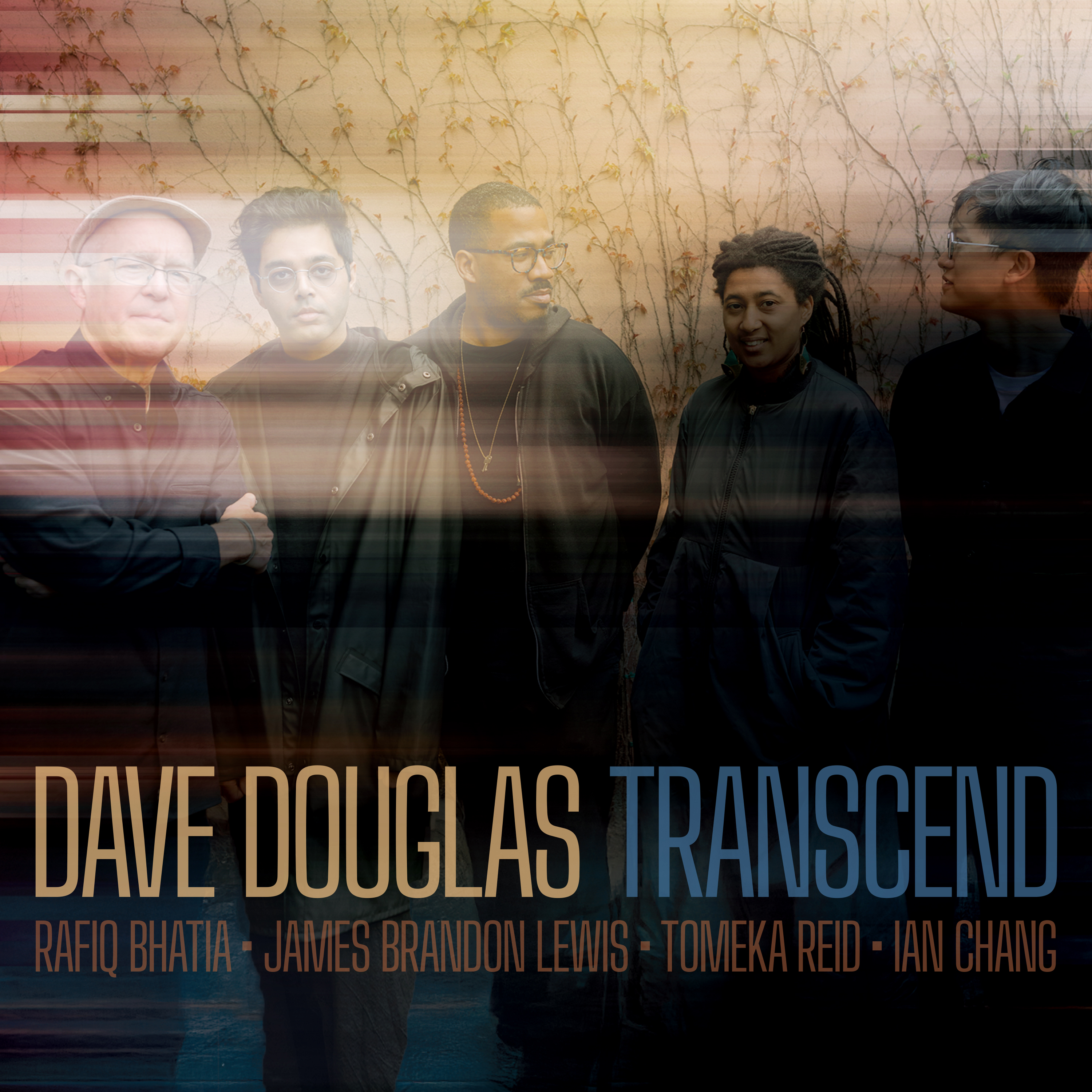
Douglas’s latest album, Transcend, came out in April. It’s the second record from GIFTS, his band with Rafiq Bhatia, James Brandon Lewis, Tomeka Reid, and Ian Chang. His last several records were openly political. This one turns toward the sacred, though we explore where that either/or framing falls short.
We also talk about painter and sculptor Jack Whitten, why Dave stayed with this band instead of moving on (his usual m.o.), and whether, at 63, he’s summing anything up.
(The musical excerpts heard in the interview are from Dave Douglas’s Transcend.)
Dig Deeper
• Visit Dave Douglas and explore his catalog at Greenleaf Music
• Follow Dave Douglas on Bluesky, Instagram, and Facebook
• Purchase Transcend from Greenleaf Music, Bandcamp, or Qobuz, and listen on your streaming platform of choice
• Check out the debut GIFTS album on Bandcamp
• Dave Douglas’s podcast, A Noise From the Deep
The Band — GIFTS:
• Rafiq Bhatia — guitarist, composer, producer; member of Son Lux
• James Brandon Lewis — tenor saxophonist and composer
• Tomeka Reid — cellist, composer, 2022 MacArthur Fellow
• Ian Chang — drummer, composer; member of Son Lux
Referenced Works and Artists:
• Duke Ellington’s Sacred Concerts — three landmark works premiered between 1965 and 1973
• Jack Whitten: The Messenger — the retrospective at MoMA (March–August 2025) that shaped Transcend
• Booker Little — the trumpeter whose 1960–61 records broke open Douglas’s compositional thinking
• Jaimie Branch — trumpeter and composer, 1983–2022
• Steve Reich — composer, discussed in the context of minimalism and process
Books:
• A Poetry Handbook by Mary Oliver — the book on craft that Douglas cites as an analog to his compositional method
Teaching:
• Dave Douglas at the New School — where he teaches Creating Music Workshop and Advanced Ear Training: Monk and Bach
(This transcript has been lightly edited for clarity.)
Lawrence Peryer: I wanted to start by asking you about the thematic shift in the music from some of your recent work, which was a little bit more overtly political in its framing and theming, and now we're maybe a little bit more numinous—a push toward the sacred. I'm curious what you're experiencing.
Dave Douglas: Well, maybe spirituality is also political, Lawrence. (laughter)
Lawrence: These days. Most days. So you're playing with the sacred and the profane.
Dave: Well, if you think about the Duke Ellington perspective, his feeling on spirituality is quite complex. There's a man that lived a full life, had a lot of appetites, wrote so much music, and managed so much in his life. What struck me about the sacred concerts is that he's getting to the end—it's clear to everyone. He's lost Strayhorn, his right hand, and now he's on his own. He has written all this extraordinary new music, and he has chosen to take the theme of spirituality—the spirit inside and outside the church, I would say. That really touched me. I'm at a certain age myself. You start to think about all the different things you've done and wrapping them up into a statement.
I wouldn't say that anything I've done has been unspiritual. Everything I've done has been political, or maybe a better word is social—something to do with how we live together on the planet. Going back to the beginning of your question, Lawrence, I feel like it's my responsibility as an artist that each project be different. I don't get in a rut and keep doing the same thing. I open my eyes and my heart and my spirit to new things, and every new project is a challenge to find a new way to say what I feel needs to be said in the music.
I don't see Transcend in that sense as being so different from Alloy, for example, or Four Freedoms, Gifts, Dizzy Atmosphere, and going back further, Soul on Soul, Freak In, Witness, and Parallel Worlds. To go back to the very beginning—I sort of feel like, without realizing it early in my career, the task and the challenge I took on was how to examine the elements in the music and find a new way to work with them, a new output every time. And so Transcend, to me, feels like a summing up in the way that the sacred concerts were a summing up for Duke.
But I also feel like it's a departure in the sense that all of these musicians are new to this world. Standard jazz practice is not where James, nor Tomeka, nor Rafiq, nor Ian come from. I love getting the opportunity to write for musicians who speak in different languages and trying to find a way to speak to them—but also to get them to speak in a way that they haven't before. I really love it. Last month we did a week at the Village Vanguard with the quartet from Transcend, and none of the four of them had ever played there before. It gave me this feeling like, wow. I'm not saying, "Here are these young musicians that I'm introducing to the scene"—I don't mean it like that at all. These are established artists who should be playing there. But I felt a sense of emotion from bringing them into that sacred space for the first time.
Lawrence: As you might imagine, I speak with a lot of artists here who have recorded at or played the Village Vanguard. To a person, they speak about the hallowed room and being very conscious—and trying not to be self-conscious—about the people who stood on that stage before. Do you have to address that with the band? Do you have to say, take a deep breath, it's the Village Vanguard? Or is a stage a stage? What do you think they experienced?
Dave: I don't think you have to talk about it. We do talk about it, but only in the sense of what the experience actually is. It's astounding. It changes the way you play. Of course everyone's aware of who's been on that stage and the music that's been made there, but the sound in the room is very special, and the way that you interact with an audience in a room like that is really special. Also, the people who come down to the Vanguard to hear you—some amazing people were in the room hearing us, and that's really intense for everybody.
Like I said, these are seasoned creative artists who have done a lot of searching and personal research and have played on a lot of stages, so maybe there were some jitters on the first night. Maybe I get them too, and I've been playing there almost 30 years now. That Tuesday night, man—there's nothing like it.
Lawrence: I think the jitters are a sign of respect.
Dave: Well, I have always said the night that I don't feel nervous going on stage is the night I will know something's wrong and I need to examine that. I should be nervous because I want to be in a position where I'm not sure exactly what's going to happen. That's what this music is really about and what it invites. A good composer for improvising musicians writes the right amount and leaves the right amount blank. But that's the risk that we live for.
Lawrence: You've already brought up a lot of the themes I was hoping to explore in our talk. Something I wanted to circle back to before leaving it: you talked about the summing up that Ellington was doing with the sacred concerts. That implied very specific things with him—he had a life fully lived, perhaps things he was thinking about that he needed to address and make right spiritually. There's a lot implied in what he went through with that music at the end of his life. You're young and you have a lot of music ahead of you. What does summing up imply in your case? Do we expect you to turn a corner now? Is this an exclamation point?
Dave: If I knew that, I'd be Nostradamus. Each project is an adventure in itself.
Lawrence: But you're not implying you're done.
Dave: No. I feel like it is turning a corner in a certain sense. I turned 63. I went through the pandemic. We're touring less now. I've been running Greenleaf Music for over 20 years. The whole industry is changing again. I feel like it is a transitional period for me, though I don't know where that will lead.
I did feel like, okay, Transcend—I've got to put everything I've got into this one, because this may be it. Then last week I just recorded a new project: a song cycle about the great American grifter Cassie Chadwick, with eight singers and a full band. It's really exciting, and it has big connections to musical theater.
Lawrence: The age of grifters, which we—
Dave: Well, she was the greatest grifter in American history until very recently. And that was going on all along. I've been working on that for over a year, and I always have multiple projects going on. I'm still writing every day. I'm still studying Bach every day and practicing the horn. I feel like the practice means not holding on to anything. We don't know what it means. I'm also writing a book about life and music and my own experiences.
Lawrence: Ah.
Dave: The more I write, the more I feel like, wow, we really don't know anything, do we? I feel like the practice of music is about finding new things and being comfortable with the uncertainty of not knowing where we're going. When I begin writing a new project, I am literally at sea. I am lost. And like I said about jitters—if I didn't feel lost, I'd feel like, oh, I know what I'm doing, so therefore something's wrong here.
I think Transcend is a summing up for me. But I am still working every day. This will sound like a humble brag—like when they ask you in an interview, what's your worst quality, and you say, "I'm really bad at taking vacations." (laughter) I don't think of it as work. My mind is just always reading and studying, and I wouldn't want it any other way.
We lose some great heroes, and their spirits are all around us. Sonny Rollins is everywhere. It's important not to forget that we are a part of that continuum. We're listening to Rollins and we always will be, and he'll always be listening to us wherever he is. Plug into that.
Lawrence: Somebody recently said to me—it was off mic, so I won't name the person—but it was an author who was ambivalent about something they were being encouraged to write. They finally got themselves talked into it by a publisher, and the pitch was, "Nobody but you can write this." And when they sat down to start, they said something similar to what you said: "Actually, I don't think I am the one to write this." (laughter)
Dave: Well, maybe that's the exact reason that they are the one to write it.
Lawrence: That's fair enough.
Dave: Because they don't know. There's nothing more boring than reading somebody who knows everything.
Lawrence: And you get a very didactic tone from that, too.
Dave: Yeah. They're just going to tell you.
Lawrence: So what is it you don't know in the context of writing a book? Clearly you've seen so many changes to the business, to the opportunities, everything.
Dave: How do you cover all that? It's huge. I have a great publisher who so far hasn't shut me down on anything and has only given me good advice. My current chapter synopsis would make the book about 2,500 pages. So then—just like in music—there's a process of editing, and it's falling to me. My editor isn't sitting there saying, "You've got to cut this and cut that," but at the same time is giving me enough rope to realize, wow, I really need to figure out how to say these things.
I started out by focusing each area around one of the musical groups I've been involved with over the years. There's a long section about all the quintets I've led and worked with, and why I feel they're so important—what you can say in a quintet that you can't say in any other group, and why this is a format that's appealed to me for so long. Then the groups I've had, starting with the group with Chris Potter, Uri Caine, James Genus, and Clarence Penn, and then subsequently with Donny McCaslin, and then the group with Jon Irabagon, Linda Oh, Rudy Royston, and Matt Mitchell. And then current groups.
Years go by and I write a little bit every day, so there's a lot of music that's documented. I'm really happy it is. I just feel like a book about the creative process and about the life of doing what we do has to find a philosophical way to express what that practice is, without giving you an hour-by-hour, blow-by-blow story of what you wrote and where you went. That's what I'm wrestling with.
It's funny you used the word "ambivalent" about your friend, because ambivalence was a key word for me in tackling the current version of my introduction, which keeps changing and hopefully getting better.
Lawrence: The ambivalence of having been taught not to be a show-off—not to be prideful of one's own skills or strengths.
Dave: And at the same time being a trumpet player—the loudest instrument in most bands, supposed to be showy—in an art form where exhibition is part of the practice. I've always been torn by that.
Lawrence: It's interesting to hear you speak on that, because in spending time with Transcend and having listened to you a lot over the years—my introduction to you, like a lot of people, was through Masada years and years ago—I was thinking about what it's like whenever I approach a new Dave Douglas album. I don't have the experience of you leaping out of the speaker and grabbing me by the throat. That is not how I perceive you as a player. I hear you as a leader. You might be a dominant voice on any given piece, but you're not the dominant sound. There's a taste and a restraint in that.
Dave: Maybe. I honestly don't know. I've started using the word "uncertainty" instead of "ambivalence" because there's a negative connotation with ambivalence—it implies you're not sure. And I realized, no, I am sure, because over many years I've had to make a million decisions about the music. You realize you know how to make a decision when one has to be made. So it's more like uncertainty at the outset of making a piece.
I've never been one to put myself out in front. I'm a soloist and I've been playing trumpet longer than I've been writing music. But as a composer, that's not the challenge I generally put before myself. The challenge I put before myself is: how can I create a unique platform where these five musicians can coexist together and make something that didn't exist before?
Lawrence: I think that's a successful endeavor. I experience that more often than not in your music. Can you educate me a little bit about Jack Whitten's work? I'm not familiar with it. It's always intriguing to me when music artists channel or refract the work of artists in other mediums. Could you talk about that?
Dave: That's always been an important thing for me—bringing in literature, poetry, painting, dance, visual arts. I don't think you can separate the poetry of all the various forms of expression. Music is the one I practice, but the human voice is something we can universally all understand, and it can help us see something that maybe we didn't see before.
Last year at the Museum of Modern Art here in New York, there was an enormous retrospective of Jack Whitten, and I wasn't familiar with his work. I had a friend who actually works at the museum, and she kept telling me, "You need to go see this. This is really important." I went to see it, and it just blew me away—first of all because of all the different mediums Whitten worked in throughout his career, and second because of what was so important to him: his process. How he made his work, where it came from, and all the technical practices involved in making it—how they grew from a metaphysical vision that was entirely his own.
I was also already working on Transcend. And it wasn't lost on me that there was a large painting dedicated to Duke Ellington in the exhibit. I was going through like, wow, I'm hearing music—this is amazing—and then suddenly there's this big Duke Ellington painting in the middle of it. My friend, a couple of weeks after I saw her, I told her I'd gone to the exhibit and that it had been really powerful for me. She gave me the catalog book, which is an enormous tome. If you're interested, it's worth ordering—not just for the plates, but for the essays, which are really well done and interesting, and there's a lot of Whitten's own writing in it.
The pieces that most drove the music that went into Transcend were pieces he called "slabs." He developed a technique where he would place enormous canvases horizontally in his studio and pour gallons of acrylic paint on them. Then he built contraptions that would drive the paint across the surface from above and drag it. He would let certain layers partially dry and then drag these tools across, and what you get are these blurred images that carry a lot of emotion. You feel the movement, but there's also the mystery of how the layers developed among themselves. It's something that predated Gerhard Richter, and yet Whitten's work has a somewhat similar resonance to it.
Whitten used these kinds of tools in a lot of different ways. He had a painting called Energy Field—it's a color field, but you can see that there's all this activity moving inside it. It's a blend of colors: the blend of all the different colors that went into it, yet somehow arranged through the manipulation of all these tools he made. No brushes—just this system that he invented and worked with for years.
I was touched not only by how those paintings looked, but by the story of Whitten's life, the milieu he was in, the fact that it was right on the timeline of the sacred concerts, and the way that he was working with those elements of paint struck me as a direct analog to the way I work with sound and with improvising musicians. So I gave myself the challenge of: let me take some raw materials and scatter them together, and challenge these people to improvise their own noise, sound, music—in a way that would create the feel of those slab pieces.
There are two specific pieces on the album. One is called "Slabs" and the other is called "Curious Species," and they deal with this idea of making raw material and throwing it at the band so the band can throw it back. There's a real feeling of anarchy and creation and destruction—big forces at work.
When I was ready to bring these pieces to the band, I did a couple of advance rehearsals just to get a sense of what would happen, and then a couple more right before the recording. I sent "Slabs" and "Curious Species" to my band and said, "This is all thinking about Jack Whitten." And each one of them wrote back: "Oh my God, Jack Whitten has been so incredibly influential for me." James Brandon Lewis said, "I've been following Jack Whitten for years. I have all his notebooks." It was not what I expected. I was thinking I'd be introducing them to Jack Whitten. They were all already familiar.
Then Rafiq, who's always asking questions, asked me whether these pieces relate to the slabs of Jack Whitten. We went through in musical terms what it was about, and it opened up a whole dialogue for us as a band—a whole way of practicing. My vision was that in recording them, we would be using these developing tools the way Whitten did: out of our comfort zones, not quite knowing the result of all this throwing together of materials. After the record came out, they all said to me, "Wow—I had no idea what that was going to be. But now that I've heard it put together, I get it. Now it sounds like a slab to me." It was a deep, long process.
Lawrence: As a composer, what role does process play for you? Do you experiment with systems, processes, prompts?
Dave: All the time. Absolutely. I think you have to. "Donna Lee"—the putative Miles Davis composition from the late 1940s—is a process. You're asking a musician to learn a specific set of information, and then you're asking them to join a process by which they play through a series of harmonic motions in a particular tempo, in a particular key, in a cyclical fashion that each member of the band needs to learn and needs to find different ways of interacting with. That's a process. But you can't just keep writing that way. Every piece has to develop a new language: how do we make this work? What is this? Where is this coming from? What is the strategy by which we improvise together?
Just like when you read a new poem—there's a syntax, there's a language, there's a process you need to understand as the reader. If you do understand, or at least make a small effort to try to understand it, you'll have a deeper, more profound experience of the poem.
Lawrence: Listening to you articulate that, I'm reminded of a conversation I had a few weeks ago with an author who just put out a book on minimalism. His thesis is that what defines minimalism in music is that you see the composer marking time and playing with time, and as a listener you're aware of that—as opposed to music that simply has a minimal aesthetic in instrumentation or composition. The music we refer to as minimalism is about time and the playing with time. That came up for me when you were talking about "Donna Lee" and process. I wonder: when a composer relies on the same process or system too often, does the output stop varying enough? Did you ever beat a process to death?
Dave: First of all, I think that's up to each composer to decide. Some composers work with the same system year after year, and thank God for it.
Lawrence: I find that fascinating.
Dave: It's a gift, I would say. Speaking of minimalism—a composer like Steve Reich has looked at the problem of time, the problem of polyrhythm, the problem of development from a lot of different perspectives, but he has a signature voice in his music. I wouldn't say he's used the same platform or system year over year. It's a music that develops, and there's some basic element of the syntax he's interested in that roots that music in his voice.
Within American composed and improvised music, there have been many moments of people introducing new processes and new ways of organizing new systems. I know that for myself, I got to a place where I wasn't really sure what to do with so-called jazz, because I felt like everything had been done. I didn't record standards because I felt like they had been done every which way. I hadn't found anything new I could say—and over the years I've done some covers, when I found something unique I could bring to it. For example, a Thelonious Monk song, or Igor Stravinsky, or Ellington, or Mary Lou Williams, or Joni Mitchell. Stevie Wonder is one of my favorite artists of all time, and I've never been able to find a way into playing his music.
When I was going through this issue of feeling like something's got to give with the way we use melody and harmony and rhythm and form and key and tempo in this music, I couldn't really find it. And then it was through listening to the music of Booker Little that a dam broke for me. The two records he made in 1960 and '61—I felt like, okay, these pieces he's written for these improvisers don't follow that standard format. Different soloists are playing on different areas of the piece. Tempos change mid-song, much like they do in Charles Mingus's music. Not every exposition of an idea results in solos over the idea—sometimes there's just an exposition and then the music goes to another place. All of that opened a door for me into thinking about how I could work creatively with all these different elements in this music and organize it differently.
So when I say that each project I do examines the process in a different way, I mean I challenge myself to work with those elements in a new way. What's a way that melody could work that we haven't really thought about?
When I met Kenny Wheeler and played with him, he told me the same story about Booker Little—that was what broke the dam for him, and it would have been around '68 or '69. Then when I interviewed Jaimie Branch, the trumpeter, gone too soon, she said the same thing: "Yeah, it was Booker Little. That changed everything for me." I've had the same conversation with Dave Adewumi and with a lot of other trumpeter-composers. Something about what Booker Little got to—he scrambled the eggs in a new way. He gave us permission to keep scrambling.
Lawrence: In terms of playing with the elements—composing and then ultimately performing compositions without a bass player. What are you researching there?
Dave: I wouldn't bring too much to that. There's no trombone either. (laughter) I had a quartet with trumpet, sax, bass, and drums. Every interview, they'd say, "What made you want to have a chordless band?" And I'd be like, wow—it would have never occurred to me. You put three notes together and boom, you've got a chord. So I didn't know what they were hearing.
To be fair, what they meant was groups like Ornette Coleman's or Gerry Mulligan's—a form like a string quartet or a symphony. But for me, writing for that band was about how to make harmony with just three moving voices. I don't think losing the bass is any impediment. In the Gifts quintet on Transcend, I've got a guitarist who, through the genius of his computing skills, brought enough low end to support the whole thing. And I've got one of the world's great improvising cellists, who has her own effects and can do octave doubling. To be honest, we played a week at the Vanguard and there wasn't a single moment where I thought, "Oh right, there's no bass."
I think about it when I'm writing. Any limitation is a chance to find something new. It's a new challenge. Like if I were to say, okay, I'm only going to write music using a serial system developed from one 12-tone row—that's a serious set of limitations. And then you sit down and you get to it. I'm writing for improvisers. So my first question is always: how do my big ideas interact on the ground with these musicians, who are going to see through your bullshit a mile away?
Lawrence: So you're the conceptualist, huh? Aren't you arty? (laughter)
Dave: Well, I have the good fortune of also being an instrumentalist. So when I get near the end of the writing process, I print out either the scores or my trumpet parts, put them on the music stand, and try to play them as if I'm not the composer. Right away I can see right through it: "Oh, that's a bunch of bullshit. You can't do that. This is wrong. I need a rest here. This could be written better." Without being judgmental, you have to be your own critic, your own analyzer. Looking at it from both sides—the player and the composer-conceptualist—is a crucial part of what we do.
Lawrence: It seems invaluable.
Dave: It's like a poet who always reads their work out loud before typing it up and sending it out to anyone. You need that physicality with any form of art. Any procedural decision—how do you make it and then work with it? I feel like that's at the very crux of the way I look at creating music, whether it's composition or creating music for a band. What sorts of procedural decisions do I want to put before us, and then how do I turn them into real-world situations and make good music out of them? For every project, I develop a set of elements—I don't want to say rules, but a list of what belongs and what doesn't belong—and then write from there.
Lawrence: Conceptual framing?
Dave: Not so much framing. More like: what are people going to do and what are people not going to do in this, and then writing from there. I'm really influenced by the poet Mary Oliver, in her book A Poetry Handbook, where she breaks down the elements of craft in poetry. She says great poets are not taught—great poets are made. However, we can talk about the craft. It struck me that what she described was very analogous to the process I was talking about: looking at melody, harmony, rhythm, form, timbre, dynamics, improvisation, community structure, articulation—how do I take those elements, maybe isolate them so I can work on them in a new way, and plug them into a new work that makes something new? I felt that Mary Oliver put her finger on a systematic way of looking at that mode of creating, and that was really helpful.
So I teach a course at the New School called Creating Music Workshop, where it's usually eight to ten musician-composers and everyone writes for everyone. We have composition prompts every week, all based on some way of looking at the various elements in the music—we isolate ways of thinking about working with concrete material. Then we bring it in and everybody plays it. It's great because the composers can't be picky and the players can't be picky—everybody's exposed on all sides. You have to play the stuff and you have to present the stuff.
Lawrence: I love talking with jazz and creative music artists who also teach. People teach for different reasons—some to make ends meet, some because they view it as part of the tradition, some because they're genuinely called to it. You teach a course called Advanced Ear Training, and the name alone implies a pairing. Tell me about that pairing.
Dave: First of all, about teaching: it's a part of the creative work. It's part of the tradition. I enjoy being around young musicians. But I also feel like having developed ways of talking about this—and anybody who was in my workshops at Banff in the late 1990s would tell you how embarrassing it was, because I only knew how to talk about my own records. (laughter) Which I guess was illuminating in some way.
This process of talking about the elements and thinking about composing in a more global way grew out of having to try to explain it to somebody. And it's the same for ear training—the practice of musicianship, the practice of hearing accurately, of being sensitive to the music going on around you in a very specific way, of knowing what intervals are, knowing how harmony works, knowing what rhythms and polyrhythms are, knowing how to both identify and perform. Those things are the basics for anyone playing any kind of music—free improv, Albanian speed metal, you name it. I have a student who's a guitar player from Kosovo, and I had him playing some Tiny Bell Trio music I wrote in the 1990s with all these odd meters. He was like, "Oh, sounds like home." He brought in this Albanian death metal band music that I couldn't even figure out—they're just unbelievable. I never would have heard that if I hadn't tried.
Ear training is about learning how to sing, how to identify sound, how to reproduce sound. Something I started doing when I was first working at Banff was singing Bach chorales in groups. Whenever I have a group of musicians gathered together, I feel like it's one of the great sacred things we can do. Each of those Bach chorales is like a tiny gem—everything about the harmony, the fact that the melodies sometimes predate Bach by several hundred years, each harmonization special, some quite simple and some very complex. The way he moves between major and minor, the different interpretations of meaning and power, the way form and structure work in the chorales—it's very special. And just as a musician, to be able to sit down and sing that is so important, and I find it so often challenging, something that young musicians playing improvised music often don't get to do.
I'll hear a tenor player playing Joe Henderson's "Inner Urge" and they're just killing it. And then they come in and they can't sing a major triad in a Bach chorale. I feel like there's a disconnect. You're playing the most sophisticated, complex harmonic and melodic motion there is—Mr. Joe Henderson—and yet are you really hearing it? So let's sit down and think about it. Let's really hear what we're doing, so that we can get deeper into it. Find the meaning, find the soil, the ground on which all of this is based.
Then I started asking them to sing Monk tunes. For improvising musicians, a lot of them feel like, "Oh, I know that one." And then they go to sing "Rhythm-a-ning" or "Bye-Ya" or "Off Minor," and they realize, wow, there's really a lot going on here. What's happening? So I developed this way of having them learn Monk tunes by singing the melody, singing the bass part, and making up one voice in the middle made up of guide tones—mostly thirds and sevenths, sometimes the root or the fifth, but mostly thirds and sevenths moving by step.
What I found was that they're not so different: Monk and Bach. These are short bursts of incredible information, very compact, with very interesting forms, interesting use of melodic information, very specific, not making any grand claims—just there, like a pillar that you could play five million ways and it would still be recognizable as that Monk tune. You could say the same about the Bach chorales. These are just distilled gems of masterful music—information that in both cases exemplifies good, smart, heartfelt, meaningful use of all those elements. And that's what ear training is about.
Lawrence: I always feel self-conscious when I speak with artists too much about their process or the inner workings of how they do what they do. I don't mean to distill it into mere moving parts. So I appreciate you going there with me. Thank you.
Dave: Well, there's a lot to it, and I enjoyed talking to you. You ask really good questions, and I have a podcast, so I've interviewed over a hundred musicians. I'm always interested in asking how they work and where it comes from. Artist to artist, I usually feel like I can get somebody to open up a little. But there have been occasions where an artist will push back—"No, I don't have a process. What are you talking about?" And I say, well, when you sit down to write, what do you do? There's one person I'm thinking of—I won't name the name—but they literally pushed back and said, "Dave, I'm against that. I'm against having a process." And I said, well, maybe that's your process.
Lawrence: I'm against that?
Dave: Nice try! (laughter)
Lawrence: Thanks for so much music. Thanks for your time. I'll look forward to more music and more time at some point. Be well.
Dave: Thank you. You too. Nice to talk to you.
Musician
Dave Douglas is a prolific trumpeter, composer, educator and entrepreneur from New York City known for the stylistic breadth of his work and for keeping a diverse set of ensembles and projects active simultaneously.
His latest project is GIFTS, an ensemble including guitarist Rafiq Bhatia, drummer Ian Chang, saxophonist James Brandon Lewis and cellist Tomeka Reid. The group released its self-titled debut album in 2024, with a new album, Transcend, set for release on April 24, 2026, with a residence at NYC's legendary Village Vanguard May 12-17. See https://s.disco.ac/lojkuagvxvhh for more on Transcend.
Douglas’ unique contributions to improvised music have garnered distinguished recognition, including a Doris Duke Artist Award, a Guggenheim Fellowship, an Aaron Copland award, and two Grammy Award nominations. Douglas' career spans more than 75 unique original recordings as a leader and more than 500 published works.
In November 2025, Sound Prints, the band Douglas co-leads with saxophonist Joe Lovano, performed for a week at New York’s storied Village Vanguard, unveiling an entire new set of works from both composers. Other ensembles include OVERCOME, with vocalists Fay Victor and Camila Meza plus musicians Ryan Keberle, Jorge Roeder, and Rudy Royston; and If There Are Mountains, a sextet with pianist & co-leader Elan Mehler, featuring haiku and poetry from vocalist Dominique Eade.
Douglas is often engaged in special projects which include big bands, tributes, and multi-trumpet ensembles, such as Dizzy Atmosphere: Dizzy Gill… Read More