

 Apple Podcasts
 Spotify
 YouTube
 Amazon Music
 Castbox
 RSS Feed
 Overcast
 PocketCasts
 Erik Hall: Multitracking the Minimalist Aesthetic
The Michigan-based composer and multi-instrumentalist discusses Solo Three, his trilogy-closing collection of solo reinterpretations of works by Steve Reich, Glenn Branca, Charlemagne Palestine, and Laurie Spiegel.
Today, The Tonearm’s needle lands on musician and composer Erik Hall.
Based in Michigan, Erik Hall has spent the last five years doing something that sounds simple but definitely is not: recording landmark works of contemporary classical music entirely on his own.
Erik’s 2020 solo reconstruction of Steve Reich’s Music for 18 Musicians won the Libera Award for Best Classical Record. Reich wrote to tell him he’d reinvented the piece. A 2023 interpretation of Simeon ten Holt’s Canto Ostinato followed, and now Hall has completed the trilogy. Solo Three came out in January on Western Vinyl, and it takes on works by Glenn Branca, Charlemagne Palestine, Laurie Spiegel, and Reich again—every note performed and recorded by Hall himself, no loops, no sequencers.
Erik is here to walk us through the project and the thinking behind it. Enjoy.
(The musical excerpts heard in the interview are from Erik Hall’s Solo Three)
Dig Deeper
• Visit Erik Hall at erikhall.net and follow him on Instagram, Bluesky, and Facebook
• Purchase Erik Hall’s album Solo Three from Western Vinyl, Bandcamp, or Qobuz, and listen on your streaming platform of choice
• Listen to and purchase Music for 18 Musicians (Steve Reich) — Erik Hall’s first volume — on Bandcamp
• Listen to and purchase Canto Ostinato (Simeon ten Holt) — Erik Hall’s second volume — on Bandcamp
• Erik Hall’s catalog at Western Vinyl
Composers Featured on Solo Three:
• Steve Reich — composer of Music for a Large Ensemble and Music for 18 Musicians
• Steve Reich — “Music for a Large Ensemble”
• Steve Reich — Octet / Music for a Large Ensemble / Violin Phase
• Glenn Branca — composer of “The Temple of Venus Pt. 1”
• Charlemagne Palestine — composer of “Strumming Music”
• Strumming Music (original 1974 Shandar recording)
• Laurie Spiegel — composer of “A Folk Study”
• The Expanding Universe on Bandcamp — the album containing “A Folk Study”
• Bandcamp Daily — Laurie Spiegel feature
Earlier Composer in the Trilogy:
• Simeon ten Holt — Dutch composer of Canto Ostinato, subject of Hall’s second volume
• The Minimalist Composer Who Keeps Getting Left Out — article on Simeon ten Holt, minimalism, and Erik Hall’s solo recording
Steve Reich — Referenced Works:
• Steve Reich — “Come Out” (1966) — early tape piece Hall encountered in his university musicology course
• Steve Reich — Music for 18 Musicians — the composition that set Hall’s course
Collaborators:
• Aaron Lowell Denton — designer of all three trilogy album covers; follow on Instagram
• Natalie Bergman — artist with whom Hall toured as drummer around the time of Solo Three’s completion
• Brian Deck — producer and engineer at Narwhal Studio, Chicago; mixed Music for 18 Musicians with Hall
• Warren Defever — mastering engineer at Third Man Mastering, Detroit; mastered all three volumes
(This transcript has been lightly edited for clarity.)
The Tonearm — Erik Hall
Lawrence Peryer: So, if I may, I would like to start by asking you—here you are at the end of basically a trilogy of releases or projects. This one's a little bit different in that you are bringing together the work of multiple composers. I just want to understand the evolution of that. How did you arrive at this as the capstone of this initiative, and what led to that choice as opposed to focusing on individual composers?
Erik Hall: Every stage of this project has been such a natural progression of what came before it. The first record started as somewhat of a whimsical decision to do a solo version of Music for 18 Musicians by Steve Reich, followed by this Dutch minimalist piece, Canto Ostinato. In considering what to do after that, there wasn't a single long-form, hour-long piece that I could find that resonated with me in the same way those did, and that I thought would really lend itself to this project. My label and I were racking our brains because it's a bit of a puzzle to solve, making these records. Then we had this realization: it doesn't need to be one long piece. It could be a collection of shorter works. That opened up a whole world of possibilities.
Lawrence: So you just gave yourself permission to change the approach a little bit.
Erik: Yeah, exactly. Which isn't always so obvious.
Lawrence: It's interesting that you bring up that point about not being able to find another hour-long piece to dive into in a similar manner. My impression is that you really do go deep into these works—they get deconstructed and put back together as part of your process. This is not a covers album.
Erik: Right. And it's not to say there isn't another piece in that format that I like. It's a delicate recipe for success—the way the music translates to my own set of instruments here in my space. It has to be the right combination of paying respect to the work, taking it somewhere I find interesting and new, while maintaining that musical and emotional behavior and sentiment. It's so easy for this process to turn something into a gimmick or to distract from the actual nature of the work. That's the balance to strike.
Lawrence: If you would, could you take me back to when you first encountered Music for 18 Musicians and what it did to you?
Erik: It set a course for the rest of my musical interests. I was in college at the University of Michigan, in my freshman-year musicology course that everybody took regardless of focus, and among that syllabus was Steve Reich. The piece we focused on was "Come Out," one of his early tape loop experimental pieces. I was a teenager in the nineties and into fairly mainstream rock music—I was studying classical and playing in an orchestra, but I was also a huge grunge fan. Avant-garde music was not really on my radar. So when I heard "Come Out," that wasn't what drew me to Steve Reich at the time. But when I was in the music school library, something about the record cover for Music for 18 Musicians caught my eye. I recognized the name Steve Reich from my class and thought, this looks interesting. I checked it out of the library, brought it home, and it immediately pulled me in. It was like an awakening—essentially my introduction to American minimalist contemporary music. I know he doesn't even call that piece minimalist, but it opened a door to this whole world: you can have permission to write music like this that's also beautiful and gratifying to a wide range of ears.
Lawrence: Something that struck me when I was listening to your work was just how modern and vital the compositions still are. If you sat someone down and played it for them and asked when it was from, I don't know if you could place it in time. That's a really beautiful attribute of Reich's work.
Erik: It really is. And when you hear different versions of his work, you always hear a new element of the composition that you maybe hadn't realized was even there before, because of how it's framed.
Lawrence: I love that—the overtones, the elements that appear whether they're played or not, because of the phasing and the way the tones blend. It's one of the more enjoyable things about listening to that music, especially if you're in a mode where you can give yourself over to it.
Erik: And it's one of the most fun things about engaging with the score and recording these pieces that I've listened to a thousand times. But then when I'm actually reading the notes, there are certain parts where I think, oh, that's what that is—and it's actually interacting with this other part that made me think it was doing something else. You realize how they're actually doled out and how the overall picture is painted. You get to see all the individual brush strokes for what they are. It's fascinating.
Lawrence: Your approach reminds me of when you hear about artists in other mediums who do something similar as part of their practice or schooling—a painter sitting down to copy an old master, or a writer typing out a Hemingway short story to inhabit the work and understand mechanically how the pieces came together. Or a jazz saxophonist transcribing a solo. It's a very intimate way to inhabit the composer's mindset and to understand exactly the threads they were pulling on.
Erik: Absolutely. And also, how much this exercise overall—for the last five years—has informed my own composing. It's a great way to open up your mind to other ways of doing things and to keep learning.
Lawrence: So you hear this music, you encounter it as a younger person with everything that implies developmentally in your musical journey, and you return to Reich's work years later. Can you talk a little bit about your engagement with that work over the years? Is it something you left and came back to, or were you always exploring it? And what was different when you finally chose to really engage?
Erik: I discovered it in college and listened to it on repeat. Then I went through my twenties and most of my thirties doing many different things—making records and touring in bands, mostly. All the while, Music for 18 Musicians was always kind of my desert island record. Anyone who knows me well probably knows that about me. It was in 2018 that I got disenchanted by the pursuit of success in indie rock—writing songs, making records, leading a band. That particular album cycle had come to a close and I wanted to be working on something in my studio, but I didn't want to write new songs. My wife was the one who, on a whim, said, why don't you do a cover of Music for 18 Musicians? It's funny because in the world of pop music, this is not novel—you do a cover, you do your version of someone else's composition. But it's radically different in the world of classical music to apply this treatment, and it's been interesting to see how it's been regarded. It really was this idea she had: you love that piece, why don't you try a version of it? And it was like immediate clarity. I knew right away that I absolutely wanted to try it. It would be so fun—who knows how it would go, but I wanted to see what happened. I started it, it sounded cool, it felt good, and I thought I could see this through. It went well. I sent it to my label, they were excited, and we decided to put it out. It just went from there.
Lawrence: That's beautiful. It goes back to what you talked about earlier—every stage of this being somewhat organic.
Erik: Totally. It just happened organically, and we didn't really anticipate anything beyond being proud of it and releasing it. I've been so humbled and grateful that it was well received and that people are still discovering it and embracing it.
Lawrence: You actually opened the door for what I wanted to ask you next: a little bit about the day-to-day of the reconstruction of the work in your studio. Something I was curious about as I was preparing was whether there was a point where you had to decide just how deep you were going to go or how meticulous you were going to be. Did the work dictate the approach, or did you have to make decisions about the engagement level?
Erik: From the beginning it was clear that what I wanted to do was create a faithful performance of the notes on the page—play the piece exactly as written. I got the score, and the only obvious major change was to use the instruments I have in my studio and that I can play. I gravitated toward acoustic instruments or electromechanical keyboards: my Rhodes, my Hammond organ, electric guitar, piano. There are a couple of synthesizers, but they're simple patches played like any other keyboard. So it's playing the piece as it would be played by an ensemble on mallet percussion and woodwinds, but applying each part to a different instrument that I can actually play.
The only area that became truly murky—where I wasn't sure I had the ability to pull it off—was the vocal parts. For Music for 18 Musicians, I figured out a way to sing them, filter them with EQ, push them down in the mix, and not really feature my voice, but they're in there. For this new record, "Music for a Large Ensemble" is one of the Steve Reich pieces included, and I took the same exact approach. By this third album, though, I'm definitely taking more liberties with regard to interpretation. There's a piece called "A Folk Study" by Laurie Spiegel that I transcribed knowingly a little loosely—it's not a perfect note-for-note transcription. I wanted to stay faithful to how I understand that piece to have been created. She used an algorithmic approach with relatively early electronic synthesizers, and I'm channeling that idea through performance. It's a much more conceptual, loose depiction of her piece. I didn't consciously choose to do it that way, but as I was exploring different works to tackle, this is where I arrived for a piece like hers.
Lawrence: It's interesting because Laurie Spiegel's piece—the closest analogy I could draw is that it's almost like treating it more like a cover in a rock or pop sensibility: this is my take on this song. What is it about that? It's a pretty inspired idea to work that piece through acoustic rather than electronic means. Did you have to demo it to make sure it would work, or did you just have the conviction?
Erik: I actually recorded three different pieces of hers before deciding that this was the one that actually worked. In a sense, that was my demo. For her music, it was such a fine line to arrive at a place that I thought actually worked—both in process, but also for the listener, and in order to remain respectful and reverent of the work. Again, what I'm trying to do is create a new outfit and allow for a new means of getting to the finished piece. What I'm always trying to avoid is anything that distracts or draws attention in a way that I'm not interested in drawing—any sort of bells and whistles.
Lawrence: In contrast, though, there's your adamant insistence that everything be performed live. You didn't assemble an ensemble. Tell me about that approach, because to a certain extent there's a sort of radicalism in it—not leaning into the technological marvels we have at our disposal. There's an aesthetic element to that, maybe a philosophical or political one. Could you unpack that a little bit?
Erik: I wish I could tell you there was some larger commentary at work, but it's just the truth of how I work. It kind of emerged as the way these projects could actually happen and be completed. It's not some dogmatic stance against loops or sequencers or anything like that. It's just that I'm not good at that stuff. I don't really make electronic music in that way, and I don't have Ableton. I have Pro Tools, microphones, and instruments, and I just like to play and record. Once I started approaching things this way, I realized it's actually doable and enjoyable, and so it kind of became a theme. But I'm also not trying to prove anything. Things do get cleaned up—there are edits. There's a balance to strike. This is a studio and it is digital audio, so it's not a live multi-instrumental performance. It's multitracked and overdubbed. I'm just trying to do the best I can as a player while making the best record for someone to put on and enjoy.
Lawrence: I'm sure you've had the experience over the years, even in a rock context, of going into the studio alone or with a group of musicians and it's almost like a submarine or a casino—if you don't leave the room, it's twelve hours later and time has sort of passed by. I've found that whether it's working on ambient music or phase music or the type of work you're doing here, the time, space, and mental state conjure a very unique experience. Did you have any sort of perceptual experiences doing this?
Erik: It absolutely plays with your experience of time and your sense of how much time has elapsed, particularly with these longer pieces that require sustained focus and require you to be relaxed. This new record has actually been done for many months, and this past year I haven't been recording a whole lot since making it. But when I'm in the process of making one of these records, it's incredible how I can enter the studio and suddenly realize the day is almost done and I need to pull myself out of this headspace, go pick up my son from daycare, and answer some emails. You really do get fully immersed, and it's hard not to because the music just perfectly lends itself to that. For me, it's so humbling. It's the most fun way to make an album because you already know and love these pieces and you get to just exist in the studio. It feels kind of selfish, actually.
Lawrence: It's so fascinating that this music does that. It has its own personality. Something else I'm really interested in is your responsibility for every stage of this volume in particular—the performance, the recording, the engineering, the mixing. This is the extreme manifestation of you in your studio. Was necessity the mother of invention here, or did you just decide you wanted to do it all?
Erik: I've done it every which way at this point—whether with these records or with previous albums I've made. At this point it really just is the most efficient way. These records are a product of me having a studio and being in it by myself, so they wouldn't really get made any other way. That's an organic result of my environment and the decision to devote time to this type of project. I love the recording side of it too—I like to engineer records when I can, and the gear is fun. Playing and recording has always been what I like to do. As for finishing the record single-handedly, again, it's not any sort of particular mission. It's just emerged as the most successful and efficient way. So many of the decisions about how you're balancing different elements in the mix are gut-based, and sometimes, rather than collaborating remotely, it's just good to do it yourself. That said, I have worked with other mix engineers and in other studios, and that's extremely helpful too. There are pros and cons to all of it.
The drawback of doing it all yourself in the same room is that you can lose sight of the immediate, visceral response to how it sounds. It's absolutely vital to leave and come back with fresh ears. Going back to 2019 when we were finishing Music for 18 Musicians, I had recorded the whole thing in my space and then brought the record to my friend Brian Deck, who's a great producer and engineer in Chicago with a studio called Narwhal. We mixed it there. That was a huge relief—knowing that his ears were on it, that I hadn't done anything terribly wrong, and benefiting from his help in polishing and framing things in the most effective way. Really fun. Then the other two records since then I've just done here. I think maybe he gave me the confidence to know that I can do it.
Lawrence: It strikes me that with this music in particular—and disavow me if this is a bridge too far—the mix is even more so a part of arranging than it might be in other idioms. There's something that makes sense about you being the one to sit there all the way through.
Erik: I think you're right. Because it's not just performance-based, it's not like chamber music. The balance of these very particular, totally unintended-by-the-composer elements is vital to how it actually comes across—so that it actually lands with impact and isn't just a jumbled mess of keyboards.
Lawrence: Clashing sounds. Tell me about Reich's reaction to this music.
Erik: He's been so encouraging and gracious. I first heard from him right after the first album, Music for 18 Musicians, had come out. I had been intending to send him a note—trying to find some contact for him, to inform him of what I had done and thank him for the music—but I was probably just nervous about it and hadn't gotten around to it. Then suddenly there was an email in my inbox from him. It was astonishing. The gist of it was: congratulations and thanks, I love what you've done here. He even mentioned that when he was writing the piece, there was a period where he had an eight-track and was recording different parts to make sure they worked together—so he could kind of relate to this idea of being alone in the studio, multitracking the piece. It was just lovely. I really appreciated it. Since then we've had a nice light correspondence. I sent him this new album with "Music for a Large Ensemble," and he was really excited about it too. This is one of his lesser-known pieces, and maybe he doesn't even particularly love it as much himself—so he was happy with what I chose to do with it, which means a ton.
Lawrence: That's pretty special. Do you know how he came across your work?
Erik: My label and I needed to secure a mechanical license to release it.
Lawrence: He got the Harry Fox notification or something?
Erik: Totally. He got an email from his publisher probably saying, here's another recording of your music coming out, just so you know. I assume it was something like that.
Lawrence: It's kind of beautiful that he pays attention.
Erik: It really is. It comes from this culture of education. I haven't studied with him, but I already just intrinsically feel like he's one of my teachers, and it feels like that kind of relationship.
Lawrence: So how do you accept his feedback and encouragement—because it's a wonderful thing to experience—while also keeping it at arm's length enough so that you're not distracted by it as you continue to work with his and other composers' compositions? Because I would imagine you could get a little too caught up in it if you're not careful.
Erik: Absolutely. You don't want to start to feel like you can do no wrong—that would certainly be the danger. And I think that was maybe one of the things to be wary of with this new record too, opening it up to so many different interpretations of different works, and just really continually checking my own benchmarks and compass points for what I'm after. I love this approach to making recordings, but it can't just be anything under the sun. It really has to add up to something that is truly compelling and worthy of adding to the conversation. I don't want to make something just to make it or just to say that I could. That's why there were roughly twice as many pieces that I recorded, to some extent, than those which actually ended up on the record. I just needed to be honest with myself about whether they were actually particularly good renditions. The ones I didn't think were—nobody will ever hear. (laughter)
Lawrence: And that's a case of trusting your own discernment, because you don't have an outside producer on these projects. You're playing a lot of roles—quality control included.
Erik: And again, it's about not being in a rush, being able to step away and come back. All of that is part of the process.
Lawrence: Tell me a little bit, if it's not too intrusive, about how this series of releases has impacted your self-conception as Erik Hall, the working musician and artist. When you talked earlier about where you were in 2018, at something of a nexus point in your thinking about being a rock musician and a band guy—where are you at now? Are you now an interpreter of modern classical music, and is that your identity? Or do you not think in terms of identity?
Erik: I do, and I think it's good to have some sense of your outward identity if you're trying to maintain an audience and put things out into the world. If anything, I like the idea that you might not ever really know what I'm going to do next. This record is coming out, but I also just spent three months on tour with my friend Natalie Bergman playing drums. As a solo artist, I don't see myself doing a lot of singer-songwriter type of work going forward, but I am actively creating a lot of instrumental music. I think these records have liberated me from any firm sense of what I'm about. Now it's a little daunting, but it's like I can do anything I want and that will still be me. That's exciting as I'm recording and writing my own music right now to eventually share. It's a totally open road. There's something uniquely liberating about having made these records—and I don't know that I'll actually stop doing them either. I love making these records, and probably it'll be more than a trilogy. For now, we're putting a bow on it.
Lawrence: I think a lot about what I would broadly call minimalism in music, and there's quite a bit of social commentary around it, especially among people maybe a little bit younger than you or me. There's this conversation around people looking for more analog experiences and offline experiences—what I optimistically look at as a rejection of some of the dead ends technology has led people toward. They're extrapolating out a vision for the future and they're not sure where they fit in it. So there's a little bit of agency being taken, and I find that exciting. There does seem to be a place that this longer-form music is playing in a lot of this. I see younger artists and musicians looking to this music as inspiration. I'm curious what you think this music is offering today, and whether it's different from the role it played when it was first coming out in the seventies. Has its impact or importance changed in your mind?
Erik: One thing that's certainly changed is that the audience has grown so much, which I think is fantastic. And touching on this idea of technology and the music industry—I don't tend to worry too much about it. I'm not that interested in the newest tools, but I'm also not trying to cast judgment on their use. The music I like to make and the music I like to listen to—I'm interested in it because of what it is, how it was made, who made it, and what their story is. I know it sounds silly to have to articulate this, but it's like what makes us interested in anything: just what it is and what we know about it. That's why, as a listener, I latch onto certain things, and I assume the people listening to my records feel the same way. They're aware of what it is and how it was maybe made, and that's interesting. That's all you really need. That's your connection to that record. And I think that base-level connection we feel to one piece of art versus another will probably never go away.
Lawrence: I can't help but think it's one of the positive manifestations of the entire canon of recorded music being available to everyone all the time. I have a twenty-year-old son in art school. The music he listens to as a twenty-year-old is stuff it took me decades to come across—I needed a mentor to teach me about it or draw the connection from one artist to another. He and his friends are fully capable of loving very silly current pop music all the way through great deep rock, classic and indie rock, and on into the material you and I are talking about, and world music. It's really fascinating. And it's nice to see a positive manifestation of that, because there is so much hand-wringing and criticism we could dive into about the state of art and culture. But it is nice to see people really have the opportunity to discover this music.
Erik: A hundred percent. We can't even fathom what that would have been like when we were twenty, let alone twelve.
Lawrence: I can't imagine. It took me years to learn about Reich, other than seeing the name in biographies and books, and years more before I would have been able to find a copy of an album—growing up in suburban Connecticut. Something else I wanted to ask you about is the role of imperfection in this music. To someone who's new to it, it can often sound mechanical, with a modernist bent that's a bit alienating. I've talked to people about even Kraftwerk in this context. I know people who say it's the most sterile music ever, and I think, no, to me it's soul music—I hear the vibe, it never struck me as cold, especially after seeing them live. I feel the same way about Reich's music and other modern composers. Part of it is that it isn't always so precise. These overtones, to me, are manifestations of—if not imperfection—unintended consequences. Could you talk a little bit about that?
Erik: I think there are a couple of things at play. Some people just have a visceral distaste for minimal, repetitive music—maybe a reaction against it seeming overly intellectual or heady. I understand that. But for those who are comfortable with how it hits, it's like this continuum of imperfect execution. The music is based on very fixed patterns and can be metronomic, but the various renditions reveal the myriad shades of human execution. I love that about it because it puts a magnifying glass on the human element. Look at Reich—he came out of creating these pieces with actual loops of tape, then abstractly applied that concept to a pair of people clapping, and then extended it further with the different phasing pieces. Music for 18 Musicians doesn't really share those exact approaches, but imperfection is interesting to me. I purposefully retain most of the uneven repetitions and little flubs—those moments in the studio. They kind of subconsciously remind the listener that this is something that happened somewhere. When my Music for 18 Musicians came out, it was funny how it quickly got pulled into this conversation. People would say it's the electronic version, the modular version. Someone commented somewhere, "I have no interest in that, it totally lacks the human element." And I thought, really? I actually played every note. It wasn't programmed and set in motion. It was just funny to observe how a record like that can spark conversation, get misconstrued, and provoke a visceral response either for or against it. I think it's all cool and interesting.
Lawrence: One last thing before I let you go. You mentioned earlier in our conversation that it was Reich's album cover that first caught your eye in the library. That's something that stands out to me about these three records—I love the album art. Can you tell me a little bit about your intention and your collaborators on the visual side?
Erik: Aaron Lowell Denton is the designer, and I attribute it all to him. He's just brilliant and amazing to work with. He's based in Bloomington, Indiana, just a few hours south of me. He does incredible work for a huge range of artists—album art, concert posters, commercial work. I was put in touch with him because I was looking for someone to come up with artwork for Music for 18 Musicians. We had one conversation about reference points and direction, and he just got it—he knew what I was feeling. We talked about geometry and color and drawing somewhat from a mid-century or Bauhaus sensibility, not super specific to those things. He sent me a couple of different ideas, and what you see was one of those, and I was just like, this is perfect, thank you. With that record cover, we created kind of a visual world, and the subsequent covers were just an evolution of that.
Lawrence: It's so wonderful when the aesthetic universe around a body of music comes together. The visual component here is not tacked on.
Erik: I really appreciate hearing that, because it's true, and I owe a deep debt of gratitude to Aaron. I've put out records in the past where I didn't feel like I got it right—the visual didn't match the music or the story, it didn't all come together in quite the right way. I've been very grateful that these records feel like they're resonating in that way.
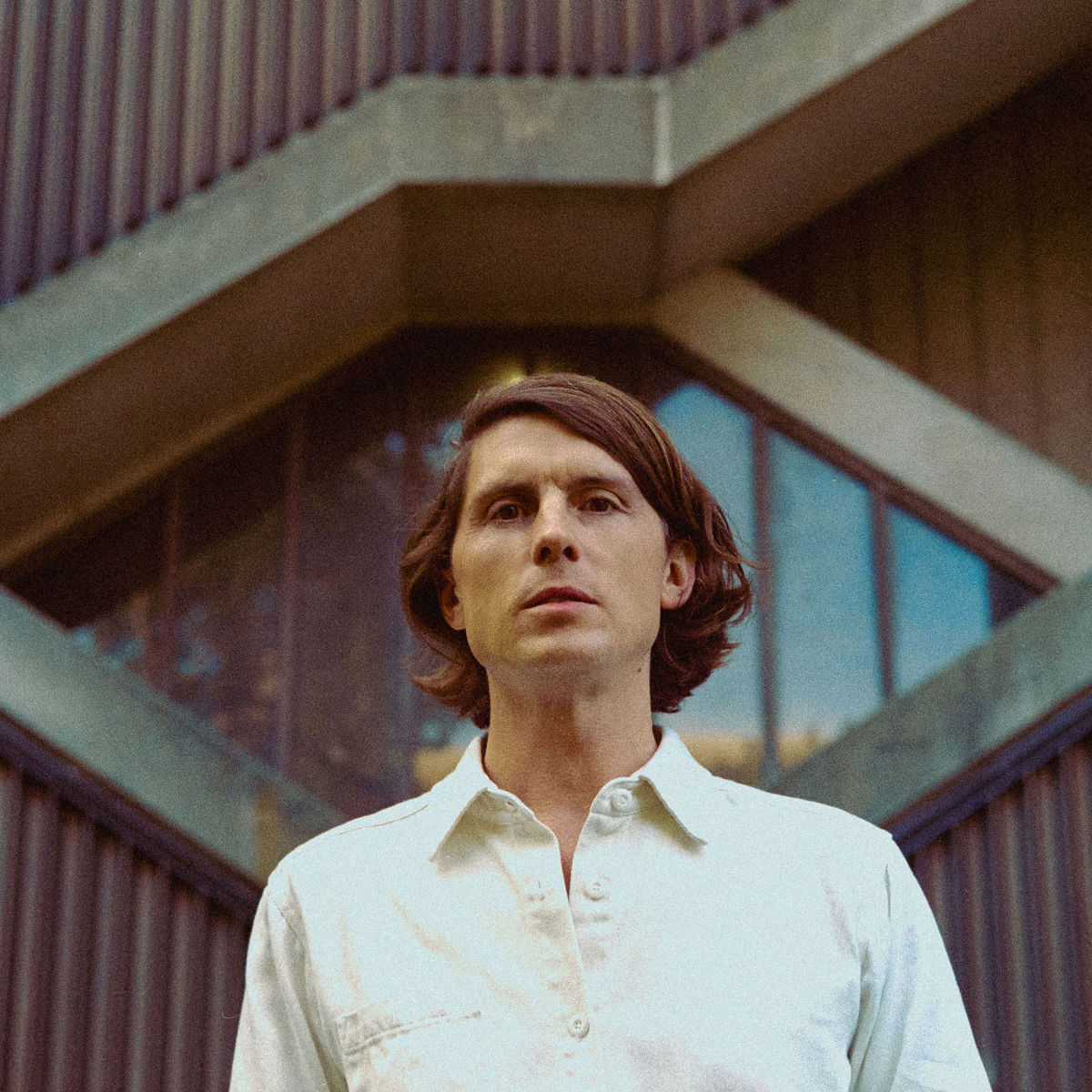
Musician / Composer
Erik Hall is a musician and composer in Michigan.
He is best known for his multi-instrumental solo recordings and live performances of contemporary classical works, which have been featured by The Wire, Pitchfork, Bandcamp Daily, WNYC New Sounds, and The New York Times. His 2020 re-creation of Steve Reich’s Music for 18 Musicians won the Libera Award for Best Classical Record, and his 2023 interpretation of Simeon ten Holt’s Canto Ostinato followed with a nomination in the same category.
Erik has composed or arranged music for Chicago’s Grammy-winning Third Coast Percussion, NYC’s Grammy-nominated Metropolis Ensemble and Sandbox Percussion, and for feature films The Night Clerk and The Mountain.
He has recorded and toured with NOMO, Wild Belle, His Name Is Alive, In Tall Buildings, and Lean Year, appearing at Lollapalooza, Coachella, Pitchfork Music Festival, Montreal Jazz Festival, CONAN, and The Tonight Show.