

Marcus Roberts: Jazz Piano and Technology's Promise
The acclaimed blind pianist who honed his craft playing with Wynton Marsalis and Seiji Ozawa now pioneers accessible music technology while leading The Modern Jazz Generation into uncharted creative territory.


Today, we’re putting The Tonearm’s needle on pianist Marcus Roberts.
Roberts plays jazz piano like he’s lived through its entire history. His style pulls from Jelly Roll Morton and Fats Waller as much as it does from bebop. He spent years in Wynton Marsalis’s band, has performed piano concertos with Seiji Ozawa, and today leads The Modern Jazz Generation, a 12-piece ensemble encompassing three decades of musicians.
Roberts is here today to talk about something beyond performance. He’s one of twenty artists awarded a grant from the Doris Duke Foundation’s Performing Arts Technologies Lab. His project tackles a technical problem that’s plagued remote music collaboration: latency. He’s working to get the delay below 40 milliseconds so musicians in different cities can actually play together in real time.
Roberts has been blind since age five, and he’s used technology his whole life to access music and create it. From Braille music notation to AI-powered tools, he shows us how tech can serve artists rather than replace them. And that’s just a hint of where this conversation goes.
(The first two musical excerpts heard in the interview are from a Marcus Roberts live performance, Jazz in Marciac 2024)
Dig Deeper
• Visit Marcus Roberts at marcusroberts.com
• Check out Marcus Roberts’ music on Qobuz
• Marcus Roberts & The Modern Jazz Generation - Tomorrow’s Promises (forthcoming album featuring “Who Gets to Decide?”)
• Marcus Roberts on Wikipedia
• Marcus Roberts - 60 Minutes Profile “The Virtuoso” (2014)
Collaborators and Ensemble:
• Jason Marsalis - drummer in Marcus Roberts Trio and The Modern Jazz Generation
• Rodney Jordan - bassist in Marcus Roberts Trio
• Wynton Marsalis - trumpeter, Roberts’ former bandleader
• The Modern Jazz Generation - Roberts’ 12-piece ensemble founded in 2012
Educational Institutions:
• Florida State University College of Music - where Roberts teaches as Associate Professor
• Florida School for the Deaf and Blind, St. Augustine - Roberts’ alma mater (also Ray Charles’ school)
• Bard College - where Roberts served as Distinguished Visiting Professor (2020-21)
Major Collaborations and Performances:
• American Symphony Orchestra - commissioned Roberts during pandemic
• Seiji Ozawa - conductor with whom Roberts has performed extensively
• Saito Kinen Festival Orchestra - Roberts performed with Ozawa in Japan
• Marin Alsop - conductor who has performed with Roberts
• Spirit of the Blues: Piano Concerto in C Minor - Roberts’ first piano concerto
• James P. Johnson’s “Yamekraw” - arranged by Roberts for Cincinnati Symphony
Technology and Accessibility:
• Doris Duke Performing Arts Technologies Lab - Roberts’ grant for latency research
• Reaper DAW - Roberts’ preferred digital audio workstation
• OSARA Extension - open-source accessibility plugin for Reaper
• Reaper Accessibility Wiki - comprehensive accessibility resources
• HIMS Braille Sense 6 Mini - Roberts’ current Braille notetaker
• Freedom Scientific - maker of Braille Lite assistive devices
• Sibelius - notation software Roberts uses for composition
• JAWS Screen Reader - Windows accessibility software
• NVDA Screen Reader - free Windows screen reader
• Zoom - video conferencing platform discussed for music performance
Understanding Latency in Music:
• What is latency and how does it affect audio? - technical explanation
• Roberts’ goal: achieving under 40 milliseconds for real-time remote performance
• Ethernet vs. WiFi connections for music production
• Audio interface quality requirements for low-latency performance
Braille Literacy and Accessibility:
• Louis Braille - inventor of Braille system (originally for music)
• Braille Music Notation - three types mentioned by Roberts
• American Foundation for the Blind - awarded Roberts the Helen Keller Achievement Award
• Braille literacy crisis: only 10% of blind children are Braille-literate
Historical Jazz References:
• Ray Charles - also attended Florida School for the Deaf and Blind
• Jelly Roll Morton - major influence on Roberts’ style
• Fats Waller - stride piano influence
• Duke Ellington - referenced as model for distinct band sound
• Count Basie - another influence on Roberts’ approach
• Sidney Bechet - quoted on jazz tradition
• John Coltrane - spiritual influence on Roberts’ music
• Miles Davis - mentioned regarding editing on records
• Charlie Parker - Milt Jackson story reference
Philosophy and Ethics in Technology:
• Dr. Martin Luther King Jr. - “moral compass must stay ahead of technology”
• AI ethics and artistic authenticity
• Technology as automated natural process
• The balance between innovation and human discovery
Awards and Recognition:
• Helen Keller Achievement Award (1998)
• Grammy nomination for Portraits in Blue
• Honorary doctorate from Brigham Young University (2021)
• Honorary Doctor of Music from The Juilliard School
• NEA Jazz Masters Award (2009, with Marsalis family)
Additional Context:
• Savannah Music Festival - Roberts served as Associate Artistic Director
• Swing Central - high school jazz band competition Roberts directs
• Carnegie Hall - where Roberts was scheduled to perform when pandemic shutdown occurred
• J-Master Records - Roberts’ own record label founded in 2009
(This transcript has been lightly edited for clarity.)
Lawrence Peryer: I am super intrigued about this work you're doing in solving latency issues that plague people who are remote collaborators. I'd love to hear the origin story of your interest in this.
Marcus Roberts: Well, it started in 2020 when everything shut down. As a matter of fact, I was supposed to be doing a show at Carnegie Hall the day everything got shut down with the American Symphony Orchestra. And after that happened, we were trying to figure out, like everybody, what we could do, how we could keep our creative activities going. How would we be able to engineer some kind of plan where we're not just all discouraged and throwing up our hands and isolated from everything?
So the American Symphony commissioned me to write a piece during that time, which I wrote called United We Play, and we did it like a lot of people remotely. So people used their iPhones and we used whatever software folks had where we could record. And it was such a complicated thing. I mean, we had a real deep appreciation for why people like to be in the same room, that's for sure.
And so we did it. We got it all done and edited and mixed. But in the meantime, of course, it became obvious: are there better ways when people are isolated and people are in different geographical areas? Are there other ways that we could work on this? So when the Doris Duke idea came and they were saying they wanted cutting-edge ideas of what to try, I'm like, well, this is certainly a cutting-edge problem because it plagues all musicians for many reasons. So our goal with this grant was to optimize technology so people could perform and record jazz music in ways that audiences and students could enjoy and appreciate, still the interactive nature of jazz. Because, you know, jazz is a moment-to-moment music. I mean, that's why I like it. It really doesn't work to overdub your parts and stuff like what we had to do in 2020. So to do that, we've got to address latency.
Latency for laypeople just means that when you hear a sound, you're not hearing it when it happens; you're hearing it later. And if you're playing live music, that does not work. Our music, everything has to be boom, boom—like you hear it right when it happens. And so to do that, there were a lot of things, and I won't get into all of the details of it. But the goal was, okay, if I'm in my house in Tallahassee, Florida, let's say my saxophone player is in his house in Tallahassee, Florida, maybe he's two or three miles away, and maybe there's a trumpet player who's six miles away—can we get on some type of platform and get everything set up so that we can record all at once and everybody hears each other in real time? That's the succinct version of what we're after here, and we have made some progress there.
The success that we've done so far means that we can extend these methods maybe eventually to not necessarily video recording in terms of real time, but maybe video recording that could be synced up later to audio. But I think the audio part of it, we're making some pretty significant progress. There's still a lot of work to do, but we have literally had people in different cities like Tallahassee and Atlanta, and we were able to play. And some of that just has to do with things like, you know, the quality of the audio interface that you're using is very important. A second thing is you cannot use a WiFi connection to do this. It has to be direct via ethernet. Those are two big, big things. And then the final thing that I think is important is your internet service. What kind of plan do you have? Are you just dealing with a generic cable plan that's slow? It's going to be tough for you, so you need a pretty high-end plan. So all of those things are involved in the work that we're doing.
Lawrence: So it sounds like on the one hand there's almost like a list of best practices or like a protocol as well as ultimately at some point some kind of system or set of software. Like how should I think about that?
Marcus: Yeah, that's exactly right. There is a best practices approach, and I'm hoping that if we are able to keep doing this work, we might be able to publish a document or a series of videos where we kind of explain, based on our research, okay, if you have a Mac, this is what you need to make this work. This is the software, this is the type of router, these are the protocols in terms of the internet service that you have that will make it work, et cetera, et cetera.
And I will say there are a variety of applications and websites that already are working on this, that allow musicians to collaborate remotely. But there are limitations in functionality. And of course, I'm a blind musician, so there's that element of it. I need something that's accessible, that a blind musician can use without sighted assistance. So that's another whole can of worms that we're addressing as well. Some people think the Mac is superior because of its audio subsystems, but I will say Windows, with its Core Audio system, is good too. It works well. But those are two different things. I happen to use, and a lot of my colleagues, we like to use a program called Reaper to record. Like right now I'm using Reaper right now. And that's the reason that the quality is so good over Zoom because Zoom, as you know, is a consumer product.
Lawrence: I mean, you sound incredible. You actually really do sound incredible.
Marcus: Thank you. Thank you. And right now, like if I wanted to play something for you over Zoom, which I may do because I do have a record that we're going to hopefully put out sometime in the next few months, I might play a little bit of that. With the setup through Reaper, I'm able to output the audio of my microphone and my, it's called a Braille Sense 6 Mini. That's the little machine that I have that I'm able to read and write with. It's got a podcast app, it's got a media player so I can play it, I can connect it into Reaper and then send it out from Reaper into Zoom so that we still have high-end audio going into Zoom. So all of these things that we've had to go through have helped me to get all this kind of stuff together, which is pretty cool.
Lawrence: Help me understand if you're able to—you've made me question something now that I never usually question. And I think that's oftentimes the best thing you could say about a tool or a technology—you forget it's there. But I do the majority of these conversations over Zoom, and I shouldn't say it out loud, but almost all of them are fine. And when there are tech problems, it's usually some kind of user error, like it's been a reliable way to do these types of recordings. What is different between you and I having an audio conversation that's simply voice and one, if I were to go sit at my piano and you were to sit at yours, what complexity is getting introduced that degrades the experience?
Marcus: What it is, is Zoom was designed for voice interaction. Like you sound great too, you know, without going through all the shenanigans I went through. But the minute you start wanting to introduce the playing of other audio sources—a piano or a song, let's say, that's on your computer or on YouTube or something—what Zoom wants to do by default is to cancel out anything other than voice. So anything that it hears that it thinks isn't voice, I mean you can't hear it. So you have to turn on something called original sound and you have to go into all these different music settings in Zoom, and as best you can get them, as good as you can get them, it still isn't great. You have to have some other method of getting the audio into Zoom so that you're not sacrificing quality. And when you turn on original sound, then Zoom isn't trying to compress any of what it thinks isn't voice.
So I have a track in Reaper that's routed through there into Zoom. And so, because a lot of people were telling me when I started doing some teaching over Zoom, oh, the kids will never, they hate that. And that's because you're getting crappy audio. That's why they hate it. So once you get things configured and set up properly—and I've had a few really smart audio engineer people who've helped me learn about a lot of this stuff over the past four years because I've just been obsessed with it and I've always been into technology anyway. And most, not just blind musicians, but I will say most visually impaired people are obsessed with technology because we try to equal the playing field in as many ways as we can. And technology, like going all the way back to the sixties with the talking book machine that eventually led to Siri and artificial intelligence, you know what I mean? So our community has always been somehow involved in a lot of these innovative technology movements.
Lawrence: There's a lot you're introducing here that I want to come back to throughout this conversation. But something I wanted to ask before we get too far down some of the other technology and capability rabbit holes: when you're working with musicians in a remote context, I'm curious as a creative, not only what changes about the dynamic and the conversation that you're having as opposed to, you know, a different conversation you have in a studio versus what you have on stage. Like is it becoming another type of context that might have its own unique attributes, and are any of them positive? Like do you have—is there something interesting emerging from this remote paradigm?
Marcus: Well, the first thing I'll tell you about the remote paradigm, especially as we dig into it and we really solve it, is it's going to save a lot of money and time. Because if I'm in Atlanta and you are in Jacksonville, Florida, I either got to rent a car or put gas in my car. I got to drive to Jacksonville. We got to find a place where we can do it. Do we have all the equipment we need to do it? Whereas if we have a remote setup between both places, it's literally, once it's all figured out, a question of just getting on there, perhaps rehearsing some music we got to play in two weeks somewhere. And we can actually just get on there and say, okay, look, can you play measures one through fifteen and I'm going to play measures one through fifteen. If we can play together, we can actually do it. We could record it, we could listen back to it, we could talk about it. So I think in that sense, there's a certain kind of weird efficiency that comes from it because people are still comfortably in where they live. They didn't have to get a hotel room. They didn't have to buy a plane ticket or rent a car. They didn't have to worry about food. Where are we going to eat? Are we going to break to eat?
So in some ways, I mean, there's never going to be a replacement, obviously, of musicians being in the same space and feeling that live energy as it's created, obviously in front of an audience. But I think the new paradigm in 2025 says we've got to have, especially as jazz musicians, because we're not, you know, our music is not the most popular music right now in the country or across the world. It's still a very wonderful music that a lot of people love, and when they hear it played properly, I think if we can just keep people into what we're doing and enter our journey and as we express clearly the objectives that we have, the struggles that we have, just like regular people have. If we can demystify some of that, then I think it makes it possible for people to enjoy the music perhaps in a different way. And the musicians collaborating in this way, being able to go right into their studio space and hop on a platform and play together does have, I think, its own special things. And again, when we can, obviously we're in the same room when we're on stage playing in front of people. That's ultimately our ultimate goal, obviously, with how jazz music works.
Lawrence: There's some really beautiful human elements to it though. Like it's this sort of interesting, I guess maybe contradiction is the word between bringing so much technology to bear and keeping people physically separate. But at the same time, I can't help but think about things like, well, there's the environmental aspect. You know, you mentioned throwing gas in your car. We know what airplanes do and all that stuff. But there's also this sort of connection opportunity. Like your favorite rhythm section on the planet might be two guys in Japan, and all of a sudden you have an opportunity to explore that collaboration in a way that you might only get to do once, if ever, or you have to go find a label who's going to fund you flying around. And there's something really beautiful in that.
Marcus: Yeah, because we live in a global economy. We live in a global citizenship, if you will, so that even though, yes, we're isolated in terms of our geographical place, we actually are, as you just said, able to collaborate with people all over the world who have talents that we wouldn't be able to access. Let's say you bought like a plane ticket, flew sixteen hours to Australia. Now you don't have to do that. My big thing is figuring out a way to do it with tools where your level of engagement and quality of performance is not compromised.
Lawrence: You said something earlier that I wanted to come back to. You talked about this idea that technology can level the playing field for blind musicians and that it comes very naturally to that community because you're often using and leveraging and searching for technology anyway. Because you said level the playing field, I can't help but wonder, are there aspects of being a blind musician that give you an advantage either in terms of how you hear or how you process or how you think about music technologically? I hope it's not too romantic of a question, but I wonder about that.
Marcus: No, not really. Some of it is romantic. Okay, don't get me wrong. If somebody told me, look, Marcus, we've got some new technology and you can get your sight back, would you rather stay like this or check that out? The answer is 100 percent, yeah, sign me up. Okay.
That being said, first of all, we all have issues and struggles that we have to cope with. The difference between, let's say, somebody who's in a wheelchair or somebody who's blind using a cane or a dog is, you know, obviously if you see somebody with a cane or a dog, you kind of know they're blind, so you could make judgmental assumptions about them without talking to them, seeing anything about what they do. You can use that to assess what their potential might even be, again, without even knowing who they are, what they do, or anything. If you have a condition or a situation that you cannot identify through sight, and it's not to say people are hiding it, but you don't see it. So I think in that sense, there's an unfortunate component to certain disabilities where people can make assumptions about you. And my argument is everybody has something they're dealing with that they would probably prefer people not necessarily know or not dig too deep into.
In the case of—and to be honest with you, early in my career, I never wanted to discuss my blindness because I didn't want anybody to think that that had anything to do with what I was capable of doing. But over a period of time, and decades of being out here doing this, I have rethought it and thought, well, you know what, if you talk openly about it, maybe people will find some inspiration from that. Or maybe talking about the struggles and the things of it that might be advantageous, that you've forced yourself through working on things day and night, you've turned something that was once a deficiency into an asset, which is kind of what we all want to do. I do think in that sense, because for example, anytime I'm on the bandstand, I'm not up there to mess around because I can't visually look out and look at the blonde in the third row. You know what I mean? Like, it's music. That's it. I'm up there to play and I'm listening to the environment that's being created around me and trying to figure out what does the piano have to do to make this work, to make this better? How can I make more room so that what somebody else is playing can be heard? These are the things that I tend to think about on the stage. And again, you can carry that into your life. Like my father used to always tell me, he said, look, you got two ears. You should listen twice as much as you talk, and you'll learn a lot more by checking out what other people are saying.
In terms of any advantage, I think you create the advantage through your work ethic. You create the advantage by not looking at yourself as a victim. Rather to look at yourself as a resource for improvement through the work that you do, and when you need help, don't be afraid to ask for it from people that you trust who care about you and who have information that you don't have.
Lawrence: Yeah. There's a tremendous vulnerability that it sounds like you have to embrace, but like with most forms of vulnerability, if you can embrace it, it opens up a lot of opportunity.
Marcus: Yes, yes.
Lawrence: I want to ask a little bit about your relationship with creative technology and studio technology, and because you used the phrase around like asking for help. I'm wondering how much did you have to, or do you have to advocate or even invent to sort of implement your creative life? You know, I would imagine like with a lot of tools, I was going to say this earlier, accessibility does not seem to be at the forefront of a lot of product design, and so—
Marcus: No, no, no, no. To be honest with you, being a jazz musician, you know, we improvise for a living. You find yourself doing that in this type of environment with a vision problem. Like, you find ways to modify something that kind of works and you fool with it and tamper with it, and you're like, oh, actually if I do this, oh, this actually works. A lot of blind engineers that I know, that I've been blessed to know over the past, like, four or five, six years. I mean, my goodness, the stuff that they have found, the tools that they have found, and a lot of it is free tools, different compressors that work really well, different EQs that are self-contained, you know, all kinds of tools that they're constantly coming into contact with, and they'll teach me about it and say, look, if you use this, your voice will sound better. It's like, oh man, really? And you didn't have to drop like, you know, twenty grand for a Fairchild compressor. You know what I mean? Like, a lot of this stuff is now available.
Technology—I'll tell you, one of the big moments. I was in Japan working with the great Seiji Ozawa who conducted the Boston Symphony for years, of course. And he had a blind violinist with the Saito Kinen Orchestra. And this was 1997, and I'll never forget, we were on break. And I wanted to meet this guy because, you know how this is, it's like any tribe, you want to meet your people. He's a blind guy. First, I wanted to know, how do you even know when to come in? They don't go one, two or one, two, three. They don't do that.
Lawrence: Yeah.
Marcus: So I was trying to figure out how do you know when to come in with that orchestra? And I guess he gave me some explanation that the next guy sitting next—I don't know what they do, but some kind of system they had. But we were talking and he says to me, look, there's a new device that just came out and you can load Braille documents into it and you can check your email and there's an account. I was like, what? I didn't believe it. He showed it to me. I'll never forget it. It was the Braille Lite M40 from Freedom Scientific. I don't know if they called themselves that at the time, but he showed it to me, and I'm not going to lie, that was like a life-changing moment, second only to when I was eight years old and came home from elementary school and my parents had bought a piano, but they didn't tell me, and I bumped into it going into the house. At first I was pissed. I was mad like, what is this? What's in my way? And it was a piano. So that was the top surprise, you know, for me.
But he showed me that. So since then, oh my goodness, I've probably bought five or six of these Braille notetakers. They're called—they're basically like our version of like an iPad, I guess you might say. And they're not cheap, I'll tell you that. You know, they average about anywhere between three and five thousand dollars. None of this stuff is cheap. But the revolutionary nature of the technology and what it allows us to do, especially in terms of being literate, because I'm just one of these people, I believe in reading Braille whenever I can. And one of the unfortunate, one of the really unfortunate aspects of our community is that our children, our blind children, even with all of this technology that's happened and all the innovation and all the opportunity, the literacy level in the blind community is still 10 percent. It really bothers me, and some of it of course is a lot of kids are priced out of being able to afford this technology. There are notetakers that are a lot cheaper. Hopefully through government support and state support, you know, we can get these children the devices that they need to learn.
Lawrence: A lot of them are very talented, but my argument is why do they have to be talented to get a fair chance? There are a lot of very average people who do just fine and they don't have to be Albert Einstein. Or we may never find out what they're capable of.
Marcus: That's exactly right. And I was blessed early, like I learned Braille when I was six, six and a half, and understood somehow, intuitively how important it was to learn how to read and write. So that was my journey and I was fortunate to get good piano teachers who could really teach me how to play. Even though my first teacher, Hubert Foster, who was totally blind also, he was a genius. I mean, he had a master's in voice and he knew how to build pianos. I mean, just an incredible guy. And he made me learn Braille music notation. And just so you know, Braille has several different types of Braille modes. You know, the first one was actually Braille music. So Louis Braille, he was an organist and he wanted to play organ music. So that was the first—it wasn't literary Braille. And there are three types of Braille music notation. So I learned all three of those. There is literally a computer science code. There's a Grade 2 code United States, and then they worked on something that's now called UEB Braille, which is the standard now. And I grew up doing just US Braille. So it's taken me years to realize, okay, you're going to have to learn this. You have to learn this code.
So all of this, I guess, you know, it stresses your mind, it stretches your imagination. The Sibelius notation program, I've been working on that for years and years because, you know, as a blind composer, I've got to figure out a way to write my music. But ultimately, if it's a work for symphony orchestra, these are sighted people. They don't read Braille music. So you've got to give them a score and parts, like what they're used to, and what I tell all my blind students that I have, the ones that I work with, I said, your life will be much simpler if you remove as much of the problems that your disability causes you, if you can remove as much of that from other people's lives as possible, people will help you. But if they have to help you do stuff for hours and hours all the time, they're going to get tired of it, and people are human and you're going to have a problem. So you need to do everything you can do to make it easy for people to help you. That's very, very important. You need to be very conscious.
I tell all the blind children, when you run into people, don't start touching all over them because that's what blind kids do. Because, you know, they can't see you, so they want to feel your face. And you can't do that. That's not—society doesn't like that. Okay, so you can't be invading people's space. You've got to be—so there's a lot that blind kids have to learn and deal with in terms of functioning in a sighted world where everybody's looking at them. Like I was told when I was fourteen, I'll never forget I was doing something stupid. I don't know what it was. I was outside and, you know, and I can't remember what it was, but one of the guys, he was a maintenance worker or something. I'll never forget. He walked up to me and he said, Roberts, he says, I hate to tell you this. You're doing something really stupid and just know that it's a shame that you can't see what other people are doing, but just know everybody can see what you are doing. And I was like, oh my goodness. It was a deep moment.
Lawrence: You're not invisible!
Something else that's deep is, I have a quote from you where you said music has to come from the body, from us. I love that for a lot of obvious reasons. But a not so obvious reason or something I wanted to ask you to explore with me a little is, what does that mean for someone—and you talked about being a composer and using these tools you have to—the technology, it seems like there's so many words I can use. I was going to say mediates the experience, enables the experience. Like there's so many—technology becomes an interface to access and create music in ways that, you know, sighted musicians just take for granted. And so there's this interesting tension between the naturalness of the body and the inorganic nature of technology. And I don't say that with value judgment, but how do you think about that?
Marcus: It's really a wonderful, truly complex statement because I actually consider myself, despite my scholarship and willingness and desire to learn as much as I can all the time, I'm really a natural musician. Like for the first four years I played the piano, I couldn't have told you E-flat from B-flat, you know, Z-flat. I couldn't have given you any idea of what it was. And my mother, you know, always made me play. She wasn't a trained musician, but she was a great musician because, you know, you could feel something when she sang. And she always told me, she said, look, I don't feel anything from what you're playing, so you're going to keep playing it until I feel something. Yes ma'am, okay. And so I learned early from her that the most important thing that we have as musicians is we have to communicate a feeling to people. Now we can put it in a simple structure. We can put it in a complex structure. That's why people are attracted to whoever they're attracted to. They feel something from them.
And of course, jazz musicians and classical musicians sometimes, you know, we're a little arrogant and thinking, well, how could you like that? And this form is so much more sophisticated. But you know what? I don't feel nothing from that, so I'm not into it. And I think learning that early on is the top thing that I've worked with my students on: why are you playing what you're playing? Like what are you trying to communicate? What message? I mean, are you communicating sadness? Are you communicating hope? Are you—like, you know, what's the feeling you want people to get from what you're doing?
And ultimately for me, technology does sometimes get in the way because if I'm thinking I'm at a computer and I'm in the Sibelius program and I've got all these keyboard commands that I've got to know—say, oh, I'm going to play something. Okay, well I've got to press this command to get into Flexi-time and I've got to set it to quarter notes because I'm primarily going to be playing quarter notes right now. You know what I mean? It interrupts the naturalness of just hearing and playing. But at the same time, if I get it right, it's beautifully notated and people can read it.
Lawrence: Yeah,
Marcus: I know Ray Charles used to dictate all of his stuff to people. You know what I mean? Like he would just dictate it to somebody and somebody would write it down. And so you had to know staff notation too. So, okay, well this is going to be, you know, I want this clarinet to start on first line of treble clef on E. You know what I mean? Like you had to—so I learned all that stuff. There's a lot of knowledge that you have to have, but the ultimate goal is to hear, feel, communicate to a public. And if you communicate to them, well, first of all, the first level is self-expression. So when you're teaching young musicians, first, do you have something to express? Okay. So you teach them how to express. The next level is can you communicate a feeling to people? Can you communicate it clearly, accurately, with good technique, with a good sound, with a good tone, with a knowledge of stylistic influences that you bring to the table? But the final level, and the one I'm always looking for with me and my audience, is to reach a state of communion, meaning we all feel this, we all feel it, and their feeling is energizing me to play stuff I never would have played without them.
Lawrence: Yeah. I love that. There's something else that occurs to me as we're talking, which is, I'm a man of a certain age and I grew up really loving technology, and music—they were the two things I loved the most. And I used to think of myself as sort of a techno-optimist, and that's a, well—
Marcus: You've done great work. There's a reason for that.
Lawrence: Well, it's a hard philosophy to still embrace in this era. And I think something that work, like what you're doing, brings out for me and it reminds me that technology's at its best when it's in the service of a larger human mission and not technology for its own sake and for its own novelty.
Marcus: Amen.
Lawrence: Yeah,
Marcus: yeah, yeah. Well, I think Dr. King spoke to that. I think he said something like, you know, you want the human moral compass to always be ahead of the technology, because if you think about it, all technology really is, it's automating some natural process. Somebody figured it out. You have these manual steps. Somebody automates them and makes that possible or accessible to somebody who doesn't have to go through that manual process, which sometimes can work against you because maybe you don't understand that manual process and you're kind of skipping through some steps. But I'm still, I'm okay with that sometimes. And you know what? I don't really need to know the details of it. It works well. It saved me an hour. Thank you.
And if it enriches, like you were just saying, if it enriches your ability to create and there's a naturalness and an organicness that the technology is helping to provide, I think that's beautiful. I don't, you know, there are some jazz friends of mine who they hate editing. They think it's false. They think it's fake. They don't believe in it. I'm like, what do you mean you're just editing something that you actually played? I mean, why would that be cheating?
Lawrence: I mean, if it was good enough for Miles, it's good enough for me.
Marcus: Who are you talking? Hello? We know Miles had all kinds of crazy editing that was going on on some of those records. I agree. That's well said.
Lawrence: Given, you know, so that quote and that paraphrase from Dr. King—I wanted to also say something else. I read a quote from you about AI saying, "We don't need you." Like if AI reaches the intelligence that all of the prophets say it's going to, the first thing it's going to say is, we don't need you. Given that and given the sentiment in Dr. King's quote, I'm curious how and if those realities, those ideas, influence or inform the choices you make about the technology you embrace and just as importantly, what the technology you resist—like how do you, do you have an ethos there or is it, you take it as it comes? How do you think about this?
Marcus: It's all experimentation for me. I try things. If they work and they make my music organically accessible to people, I'm okay with it. If it gets in my way and slows me down or makes me feel that what I'm doing is less authentic, I don't want anything to do with it because for me it's all about authenticity. It's all about—in fact, if you go to a restaurant and you know the food's good, I mean, you don't know if, did AI cook the food? I don't know.
Lawrence: Did they microwave it?
Marcus: It's really good. It's really good. I don't know how they did it. Somebody somewhere had to make a decision to make the food good, whether they did it all themselves manually or they used some other processes because we've always used technology. A car is a technology. A piano is technology. I mean, you can't grow it on a tree like a clarinet or a saxophone either. You can't do that. So I think the key with technology is what's the intent? What's our intention with it? And I think that's where the danger and the glory comes from. What, you know, how are we going to use this tech—are we going to use this technology to uplift people or exploit them? Are we going to use this technology to inform people or deceive them? Like what do we want to do? And so in music, I think honesty is—and truth. I mean, from our perspective, based on our knowledge, our wisdom, our dedication, what we can bring to it, which is just one perspective. Let's be clear. Like I tell my students all the time, I can give you my approach. It's one approach.
You need to look at other people who've been very successful that you like and check out what they did because that's really what made jazz so great, is that you had the Duke Ellington Orchestra and you had the Count Basie Orchestra, and you had Glenn Miller and Benny Goodman and Jimmie Lunceford, you know, Woody Herman. You had all these great bands and they all had different sounds and different styles and different influences. And you can use all of that and bring of it what you understand into your identity as a musician. And like Sidney Bechet said, you know, he said, look, there are two big feelings in our music. One is how you feel about it and what you bring to it. But the other is people who came before you who laid it out. You've got to bring their feeling and the general feeling and love that jazz music presents and that true sense of freedom within a group context that the music represents to the people. And that's why people wanted to dance to it in the first place.
Lawrence: Yeah, we forget often that jazz is dance music, you know. It got put in the recital hall, but we forget that it was the great dance music.
Marcus: It was a great dance music. And I think it's a shame that we—to me, you can have both. Like, I don't know why America, I don't know why we pick something like it can only be this. And then in ten years, well now we want this. And it's like, well what is that about? I mean, why—your mom made a meal that her grandmother made that tastes good or are you upset? No, again, it's a great meal. You don't care. You don't care that it was a recipe that was a hundred years old. Can I have more of that? So I think music is the same way. And the ultimate test of the validity of a musical style is ultimately going to be based on how many people need it and want it.
And unfortunately there are times when something very good goes undiscovered for a long time, like Bach music. I mean, it went—people quit playing it for like 150 years. Now, maybe some of that was because Bach was not like Handel. He didn't travel a lot. So when he died, you know what I'm saying? Like it wasn't like he had expanded it. Whereas Handel, you know, he was all over the place. But it took Mendelssohn saying we should play this music, and then people got back into it. But I tell people all the time, whether people get into it or not, greatness is great, and when people stumble upon it, they will check it out. It's just a question of when.
Lawrence: It's fascinating you make that point about Bach because there's so many people now who, if you ask them to say, oh, the greatest, like the greatest, there's like—and we almost lost that as a culture. We did. The other thing that you touched on that I think is really fascinating is that tendency in America to dismiss the—I don't know if dismiss is the right word, but we need to have this, like, high and low or is it in the dance hall or the recital hall? And, you know, my pet theory is that it's not snobbery, it's our puritanism. We just look down on the things that give us bodily pleasure. It's like it's our national psychosis. We just can't accept bodily pleasure. It has to be like in the intellect or it's bad, you know?
Marcus: That is probably true because people deep down want to ignore the fact that we're just humans, man, trying to figure it out. That's why we have all these deep systems of psychology and ethics and philosophies and "I exist, therefore I am" and all these things which are certainly valid, up to a point. But then you contrast that with then people are fighting over land and over money and women and this and that. And jazz has all of that in it, and American music has all of that in it. It has the struggle to be human and ethical against the idea of, yeah, you know what, listen, let's go have a good time. You know what I'm saying? Let's go hang out. Let's dance, let's eat a great meal. Let's enjoy the football game. So there's that. And to me, you can have both. Like you can have a spiritual belief that you are a better person if you care about somebody who doesn't look like you or who doesn't act like you, that you could have empathy for them, but at the same time, you could have the stuff that you're into that defines you. And I think that's perhaps our struggle and we can't be denying other people the same, to explore that for themselves.
Lawrence: One more quick one before we get to new music. I'm curious, when you look back over the last five or ten years, have there been any technology breakthroughs or technology tools even that you wouldn't have thought were possible but now are here? Like, you know, what's excited you?
Marcus: Well, just like this particular equipment that I bought maybe three or four years ago, this is the Braille Sense, and it's made by a company in Korea and they have a very small but very competent, really brilliant staff of folks who work on this product. And to tell you, I didn't know—like it's got a fantastic YouTube app on there that's very simple. User interface is very simple. So I can just type in, if I want to hear like Miles Davis, I type it in there, I hit enter and boom, it's playing in like three seconds. It's got a podcast app, so a lot of the podcasts that I'm into, it's there. I even got like SiriusXM on here, you know, and it's got a Braille display and I'm able to read and write and it's got all these apps. So that was not something that I ever thought would be, not necessarily that it wouldn't be possible, but not that it would be this easy to assemble all these things. Yeah. And Sibelius, the fact that there's been a lot of progress made with that program, it's still difficult to use, I will say. I'm able to produce major orchestral works with it. Like I just did an arrangement of James P. Johnson's "Yamekraw" that I recorded with the Cincinnati Symphony in March. I guess we'll put that out sometime next year. But I did all of that. Well, first, I did a lot of it in Reaper, which is my preferred digital audio workstation. Then we had to, through XML, we had to transfer it into Sibelius and then take it from there to put all of the CCAs and slurs and, you know, all of the instructions in there. And I couldn't have imagined that I could have done it with this level of professionalism even ten years ago. So those are just some quick examples.
And then in the case of what we call screen readers, which are the software that interprets the screen—that would be JAWS, that would be NVDA. These are two very popular—and VoiceOver on the Mac. They interpret the screen. So as a result of that, in Windows, you know, all the Microsoft products are completely accessible. So if you want to do a complicated Excel spreadsheet, you can do it. If you want to write a complex document with all kinds of graphs and tables, you can do it. I mean, all these things are being done at very high levels and they're even, you know, we got many blind computer programmers, physicists. I mean, it's—I would argue that our community is one of the most diversified in the world. Like I went to school with guys that were drug dealers and others that were like very scholastic. I mean, it's a wide range. Trust me.
Lawrence: The blind drug dealer is like something out of a Quentin Tarantino film or something.
Marcus: Man, this dude, I mean, and I asked him, I said, well, how do you know if somebody's, you know, selling you the right stuff? He said, man, you can tell, you can smell it. You can tell. I'm like, really? Oh, okay. And he in some kind of way, and he was a short guy and he had it way up in the ceiling in the dorm room. I don't know how he did it. And the other thing that he was able to do that always mystified me. I was never great at mobility, just traveling around and crossing streets and all that stuff. And at the school I went to, which was the Florida School for the Deaf and Blind in St. Augustine, Florida, they had this whole zone system. So in order for you to go off campus, you had to pass certain tests. And what they would do, and this was kind of crazy, oh no—they would drop you off in St. Augustine, Florida and you had to get back on your own. They would just leave. You had to figure out like what street you were on, like figure out your crossings, your landmarks, whatever. And I only made it up to zone two. This cat had like a zone four pass. Like he could cross like four lanes of traffic and hear where the traffic patterns were and all this stuff. So I never—well, I was the type of person who—I waited when I got to Florida State, man, I would wait until I heard no traffic and I would run across the street. So, man, that was me.
Lawrence: You know, when you were talking about the hardware interface you have and you were talking about the different apps that you have available now, I was thinking, oh, so now Marcus can waste his time like the rest of us.
Marcus: Oh, would I do? Yeah. I get right into that rabbit hole!
Lawrence: We've finally done it as a society, we can finally waste blind people's time too.
Marcus: Oh yeah. Oh, we are the worst. Oh my goodness.
Lawrence: Talk to me about music. I didn't know that we were going to have a chance to talk about music. What do you got going on?
Marcus: Oh, well, I got several CDs that need to be put out over the next year or so. There's, you know, solo piano stuff. There's trio records with my great drummer, Jason Marsalis, and Rodney Jordan, my bassist. And then I have a bigger group called The Modern Jazz Generation with a lot of young people that I've, most of whom I've worked with at Florida State University. And they're very, very talented. So we have a record that we're going to put out called Tomorrow's Promises, and it's, you know, a thoughtful, optimistic kind of document that just poses a lot of the questions that we're all struggling with right now. One particular track that I thought I might play—I might not play the whole thing, but maybe I'll play half of it or something—but it's called "Who Gets to Decide?" And that's a big question that everybody in their life has to ask. You know what I mean? Are you going to make your own decisions? Are you going to have the church tell you what to do? You going to have—like, who gets to make the decisions that define a lot of where your life is going to go? And at the same—you know what I mean? But at the same time, it's an uplifting question. It's not designed to be dark. I mean, it can be beautiful.
There are other songs on the record, like "Do What You Want, Then Pay for It." I mean, there are other songs that are interesting. But then there are songs like "There Is Beauty in the World" and "Life Rhythm Is Life," you know, that's another one. But I'd like to play a little bit of one called "Who Gets to Decide?" and it's kind of cool. We got Jason playing drums and percussion all simultaneously, which only a genius like him can do. And maybe we'll hear a couple minutes of that. Wonderful. Now hopefully you'll hear this. We'll see if this Braille Sense does what I need it to do or if it's going to let me down. We'll see.
Lawrence: Hmm. That was—I love that horn interplay. Wow. Beautiful.
Marcus: Oh, you like that?
Lawrence: Yeah, yeah, yeah. It's all communication and you know, these guys are all friends now and they—because when I first started working with a lot of them, I mean, they couldn't stand each other. Like a lot of young people in college, you know, they thought they had it all figured out and they were looking down on all the other kids. But now they've all grown up and you can hear the view of the world they have is very, very positive and optimistic.
Lawrence: I love the left hand during that first piano break that—
Marcus: Oh, you like that?
Lawrence: Yeah. I love that. I love that. I love that. Oh, man. You know, when I was listening to that record, that track, I wanted to say to you, that sounds like America.
Marcus: Exactly.
Lawrence: I feel like I heard the twentieth century and into the twenty-first century across that track.
Marcus: Yeah. Yeah, yeah. It's weird. I don't think of it as jazz per se, or maybe in the tradition, you know, like the music that I'm typically associated with. You know what I mean? Like, I don't think you would have expected to hear that. Yeah, no. And it's really to be blunt, I, you know, I just want it to be accessible so when people hear it, they don't have to pull out a dictionary to know what you're doing.
Lawrence: It was beautiful. Thank you for sharing it, and thanks for making time this last hour, man. It's been such a treat talking with you.
Marcus: Oh, man, my pleasure. I hope we stay in touch. You know, you got a lot of—I mean, your whole delivery is such a relaxed and real way of communicating and I can tell it's just natural again, like what we've been talking about.
Lawrence: Well, thank you. Thank you. Yeah. I look forward to talking with you again. Next time maybe we'll spend an hour just nerding out on music.
Marcus: Let's do it. Let's do it.
Lawrence: I would love it. Anytime. All right, Marcus, be well.
Marcus: Okay, bro. You too, brother. Thank you. Take care. Peace.
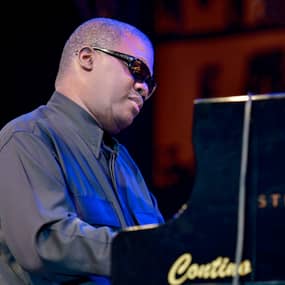
Jazz pianist, composer, educator, and recipient of The Doris Duke Foundation's inaugural Performing Arts Technologies Lab Grant
Pianist Marcus Roberts is often hailed as “the genius of the modern piano”. He is known throughout the world for his many contributions to jazz music as well as his commitment to integrating the jazz and classical idioms to create something wholly new. Roberts’ melodic and soulful group improvisational style uses musical cues and exotic rhythms as the foundation for his modern approach to the jazz trio.
Roberts grew up in Jacksonville, FL where his mother's gospel singing and the mu sic of the local church left a lasting impact on his music. He began teaching himself to play piano at age five after losing his sight but did not have his first formal lesson until age 12 while attending the Florida School for the Deaf and Blind. At age 1 8, he went on to study classical piano at Florida State University with the great Leonidas Lipovetsky. In 2014, Roberts’ life and work were featured on a segment (entitled “The Virtuoso”) of the CBS television show, 60 Minutes.
Roberts has won numerous awards and competitions over the years, including the Helen Keller Award for Personal Achievement. Most recently, he was honored to receive the 2024 Dorothy and David Dushkin Award by the Music Institute of Chicago. Roberts’ critically - acclaimed legacy of recorded music reflects his tremendous artistic versatility as well as his unique approach to jazz performance. His recordings include solo piano, duets, and trio arrangements of jazz standards as well as original suites of music for trio, large ensembles, and symphony orchestra. His first recording with orchestra (Portrai…Read More