

 Apple Podcasts

 Spotify

 YouTube

 Amazon Music

 Castbox

 RSS Feed

 Overcast

 PocketCasts
Mark Isham: Analog Machines and a Jazzman's Breath
The Grammy-winning trumpeter and film composer joins us to discuss 'At the Carousel Club,' his first solo album in 15 years, built from a wall of vintage analog synthesizers and a band featuring Nels Cline and Vinnie Colaiuta.
This week we’re putting The Tonearm’s needle on trumpeter, composer, and synthesist Mark Isham.
He’s out now with At the Carousel Club, his first solo album in fifteen years, built around vintage analog synthesizers and a band that includes Nels Cline, Vinnie Colaiuta, and a string quartet.
We talk about where the album’s title comes from, his history with David Sylvian, and what it was like hearing the finished record on vinyl after sixteen hours of sessions.
(The musical excerpts heard in the interview are from Mark Isham’s At the Carousel Club)
Dig Deeper
• Visit Mark Isham at isham.com and follow on Instagram, YouTube, and Facebook
• Purchase At the Carousel Club from the Mark Isham store, Bandcamp, or Qobuz and listen on your streaming platform of choice.
The Band:
• Nels Cline
• Vinnie Colaiuta
• Kaveh Rastegar
• Ayo Awosika
• Orchid Quartet
• Wilco
Musical References:
• Weather Report, I Sing the Body Electric
• Friedrich Gulda
• Sonny Sharrock
• Bach, Mass in B minor
Film:
• Never Cry Wolf (1983), directed by Carroll Ballard
Trumpet Players and Builders:
• Doc Severinsen
• David Monette
• Maynard Ferguson
• Arturo Sandoval
• Wynton Marsalis
Bay Area:
• Cal Tjader
• Merl Saunders
• Jon Faddis
• John Coppola
David Sylvian:
• David Sylvian
• Brilliant Trees (1984)
• Holger Czukay
• Kenny Wheeler
• Jon Hassell
Jazz Collaborators:
• Horace Silver
• Charles Lloyd
The Next Generation:
• Chief Xian aTunde Adjuah (Christian Scott)
• Keyon Harrold
• Theo Croker
From The Tonearm:
• Nels Cline: Tales of a Daunted Guitarist (The Tonearm Podcast)
• OK Bloomers — Nels Cline Finds His Happy Place
(This transcript has been lightly edited for clarity.)
Lawrence Peryer: You compared the instrument you have on the back wall of your studio to TONTO. That made me laugh, because I'm curious: does your setup misbehave the way TONTO does, in terms of seeming to have its own mind and autonomy? Or have you learned how to tame it?
Mark Isham: Well, I think I've got it pretty much under control. I actually look for some of that strangeness. I look for those things that are unpredictable, and that's really why I enjoy those older machines. The communication between them—we do use MIDI, which I guess technically is digital, but it's such early, early digital that it's hardly digital. A lot of it is still control voltages and gate voltages, which are analog voltages. That's the beauty of it. It's sort of a little untamable beast at times. That's just why I love it. I want those things to happen that I would not think about.
Lawrence: It reminds me, in an indirect way, of guitarists who like to play with feedback, or any kind of element of chance or noise that allows you to turn sound into noise, into music.
Mark: I love that. That's one of the reasons that Nels Cline is just all over this record, because he is the master of that. Just to jump right into those sorts of details, he's the master avant-garde guitar player, but now, of course, he's known more as a rock star in Wilco. I knew him long before Wilco, when he was doing all the weird Cline ensemble and all that stuff, and I have just loved him forever. So it was great to have him back after all these years to play on this record and to bring that exact thing you just described—this harnessed noise.
Lawrence: The combination of him with Wilco is so inspired. I'm so happy for him, too. I'm happy for that band that they have him, and as a fan I'm happy, but it's such a wonderful, odd thing to have happened.
Mark: It is. I think it's great. It's great for him, because he was a starving avant-garde musician, and now he's not, but he's still an avant-garde musician, better than he's ever been. So I just think it's fantastic.
Lawrence: It would strike me as—I don't know who the modern-day equivalent band would be, but as if some hard rock or heavy metal band had enlisted Sonny Sharrock or something.
Mark: Exactly. Exactly.
Lawrence: Tell me about the genesis of this project. I understand, from doing some prep work reading the materials, that Weather Report and I Sing the Body Electric were somehow in your mind and heart leading into this. Can you tell me about that?
Mark: Absolutely. I think I Sing the Body Electric was perhaps—I mean, there have been several along the way, but certainly in the top five, and maybe the top three, and maybe the top one of all-time influential records upon me and what I learned music could be. It's interesting: I heard the first Weather Report record at a friend's house. I hadn't heard it before, and it blew me away. So on my way home, driving, I stopped by Tower Records to pick up my own copy, and it was out. They didn't have it anymore, but they had I Sing the Body Electric, which had just come out. I had no idea what it was, and that first track just changed my life. It was the perfect combination of Zawinul's European classical crossover education combined with the ferocity of Eric Gravatt and the brilliant melodic improvisation of Wayne, all put together, and it made so much sense. A lot of the time, these fusions of genres are, eh, a little creaky. You feel the Scotch tape. But boy, you didn't feel any Scotch tape here. This stuff just felt like it all belonged together, was all perfectly constructed and perfectly designed, and I've taken that as an influence ever since—that things from different worlds, from different genres, can live together comfortably and interact with each other.
That's really what this record is. It's composition, it's harnessing the performances of great players and improvisers, cinematic compositions, cinematic orchestrations. All of it sort of tries to work together—I'm very proud of this record, so I won't say it tries. It does. I solved the problem. I did it. I managed to make all this stuff really work together.
Lawrence: Listen, I think that's fair. I try to listen to the new work before I read much about it, and so especially the Western classical element—when I first put it on, I thought, this sounds like a late twentieth-century or contemporary sort of modern composer. All the cliché words, but almost like a Third Stream kind of thing.
Mark: Well, good. That was mine. Friedrich Gulda, all those guys, back in the late sixties and seventies, and then I think Weather Report was really the culmination of all that for me. It's been a constant influence, and I've been so fortunate that I've had a film career that has allowed me to experiment with a lot of this stuff and try different things, and learn a lot along the way, so that I come here, years later, and I kind of know what to do. I kind of know, well, let me push out here. I've never quite done that, but experience has told me that this sort of thing is going to work.
Lawrence: Would you mind telling me a little bit more about that? I'm so intrigued by people who get to work in film and television and how you get to actually explore and experiment with different compositional modes, or even genre, because you might have to score something—you know better than I do. Did you pursue that because of the experimental possibilities, or was it just part of the working life of a musician? I'm really curious about that aspect of your career.
Mark: I never set out to be a film composer. I never studied it. I never aspired to do it. An offer just came to me, and I realized, maybe things like this don't happen a lot, so maybe I should really put some effort and time into this. And I put enough effort and time into that demo phase that he hired me. Carroll Ballard hired me—a very brave move for him, because I was totally untested. I had never scored a film before. I had some solo albums out, and the studio, I'm sure, was saying behind my back, "What the hell are you doing? You're hiring this kid? He's done nothing." Carroll probably just said, "Hey, he's cheap." Because I think they were at the point of probably saying, "Carroll, just hire John Williams. Just hire the guy. We'll finish the film. It'll be great." And Carroll, he's such an iconoclast. He said, "No, I want this kid who doesn't know anything. He's going to give me the greatest new stuff."
And I think I did. I saw that, oh my God, there's an opportunity, and I threw myself into it with every ounce of energy I could possibly muster—seven days a week for four and a half months, eighteen-hour days, just nonstop. This is my shot, this is my shot. And I had a really great support team, two music editors who were also composers, and they really guided me through the synchronization process: "It'd be better if we didn't go this far. It'd be better if you wrapped up that melody by here." Just guiding points like that, which I probably could have figured out, but they got me through it much quicker, without wasting a lot of time.
I came out of that exceedingly inspired, gratified, knowing that I'd actually done a good job, but also that I had learned something about my innate abilities—that I could do this. There was something about the way I saw, perceived, and wrote music that was intrinsic to storytelling. I could shift music per a story, per an emotional through line. It seems to have worked out well.
Lawrence: You brought up something else I'm very intrigued with, especially as it relates to instrumental music, and that is the role or the function of narrative. I'm curious how much of the work from that world comes back into your music-only work. I'm very intrigued by the role narrative can play, and often does play, in instrumental music. Is that a thing?
Mark: Absolutely. I would much rather think emotionally about what should happen next than, "Oh, this is an A-A-B-B-C-D-A-B form, and I should go to the D section here." I don't care. You'll see that very prevalent on this record. There is some adherence to traditional form, but a lot of the time I just throw it out the window, because I feel that as a storyteller, we need to shift. We need to make a complete about-face, or a dramatic bang, or a complete absence of emotion for a second. You don't do that in pop music, which is fine. I understand the rules of pop music, and they're pretty strict. But the stuff that really excites people is the stuff that breaks the rules, right? So I've always been an adherent to that—that I am experienced enough and knowledgeable enough that I can break the rules without sounding wrong, because I know how this stuff works. I've done this a long time now, and I've done my homework.
Strangely enough, I don't really have a title for these songs, these pieces, until they're done, or just as they're wrapping up. So it's not like I've said "My Night in an Iberian Post Office" right from day one—"I'm going to walk up to the other box, and I'm going to trip over the counter." That's not how this goes for me. I get an idea of a space, musically. And actually, "My Night in an Iberian Post Office" came from the title of a sample that I was using.
Lawrence: Oh, really?
Mark: And the image of that was just so cool. It wasn't Iberian; it was another locale. But I changed it to Iberian because all of a sudden the trumpet part in this was getting very Spanish, very bullfight-type trumpet playing. So I said, "Well, let's just put this whole thing in Iberia." But those are decisions that are made sort of toward the end. I've already set the stage. I've already got the atmosphere, the rhythm, the intensity, the levels, the ups and the downs. And I think that just comes from wanting to tell a story, wanting to find a pulse that I feel.
Good filmmaking will make you write a good score, because something new will happen just when you need it to happen. Just when your attention needs something to happen, it will happen, and the music reflects that. Then the music has that strength as well. Weaker filmmaking isn't always like that, and sometimes we have to help and put things in where things need to happen. But that's the beauty of working with really talented directors: you get into the same pace of how the story's unfolding, you're in sync, and the film is the stronger for it. The music is the stronger for it. I've been living and breathing that for decades, so that's more what defines form for me and the way these pieces unfold.
Lawrence: Are you one of those types of composers who has a notebook full of titles waiting to be used? I love that. Love that.
Mark: Yeah, because I've been there at the end of a project and had no idea what the album would even be called. So I've started, and sometimes it's full and ready to offer. And then sometimes I've neglected it for a year or so, and I go, "Oh my God, I'd better pull out the gallery, the art books, and the poetry books," the things where the masters have summed up an idea in a single sentence. That's what you're looking for: somebody who has that creative thing with the English language, that they can, in four words, put you—"Oh yeah, I'm there. I get that. I see a whole thing."
Lawrence: So with all that said, what's the Carousel Club? What is it? Where is it? Where is it in your universe?
Mark: Well, "carousel" is an interesting one. My wife is a painter, and we do these immersive works together, and she had a painting called Carousel. Both of us were sort of drawn to it. She was drawn to it because on our trips to Europe, she'd walk into the park in any city, and there's a carousel, and the kids are on it and running around, and there's sort of a magicalness to it. We came to the idea that if you're three or four years old and your dad lifts you up onto the carousel, that first horse is riding through the Pampas, or whatever it is. And then you get off that and you're taken back to where there are more seats, and you're in the middle of the glitter, and then you're in a mystical land. Then you go up to the next horse, and it's a unicorn, and you're at a whole nother—so the point of view of a kid on a carousel is that you get to visit all these little magical places, but at the same time, you're in this universe of constant motion and excitement. And it just seemed to me like a great image for what an album could be: come to the Carousel Club, and we will present you with images, we will present you with stories, we will present you with universes, and you get to live in them for four, five, six minutes. And then if you push repeat, you get to live in them again. So that's the idea.
Lawrence: Have you been on one in the last X number of years? If you see one, do you go on? I like them as well. I find the whole process of standing in line, running to the horse you want, and then the blur of people—it's a very liminal, contained, interesting universe for those two minutes, or whatever it is.
Mark: It is, and I think both my wife and I were very attracted to that image, to the experience, and to the various interpretations you can have. Originally, it was a training exercise for knights.
Lawrence: Really?
Mark: They would get on a circular horse, and there would be rings and stuff mounted, and as they went around, they'd have to throw their lances through.
Lawrence: Oh, is that the origin of the brass ring?
Mark: Yeah, that's the origin of that phrase.
Lawrence: Wow.
Mark: Look at that.
Lawrence: Some of the language you use about the trumpet seems almost to give it a personification. I'm very curious: when did you start to perceive it as its own life force? I don't want to put words in your mouth, but as its own entity. And what's the significance of that to you? Because there are a lot of things you could imply from that, or conclude from that.
Mark: Well, there are two seminal events with me and the trumpet. My mother was a professional violinist and played in symphony orchestras all over the world. My father was a professor, so there wasn't a lot of money for babysitters. I would always get hauled off to the orchestra rehearsals with my homework, and I'd sit in the auditorium as they rehearsed and finish my homework. So I would be there in front of an orchestra playing various types of music, and I'll never forget the time they played, I think, the Bach B minor Mass. Bach wrote for the clarino trumpet, which is this high, high trumpet. That technique was actually lost after Bach and wasn't resurrected until the beginning of the twentieth century. And it's just the most sublime music in the world. My head came up, and I went, "What is that?" It's spiritual. It's extroverting. It's just glorious. Bach was making it as talking with God, trying to bring God into the room. And for me it sort of had that experience. Although I'm not traditionally religious, it opened up. It just has this call to beauty and aesthetics and the greater parts of life, and that made me go to my mother and say, "I want to play the trumpet. I want to play the trumpet. I want to be able to have that effect upon people that that music has upon me. That's my calling."
So I was practicing diligently, and I was a really good classical trumpet player. I'm playing along and playing along, and one day I came across a jazz radio station, and I heard Miles Davis. It just took over, right? It just took over in my head. Any instrument that could make me feel the presence of an infinite spiritual being, or an infinite spirituality, and whisper in my ear—sexy, sexy shit. Any instrument that could do those two things, that's it. You don't need much more if that instrument is capable of that level of expression, from the highest exaltation down to just the coolest, intimate statement. I'm in, and I've been in ever since. So I really do look at it as a vessel for communication. It's a tubing, and I'm still worried about mouthpieces, as every trumpet player's worried about their mouthpiece. Do I have the right mouthpiece? It is an extension of me. It allows me to perhaps express things in a way I wouldn't know how to in any other way.
Lawrence: That strikes me as incredibly healthy.
Mark: I think so. I think it's kept me sane all these years.
Lawrence: Well, I'll be the judge of that.
Mark: Yeah, well, exactly. You ask my wife about that. You see, she agrees.
Lawrence: Just to rabbit-hole for a second, because you brought it up: tell me about mouthpieces. What's the journey there? Is it never-ending? Do you have multiple? Do you change them out? What's the story there? It's so bizarre and mystical.
Mark: Yeah. I mean, look, Johnny Carson was making jokes with Doc Severinsen about mouthpieces. It's become sort of a cultural thing for trumpet players. Dave Monette, who's one of the great custom handmade horn builders around these days, says the mouthpiece is 80 to 90 percent of the design of the instrument. I don't know if everybody agrees with that, but the mouthpiece certainly is a huge factor. It can change the sound. It can change the way you play. It can change how you have to practice. The bigger the mouthpiece, the bigger, the broader the sound. The smaller the mouthpiece, the easier it is to play high and to play brilliantly. And having said that, Maynard Ferguson didn't especially play a very small mouthpiece, and he could play anywhere on the horn. The great Cuban trumpet player Arturo Sandoval, who's possibly the greatest technician on the instrument we've ever seen, plays a very large mouthpiece, and he can play as high as you could possibly want. So this is where the mystique comes in: do you get the perfect mouthpiece so you can play everything you want to play, or do you just practice? I'd like to think that basically you just have to practice, and you pick a mouthpiece that's comfortable, that you can learn, so that you know where everything is. The relationship between the mouth and the mouthpiece is comfortable, you know you can control it and get out of it what you want to get out of it, and it gets you the sound you want.
Lawrence: I'm curious about a little bit of the process of making this record. My understanding is you put a lot of it together and then turned it over to the band and the string quartet. Will you take me through that a little bit? I guess where I want to end up is, I'm curious what surprised you about what the band and the string quartet did or added to the music that you weren't going to get at on your own.
Mark: I think the element of surprise was different for different elements. I can't say I turned any of this over to anybody. I wrote the string parts. The string parts are written. They were arranged by a young lady who's worked for me for years and done some string arrangements for me. I think the surprising thing about the strings, which is always surprising, is that you write strings with samples, in a computer, and then you put four virtuosos in a room, and you hear them play it, and you just go, "Oh, that's what I meant. In fact, that's much more than I meant. That's so great." Just to hear it played by virtuosos—each part now has a breath and life to it. And then you can sit there and talk to them and say, "How about if we do this? How about if you try the whole thing in harmonics, or try it all on the fingerboard?" You can try different techniques with real humans that you can't do if you're just doing this on a computer. So that was the great part of the strings. It just brought a life and a performance to it.
Vinnie Colaiuta, the drummer, is a force of nature, and he and I go back decades and decades. So I could turn to Vinnie and say, "The way Al Foster played on that Miles record, when he comes in—let's do that." And Vinnie—we wouldn't have to write anything down. We wouldn't have to go more than that. He would just know. And I'd say, "And then there's a spot on the Weather Report where Eric Gravatt takes it up—yeah, do that." And then I could say to him, "Look, you'd love this stuff. I love this stuff. I want you to go into six against the four. The band is in four, but I want you to play in six against it." And he'd say, "Oh, sure, no problem." Or I'd give him a little motif—dun, dun, dun, dun, dun—and say, "Put that in the groove somehow." He could do that. So we could interact, we could talk in very simple terms, and it wouldn't take long, because we share this vocabulary, we share this knowledge, and he is a master. Playing in six against four is like falling off a log for him. This is not a big deal for him. And he'll do it with all the grace and groove and excitement you could ever possibly want.
Kaveh was great, because I had written a lot of the bass parts, but Kaveh brought some instruments I didn't expect him to bring. He brought his acoustic bass, and he brought a lot of pedals and stuff, so he'd be playing a part, but at the same time he'd be constructing a loop, and all of a sudden I'd hear this weird loop out of the bass channel. I said, "That's awesome." So there were definitely some surprises from having Kaveh there, because I had never worked with him before. My original choice fell out at the last minute, and Kaveh was the last-minute call, and he came in, and he's now become a number-one favorite of mine. He's a tremendous player.
And Nels, of course, is completely the wild card. I have nothing to say to Nels except, "I want G Mixolydian. You can fuck it up as much as you want. Just don't play the F sharp. Go." And he would just make his bonnel stuff. He is so intelligent and so well versed in music that he doesn't just give me an amorphous cloud. He gives me the G Mixolydian without the F sharp, but it's also really cool and really strange. I know that I can tell him that, and it's going to fit compositionally with everything else it's going to blend with.
Lawrence: Did you have any constraints around making this record? You talked about the way you were working with the strings, and it sounds like you had some time to give them feedback or try different approaches. It doesn't sound like this was a two-day session where everybody had to come in and do the thing and be done. How long did you have?
Mark: It was kind of that way. We did the strings in three hours.
Lawrence: Oh, really?
Mark: We did the band in two days.
Lawrence: Wow.
Mark: I did Nels in probably five or six hours, and I did Ayo in two sessions, six hours. But look, I've been doing this for a long time. I know how to schedule people. I also know how to cast people. I didn't pick a singer who's going to have to learn everything by ear. I picked a singer who can read, who reads perfectly, so the parts I knew I wanted were written out for her. The same with the strings: it's all on the page. These women are consummate studio players, and if I have a certain number of minutes to record, I know how long it's going to take, because that's what I've been doing for a living for the last thirty years. So if you hire the right people and give them the right amount of information—withhold the stuff you want to withhold, so that you get some of their choices involved, but make sure they understand the stuff that has to be there—it can go pretty quickly. And you can still experiment, you can still try stuff, you can still fool around. It's just production. It's just being an experienced producer in the film business, where it's not my money, but boy, if I go over budget, I hear about it. And in this case, it was my money, and the budget my wife and I had decided on—this is what we're going to spend. So, boy, if I went over budget, I was going to hear about it.
Lawrence: Well, it's good to have somebody to be accountable to in that regard.
Mark: Exactly. So we just made sure that we did it on time and on budget.
Lawrence: In a lot of ways—again, I don't want to put words in your mouth—but to reflect back some of the ways you've spoken about this over the last half hour or so, it really does feel like somebody who is able to flex and articulate all of their—my impression is that you were in control of your superpowers on this project, and it was a bit of a culmination of all these different things you've done before: a leader, a collaborator, the film work giving you the discipline to run the show. It seems like one of those projects that's a full articulation of capability.
Mark: I think you're exactly right. "Superpowers" may be a bit generous, but certainly knowledge and experience and abilities to get things done in an efficient but still open, non-pressured way. You don't want any of these guys to feel the pressure. You want them to be totally relaxed and to say, "Oh, come on, let me do another one." "Of course you can do another one." It's not my first rodeo. I've done this. But it's casting. It's picking people you trust on that journey, who you know have the knowledge and the aesthetic vision to go where you want them to go, quickly. Because you don't want to pick somebody you're going to have to spend two hours with just to get them to duplicate what this record sounds like. You want somebody who can listen to the demos and say, "Oh, I know exactly what you're doing, and I know what I can contribute to make that even better."
Lawrence: Tell me about mixing. Do you mix your own work? And if not, are you present, or do you like to just get mixes sent to you? I'm really curious about that aspect of it.
Mark: I do not put my hands on the knobs. I worked with a very experienced engineer, Cary Butler, who's just really, really good, and he knows Mad Hatter really, really well. I think part of it is that, to him, Mad Hatter is like his instrument. That's the instrument he's been playing for years. And a young guy named Max Shereshevsky, who, as a second, was brilliant. So I sit there and I say, "No. Yes. Yes. No, let's try—no, that's terrible. We need to rethink that whole thing." Or, "No, that's perfect. Let's move on." I know what I want it to sound like. There's no question about that. And there are times when Cary would say, "Just give me a couple days to do the busy work"—to go in and clean up the tracks, to put the reverb sends on all the different presets. "We know that's the trumpet sound you like. So it'll take me half a day," because we're on an analog console with computer recall, so he's going to have to go through each session and set things up. Things like that, I didn't hang around for. But any decision-making day, I was there. Absolutely.
Lawrence: I would think not being there for the setup is good, just in terms of keeping your freshness. There's a fatigue in that waiting.
Mark: Absolutely. And I've learned that on film mixing. There'll be a lot of times when I just let my film mixer have two days by himself: "Let's get the surround thing fixed. Let's get everything aligned. Let's clean up the things that are sloppy." If I'm sitting listening to this music over and over and over just to do that, by the time we actually have to make crucial decisions—you're right, it's like, I've heard this thing so many times, I don't know anymore. Whereas it gets into a condition where it's really listenable—"Ooh, this sounds good"—and I can come in and make those fine-tuned decisions with fresh ears.
Lawrence: My understanding is that you had a bit of an emotional experience when you finally heard the full playback. Is that right? You had sort of a moment when you heard it?
Mark: Well, I did. I did in the studio, for sure, and then I did again when I listened back on a friend's high-end turntable. I got the first pressing back of the vinyl, and I have a friend who has the big $75,000 system with the $20,000 turntable and the special room and the whole thing. And he's told—
Lawrence: We all need that friend.
Mark: We all need that friend. He's been a friend of mine for years and years and years, so this is his third room. I've been in all of his rooms. He said, "Absolutely. Test pressing? Yeah, come on over." So we put it down and listened, and I actually just said, "I think this is the best this has ever sounded." I like this better than sitting in Mad Hatter listening to it right off the half-inch tape. There's still something magical about a great—and Bernie Grundman cut the vinyl. So you don't get much better than that.
Lawrence: There you go.
Mark: And it was pressed on 180-gram, and we listened back and went, "Yeah, this is why vinyl is on a statistical uprise right now." More and more people are wanting that experience. It's pretty unique.
Lawrence: Coming into our time together, over the last week—and as somebody who sort of enjoys and believes in synchronicities—I had a couple of experiences leading up to our time together. Last weekend, somebody was having a yard sale and selling a bunch of vinyl. Their neighbor was a friend of mine who said, "Oh, I think I can get you over there early if you want to take a look at their records." Of course I did. I used every ounce of restraint not to take all of them. But the ones I did take, when I came back here, I was flipping through them, and they were not necessarily records you were on, but records that were reminding me of you. There was some Weather Report, but there were also some Cal Tjader records with Jon Faddis on them, and other records from the Bay Area in the early to mid-seventies, with Merl Saunders and, like I said, Faddis—all those guys.
Mark: Oh, wow.
Lawrence: I don't know. It just put me in this mode of, oh, of course these records came to me this week.
Mark: Well, those are interesting names. I played with Merl. I was in Merl's band for a short period. He was a great guy. And Cal Tjader was one of the first jazz quartets I went to see on my own. I saved up my money, and it was a place that served food, so I could get in at the age of eighteen or something. I would go and see the Cal Tjader Quartet. That was always fun. And Jon, of course, studied with the same teacher I did. I'll never forget going in for a lesson with Johnny—Johnny Coppola was the teacher—and he said, "Oh, man, I just taught this kid. He's sixteen. He plays better than Dizzy. I can't teach this kid anything." And that was Jon Faddis.
Lawrence: Wow. Well, I loved reading about the variety of work you've done, not just across film, TV, et cetera, but the breadth of artists you've worked with over the years and the styles of music. I love when artists do that, and I feel like I would be very remiss—if you don't mind me asking, could you tell me the story of David Sylvian?
Mark: Sure. Now, let me think how it started. I think he just called me up, or Richard Chadwick, his manager, called me up. I think he had heard some of my albums. The first time I played with him was on just one track. I think he asked Richard, "Are there any cool modern trumpet players here in London?" And Richard, for some reason, had heard that I was living in London and said, "Well, there's this American guy who's pretty cool, and he's living here. Maybe you should try him." So I went over there. Holger Czukay had this thing that you would sample on and then play with a pencil, as only Holger would, and he had sampled a trumpet and then played these weird trumpet parts on the record. David loved it, and then realized, well, it would really be good if it didn't go up there but went down—it would help the vocal better. And Holger had left; he was no longer in London. So I said, "Well, maybe we can augment this with a real trumpet." So I came in, and we basically did that. I put a mute in the horn. We off-miked it. I growled. I did everything to make it sound like an eight-bit sample played by a pencil. And it worked, and he got what he wanted, and that sort of started this relationship. I think I did some more with him when I was living there.
A number of years later, I'd moved back to America, and he called me up and said, "I want you to come and play on this record." I flew to London and played on a big piece that sort of featured me. And then he did a world tour, and because he had Kenny Wheeler, Jon Hassell, and me on his records, I think he said, "Well, Mark can probably do the Kenny stuff. Nobody can do the Jon stuff, but if anybody can, it might be Mark. So Mark's going to be the guy on tour." And what a job—to play what Kenny had played, who was one of the all-time most brilliant trumpet players, and then Hassell, who's just totally iconoclastic. God knows how to describe what he does. So I somehow managed to cover the trumpet chair in the David Sylvian [band].
Lawrence: That's pretty amazing.
Mark: But again, it comes from being somewhat eclectic and having played traditional jazz. I played with Horace Silver, and I played with Charles Lloyd, and I've played traditional jazz trumpet, so I could understand exactly what Kenny was doing, and I could do that. And I knew enough about pedals and harmonizers and stuff that I could at least get into the world of Jon Hassell. Nobody will ever be Jon Hassell, but I could approximate that field.
Lawrence: I'm sorry, I don't know this, but are you playing the current record live?
Mark: We're working on it. It's an ambitious task. I think I'm going to do a premiere concert here in LA toward the end of this month, and I think we'll treat it more like a very modern sort of show—maybe only have three or four real musicians and do playback, but project video, and treat it a little more like a modern show than a jazz show. I think it'll be very good. For me, it'll be a good stepping stone to see what more it would take to actually reproduce it really live. It would be a wonderful challenge to be able to do that, but look, it's a conceptual record, there's no doubt about it—things that are very planned out and quite wide orchestrationally.
Lawrence: When you talk about the visual element, where does that come from? Is that a collaboration with your wife, or is that something else?
Mark: Actually, it's a collaboration with my oldest son, who's a filmmaker.
Lawrence: Oh, beautiful.
Mark: My wife runs my business as well as being a painter. We were going over promo and what we could do. I did Atmos mixes of the record, so I wanted to put out a Blu-ray Atmos version of it.
Lawrence: Wow.
Mark: And the Blu-ray author said, "Do you have any video material? This is a video medium, Blu-ray." And we looked at each other and said, "Shit, we don't." My wife, in her inimitable style, said, "Well, Jake will make some videos." "Sure. Six videos." And he did it. He just put his nose to the grindstone and his shoulder to the wheel and every other phrase I can dig up. He's got one more note on the sixth video, and then we'll be done. A music video for each song. So that'll be on the Blu-ray and also be projected at this concert.
Lawrence: That's a very special element. The more you talk about the project, the more it really does seem like a really special project.
Mark: I think so. It's more than I ever really imagined. It's interesting that we're self-releasing this. I've always had a record label, or just sort of thrown something out on my own and not really bothered to do anything with it, just put it out there. But we're taking this on—we're a label now, and we're doing all the things that labels do. And I've got to say, as much as I've had a love-hate relationship with record labels, I do understand that there's a lot of work to do, especially in this day and age, where it's still sort of the Wild, Wild West up there. Nobody really knows what the rules are, but you do your best, and the basic game is still the same: you just get as many people to hear it and hopefully enjoy it as possible.
Lawrence: Do you think there's something you're doing differently as a label than a label would do if you had turned in a master or licensed this to someone?
Mark: It depends who the label was. I talked to a whole bunch of labels before we decided to do this. I think the one thing we have going for us, that I don't know if any label would, is that we're 100 percent committed to this. I had labels say, "Well, we don't know what genre it is. We're unsure. I have to take it around to the different A&R people and see." They're still trying to play by some unwritten rule, as if there really were a bin in the record store that it had to fit in. Well, there isn't anymore. Although I guess there are genres and subgenres and sub-sub-subgenres, and there's got to be a sub-sub-sub-sub-subgenre somewhere that this fits into. So we don't care. Now we could get right into the current state of art and our culture, but I think the way art is going to survive is for the unique vision to be supported—the original thought. And this is very much an original thought. We're just going to say, "Well, to hell with everybody. This is it. This is what's there." There's never a thought of, "We'll change this to fit the market." No. Find the market. Create the market. Which I think is a slightly different point of view than a lot of labels have.
Lawrence: First of all, that's a big point of what I'm doing with you and what you're here to do. To me, it's: let's go find voices and try to magnify them and amplify them and learn from them. I tend to operate with that mindset as well. Anytime I'm listening to something and I'm excited about the eccentricity of the music, I always come back to, clearly I'm not the only one. If I like this—I don't know how big the army of people is, but they're out there.
Mark: Yeah, exactly. And the good news about the current society we're living in is that it used to be, when I lived in San Francisco, "Well, build your audience in San Francisco, because that's who you can see. That's who you can talk to." And then it's going to cost you too much money. You're going to have to go to New York. You're going to have to go to the New York radio station. The world is your audience now. I have fans writing me from India. A guy sent me a cover from China the other day. And that is a great thing, because now, in finding that army of fans you just referenced, the world is your basic audience to find them in, as opposed to the city you're living in.
Lawrence: I would have to guess that translates to offers, too. You must get weird, random offers dropping in—"Come play at such-and-such festival in the middle of nowhere." I hear that a lot from artists. They get random things coming over the transom now.
Mark: Yeah, I can imagine, because it's just as easy to tune into Spotify anywhere in the world. Or Apple Music.
Lawrence: When you're the composer and arranger and bandleader and producer, you're manifesting your vision. Is that something you've come to recently? When did you develop the trust and confidence in your vision as an artist?
Mark: I think the basic trust has been there since I realized that the choices I would make to write something or play something were not just copying somebody else. I'd gone through the phase where I wanted to play like Miles, so I played like Miles. And then I realized, well, now that I've learned that, I know what Miles did, but I have to find out who Mark Isham is, right? And play like Mark Isham. Once I figured that out—and it took several years—there was a point when I said, "That doesn't sound like Miles. Doesn't sound like Wayne Shorter. Doesn't sound like Chet Baker. Doesn't sound like Freddie Hubbard. It sounds like me." And then, as I started doing more composition, I could see that in the composition. People would come up to me after six or seven movie scores and say, "I saw this score. I knew it was you right away." And I realized, yes, there is something there in what I do. I have now endowed what I do with my point of view. And I'm not even sure what it is, but it does happen.
Lawrence: I love that.
Mark: Now, the word "confidence" is a different thing. I can recognize that it's part of what I've developed, but are you kidding me? Five hours into building something, I still sort of listen and say, "Oh, this is a piece of shit. I'll never work again in this town." You get the voices, and that has gotten better over the years. So in terms of the word "confidence," the things that have made me less confident—the more I realize that's not really me. That's not me, the individual, the artist. That's whatever—however you look at psychology—it's the other shit, right? And if you can just tune that out and acknowledge that's the other shit, that's not me, the person who had the balls to sit down here in the first place and write a piece of music.
I always used to say, when people would ask me about writer's block, that the problem with writer's block is that basically you have the gurgitator, right? The part of you that's just willing to put stuff out—"I'm doing this, I'm doing this." And then, sitting right there at the door, is the editor: "You really want to put that out? I don't think so. Don't put that out." And you have to get the editor to just shut the fuck up and call them in when they're required. If they can have a qualitative evaluation of what you're doing, fine. But if it's just to say no, the hell with them.
Lawrence: I hate that guy.
Mark: Yeah, he is a real jerk. And I think it's fun and interesting to actually be able to say "that guy."
Lawrence: No, that's a key part of solving it.
Mark: Yeah. It acknowledges that you are the one creating this stuff, and that creating isn't thinking. Thinking is somebody—"Ah, that's not good"—because I'm thinking about it. No, just shut up. Create. And I think the more you can separate those things out—at least this has worked for me—the more you can separate that stuff out, the more that confidence you asked about goes up. Then I can sit there and make this record, and I can go into the studio for maybe a total of four and a half days and get it done and know that it's going to be great.
Lawrence: Are you still a listener, or do you have to block yourself off from the influences of other music? Can you put on a record? Can you put something on Spotify? Is that okay for you, at times?
Mark: I'm sort of back into listening right now, in the car. All the channels I have are comedy channels, but I did get Spotify to work in the car the other day, because I've especially been listening to the—I say young trumpet players, and I realize these guys are in their thirties.
Lawrence: Well, for us it's young.
Mark: I've been listening to the generations of trumpet players after me, like Christian Scott and Keyon Harrold, Theo Croker. These guys are really, really good trumpet players. And because I'm practicing again, and I want to be able to get on the stage for an hour and a half and play this show, of this album and other material, I'm just listening to these cats and saying, "Well, if they can do it, I should still be able to do that."
Lawrence: Nice. You're optimistic about the state of the horn, though.
Mark: Absolutely. I'm looking at these guys, and several of them are plugged into all the pedals. Now, I did plug into pedals when I was nineteen or twenty years old, so I've been plugged into pedals for a long, long time. But it's gratifying to see the post–Wynton Marsalis [generation], because Wynton Marsalis would never plug into a pedal to save his life. And God bless him. He is still the greatest trumpet player of all time. I love his playing, and he's just fabulous. But he has that point of view, and I don't have that point of view. I've been plugged into pedals since, literally, I borrowed one at the age of nineteen from my friend, the guitar player. And some of these younger guys are plugging into the pedals, and they're having a blast with it, and they're making some incredibly new music. I just think it's wonderful.
Lawrence: Beautiful. Mark, thanks for your time. So great to talk to you.
Mark: Of course. Likewise, Lawrence.
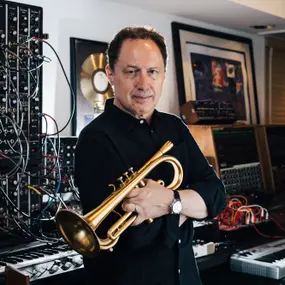
Trumpeter, Composer & Synthesist
Mark Isham is an electronic music innovator, jazz artist and prolific film composer. Isham’s ability to create unforgettable melodies, combined with his willingness to experiment with innovative musical palettes, has earned him accolades including Grammy and Emmy awards, and Oscar and Golden Globe nominations.
Isham’s inimitable musical voice is evident in his memorable scores for award-winning features including the Oscar-winning Judas and the Black Messiah, Crash and A River Runs Through It (Oscar nomination) along with Golden Globe winning Bobby, and Nell (Golden Globe nomination). For The Black Dahlia, Isham was awarded “Best Score” by the International Film Music Critics Association.
He has collaborated with top directors and artists including Robert Redford, Robert Altman, Sting, Jodie Foster, Shaka King, Lynn Shelton, Swizz Beatz, George Tillman, Forest Whitaker, Tom Cruise, Brian De Palma, Chick Corea, Will.i.am, Sidney Lumet, and Mick Jagger.
Most notably, Mark has scored films such as The Cooler (2003), Blade (1998) and Miracle (2004), as well as TV shows such as Hulu’s limited series Little Fires Everywhere for which he garnered his sixth Emmy nomination, EPIX series The Godfather of Harlem, and the long-running hit show Once Upon a Time.
In 2020, Isham made Cannes Film Festival history as the first film composer to perform a live in-studio concert of some of his most beloved scores, for the inaugural film music summit of the Cannes Film Market, the business counterpart of the prestigious festival.
Today, GRAMMY and Em… Read More