

 Apple Podcasts
 Spotify
 YouTube
 Amazon Music
 Castbox
 RSS Feed
 Overcast
 PocketCasts
 Miho Hazama: The Conductor Who Leads with Love
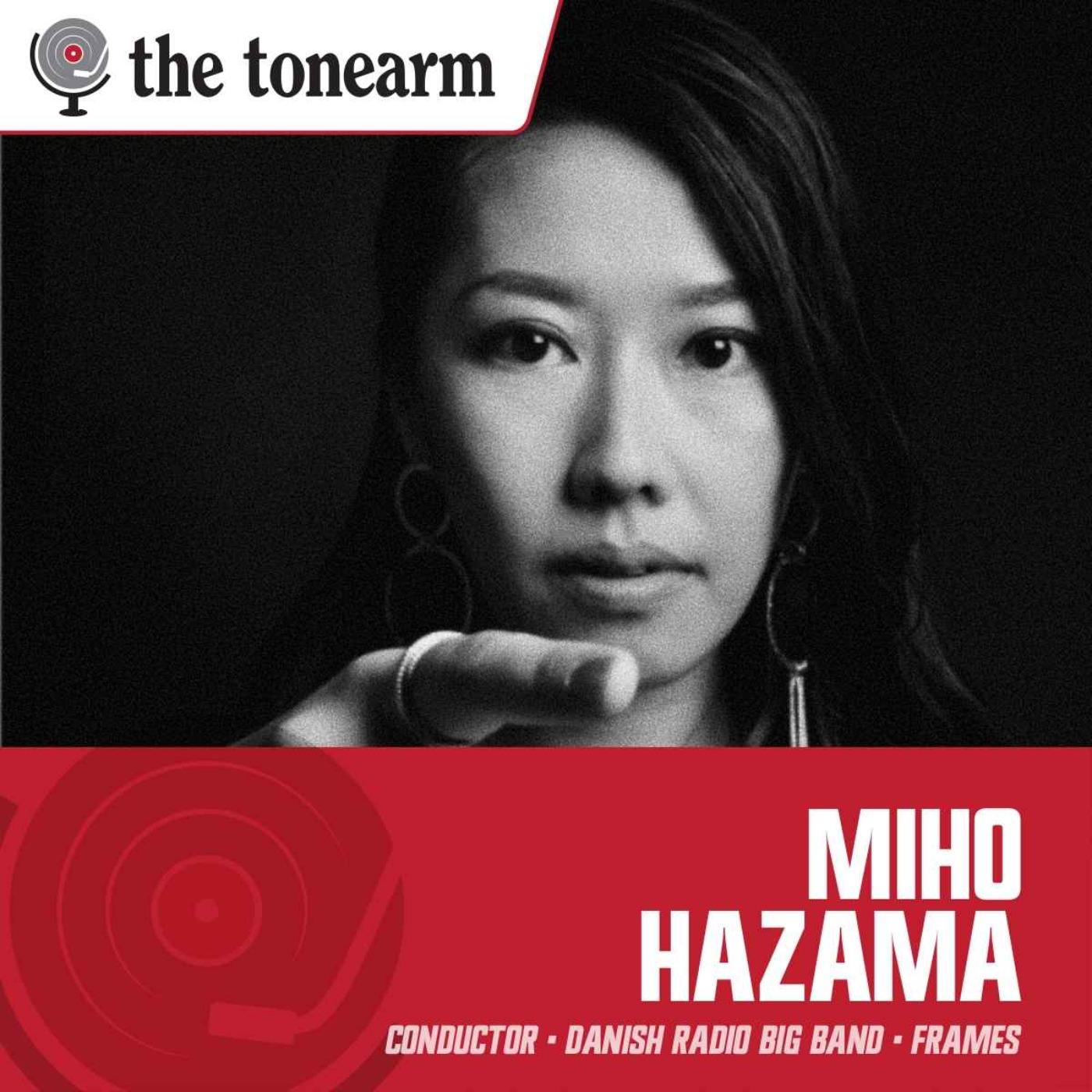
The Grammy-nominated composer and chief conductor of the Danish Radio Big Band discusses her new album Frames, the death of her mentor Jim McNeely, and why love is the only honest reason to make music.
Today we’re putting The Tonearm’s needle on composer and chief conductor of the Danish Radio Big Band, Miho Hazama.
Miho grew up inside the Yamaha music education system in her native Japan. She moved to New York to study jazz composition at the Manhattan School of Music under Jim McNeely and has spent her career as one of the most distinctive voices in large-ensemble writing. Her work includes her own chamber jazz group m_unit, conducting posts with the Metropole Orkest and the Norwegian Radio Orchestra, and a BBC Proms debut last year.
This week, she released Frames, her fourth album on Edition Records with the Danish Radio Big Band. The album draws on the musical language of the conductors who led that band across its decades of existence, including McNeely, who passed away last year. It’s a project with significant weight behind it.
(The musical excerpts heard in the interview are from Miho Hazama’s album Frames)
Dig Deeper
• Visit Miho Hazama at mihohazama.com and follow her on Instagram, Facebook, and YouTube
• Purchase Miho Hazama’s Frames from Edition Records, Bandcamp, or Qobuz, and listen on your streaming platform of choice
• Listen to m_unit: Beyond Orbits, Hazama’s most recent album with her New York ensemble, on Bandcamp
Danish Radio Big Band and Its History:
• Danish Radio Big Band — Wikipedia overview of the band’s history and chief conductors
• Danish Radio Big Band performance archive on YouTube
• Ib Glindemann — founding bandleader and inspiration for Frames composition “The Pioneer’s Quest”
• Palle Mikkelborg — Danish trumpeter and composer; former Danish Radio Big Band leader; Hazama cites him as a compositional influence on Frames
• Thad Jones — American trumpeter and composer who led the Danish Radio Big Band in the late 1970s
Jim McNeely:
• Jim McNeely official website — composer, pianist, and Hazama’s mentor at the Manhattan School of Music
• Jim McNeely — Wikipedia
• Pianist-Composer Jim McNeely: 1949–2025 — DownBeat obituary
• Vanguard Jazz Orchestra — the ensemble McNeely served as composer-in-residence, performing weekly at the Village Vanguard
Educational Institutions:
• Manhattan School of Music — where Hazama earned her master’s degree in jazz composition
• Kunitachi College of Music — where Hazama studied classical composition in Tokyo
• Yamaha Music Foundation — the educational organization whose nationwide network of schools supported Hazama’s early musical development across Japan
Composers and Ensembles:
• Maria Schneider — one of the jazz composers Hazama discovered in college that redirected her toward jazz
• Metropole Orkest — the Netherlands-based pop and jazz orchestra for which Hazama serves as permanent guest conductor
Musical References and Concepts:
• George Russell — the American jazz composer and theorist Hazama imagines as a collaborator for the Frames composition “The Pioneer’s Quest”
• Third Stream — the mid-twentieth-century movement blending jazz and classical idioms, associated with Ib Glindemann’s programming at the Danish Radio Big Band
(This transcript has been lightly edited for clarity.)
Lawrence Peryer: I am particularly curious about your early start with the Yamaha Music Foundation. What led you to music instruction at such a young age? Was music part of your family and household, or how did that come about?
Miho Hazama: My parents are not professional musicians. My mom used to play piano and electric organ as well—she especially, but both of my parents, really noticed that baby Miho was just dancing wildly to music all the time. They decided to bring me to dance school and music school and see how it went. At the time, my father worked at an insurance company, which required him to move to many different places in Japan. Yamaha Music School has branches everywhere in Japan—it's one of the biggest music education systems in the country. So my parents thought that as long as I was at a Yamaha school, I could just keep learning music wherever we went, which is exactly what happened.
So I attended three different elementary schools—I moved twice—and I also moved once during kindergarten, but I just kept going to the Yamaha school wherever we were. When I began more fundamental musical education at the Yamaha school at age seven, I had to choose an instrument to continue with: either piano or electric organ. I had been going to the Yamaha music school since age three, so from age three to seven it was just time to sing with the teacher and dance with the teacher—just having fun with music. At age seven, I chose to learn electric organ. They had students play all kinds of music on the electric organ and also compose on that instrument as well. Especially because of my teacher at the time—she was more familiar with classical music—I started playing classical music on electric organ as an individual lesson. Then for group lessons, they had textbooks where you could encounter a wider range of genres.
So I was in group lessons playing ensembles with all kinds of music, but in my individual activity I started playing symphonic and classical music on electric organ and also began composing. By age nine, I was able to read a pocket score of symphonic music and try to orchestrate it for myself—playing the melody on the right hand, the harmony on the left hand, the bass line on the left foot, and the controlling pedal on the right foot. That way you can play everything yourself, and you program your rhythm section into the electric organ's computer so that you can essentially play all the parts at once. It's a wonderful music education tool, the electric organ in the Yamaha Music School. That's how I learned all the classical symphonic repertoire—by scores and by ear, making it work on the instrument. I got really into composing on that instrument as well, and I was able to combine all that knowledge into my composition at such a young age. That's how it went.
Lawrence: It's interesting to hear you talk about how you moved around but stayed within the same educational system. That implies you had different experiences with different teachers. It would seem that, especially at a young age, the pupil-teacher relationship is so important. Did you find that you had different experiences with each teacher, or was it consistent because they were all within the same system?
Miho: That was indeed a different experience each time. I think the biggest influence I got from that music education system was exposure to a wider range of music in general. I would say I had one absolute favorite teacher for my composition lessons and one very memorable teacher for electric organ—although he was very strict, so I was always a little nervous going to his lessons. But that's exactly why he elevated my ability in both playing and orchestration, and I'm really grateful to him. There was also the teacher who arranged those specialized lessons for me, which was one of the biggest opportunities I had. Later, when I moved to the Tokyo area, my new teacher was not a classical music teacher, so I started playing more concert band and wind symphony pieces with her on electric organ, which is how I became familiar with that repertoire. So the differences between teachers were significant.
Lawrence: I was curious about your experience with competition at such a young age. I talk to a lot of artists and musicians who—especially outside the United States, where the competition scene is different and more intense—learned a great deal from performing under pressure at such a young age. How did those experiences shape how you think about public performance? Is there anything from that experience that still exists in you today?
Miho: That definitely still carries over today. I think I have a clear mental image of how I look when I perform on a stage because of those experiences.
The higher the level you advance to in competition, the more elaborate the productions become. They even had video directors for those events, so you could watch your own performance on video afterward. So there's that visual element—you remember how you carry yourself on stage. Whenever I conduct now, conducting is different from playing electric organ, but it's still me doing something on a stage. I think I have an easier time imagining how I look from the outside—how I move, how I act on stage. It may not be a hundred percent accurate, but it really helps to have that perspective.
And when I was young, I truly did not feel any nervousness on stage. But the older I got, the more that changed—the intensity of nerves hit me much harder. When I started competing at age eight, it was always really fun, no problem at all—I just practiced, and that was fine. But by age fourteen or fifteen, I really had to work on managing my nerves, because my hands were shaking, cold, and sweating, and yet I still had to perform on stage. Those experiences definitely helped me learn to stay calm in intense situations. Of course, that's very different from a genuine emergency—I would probably be very alarmed by that. But when something goes unexpectedly wrong on stage while I'm performing, I feel like I understand that feeling from the inside, and I understand how the players are going to react to it. So I can respond in a way that calms them down or makes them feel a little more comfortable rather than adding to the intensity. I have a deeper understanding of that. I think that's my answer to your question.
Lawrence: That seems like a superpower for a conductor to have—to be able to bring that kind of confidence to the ensemble, so that it feels safer for the musicians.
Miho: Yeah. So that process all happens in rehearsal. My biggest task as a conductor and director, I would say, is to make musicians comfortable while also motivating them to achieve something a little beyond their usual goal. At the first rehearsal, I always try to work through a mid-level piece with the orchestra—or whatever large ensemble or group of musicians I'm working with—to understand what level I can bring them to and what level I should not push toward. I need to gauge that in the first ten or fifteen minutes of rehearsal. Then I can judge: okay, this is the level I can push to; this might be too much. That distinction is very different between, say, a high school band and a professional ensemble. You have to understand how much you can push. By the time you're on stage for the concert, you can push further if they're willing—but if you maintain that level of intensity on stage, they'll probably become too overwhelmed. So it's something you have to assess throughout the rehearsals in order to calibrate the level of demands you're making.
Lawrence: I think I understand conceptually what you're saying, but what does it mean to push the ensemble or push the musicians? That's something that has always intrigued me about watching a conductor interact with a symphony or an ensemble. I see the guidance and the management of dynamics that's happening, but I don't think I necessarily understand what that intensity or pushing means—because I don't understand the missing piece between what's on the page and what the conductor is drawing out of the players. Are you able to articulate that at all, or is it too mystical? (laughter)
Miho: Well, practically speaking, you can work on things like pitch, rhythmic feel, dynamics, the balance of instruments, and the relationship between melody, harmony, and bass—and making sure everyone understands their role in the music. Those are things you really have to address in rehearsals. Take a high school band where students don't look at scores—they may not know what role they're playing in the music at a given moment. I have to explain: you're playing a melodic line right now, or a counterpoint, so you can't play that loud. You have to explain it.
For professionals, you don't have to explain it, assuming they study scores beforehand—though sometimes you still do. Once you've worked on all those practical elements in rehearsal, you can assume at the concert that everyone remembers and understands them. Then, if you want to make the music a little more magical than purely practical, you can add a kind of color or essence—like a spice—and that's the more emotional dimension, the relationship between human beings playing with human beings for human beings. There are three levels of human interaction happening at once. If the players—the middle group—actually trust the conductor, they'll feel: I want to play this as balanced as we rehearsed it, but I also want to play it more movingly. Just imagine that your beloved dog died yesterday after fifteen years together. Imagine playing the music with that feeling—still balanced from the rehearsal, but so sad. That's the kind of emotional content that transforms practical music into something that reaches the audience, who are the third group of human beings in the concert.
I think that's the final thing a conductor can add to the music, and I think it works—those messages are most powerful on stage, because the shared goal of every player and conductor is to send a musical message to the audience. Rehearsals are different because there's no audience. What kind of message do you want to send to an empty chair? There's no one listening, so you have to work more practically. But the concert is very different because you have human beings actually reacting to you.
Lawrence: When you talk about how, in rehearsal, the conductor or director is learning the capabilities of the musicians—what are the musicians learning about the conductor in rehearsal?
Miho: That's something I'm very scared to ask them. (laughter)
Lawrence: But on a practical level, are they learning what this gesture means, that this person speaks a physical language different from the guest conductor we had last week? So there's that practical piece, right—is that mostly what it is? I need to understand how to read this conductor?
Miho: Oh yes, I think so. They're judging and reading everything, looking for signals. They're also judging whether you're a real conductor or not, judging whether the music is good or not, judging whether the notation is clear or not. If the notation or the music isn't clear enough, they need to ask. If the conductor is giving less information than they need, they need to ask. They're just working to make sure everything is clear for them, so that they can feel more comfortable and confident on stage at the concert.
Lawrence: Thank you for taking me through all of that. What drove you to leave Japan for the Manhattan School of Music? What was happening for you, and specifically, what directed you not only to that institution but into jazz studies?
Miho: So, as you might guess, my studies in music had long been in classical music. My major at music college in Japan—at the Kunitachi College of Music in Tokyo—was classical composition, and I received my bachelor's degree in classical composition. At the time, my dream was to be a film composer, so I also spent two years during my junior and senior years studying film composition at the same college. I enjoyed those studies very much. However, the timing was not good for me in the film composing world, because at that time jazz composers had started sampling beautiful harmonic material rather than composing for orchestra—everyone was making music on a computer.
And the computer is not my thing at all. I basically lost my dream of being a film composer around age nineteen, because my professors told me I would have to use a computer—otherwise I wasn't going to make it in film composition. And I thought: well, I did not start composing at age seven to write for a computer for the rest of my life. I don't want to do that. So I was completely lost, in a way.
But at the same time, in college, I happened to join the college big band because I love playing in large ensembles—the genre didn't matter at all; I just wanted to play in an ensemble. This college big band didn't know how to swing because everyone was a classical music student—they were extraordinary instrument players but played terribly in terms of jazz feel because they didn't know how to swing. We didn't really have a teacher for it. But I simply enjoyed playing in this college big band. And that's where I discovered modern jazz composers such as Maria Schneider, Vince Mendoza, Gil Goldstein, Mike Holober, and Jim McNeely.
And then I discovered that those jazz composers are all alive, really active, and teaching. I got really excited and thought: I've lost my dream anyway—maybe I'm going to change my dream, or maybe my life is going to change if I actually meet them in person, because I had never had the experience of meeting a living composer hero before. So I decided to audition for all the schools where they taught. I was barely accepted to the school where Jim McNeely taught. My English was terrible—I couldn't speak English at all when I came to New York City—so I had a really funny, rough start in terms of the language. But that school had an English class before the semester started, which was why I could manage. I got to study with Jim McNeely for two years at MSM. That's how I got to New York City—the city didn't matter. I just wanted to study with Jim McNeely.
Lawrence: That's very bold. That's an adventure.
Miho: Yeah. But I'd lost my dream anyway, so I didn't know what else to do.
Lawrence: Tell me about studying with Jim—and I'm also curious about your evolving understanding of him and his work now that you are in his place, in the conductor's chair.
Miho: He gave enormous freedom in composition lessons, which I found really interesting. His ideas were definitely there, but he didn't really express them unless you asked. For example, if I brought a composition to my lesson, he might address a few practical things or point out mistakes, but otherwise he'd say: "I think your idea is good—keep going." I sensed he was thinking more, so I started asking more questions: What do you think about this form? What do you think about this theme? What do you think about this orchestration? And he did have his opinions—he just didn't want to impose them too strongly, because he had so much respect for each student's originality and authenticity. I really wanted to learn as much as possible from him, so I started asking questions, and we had these really wonderful conversations.
I also asked him to show me his own compositions and explain how he came up with the ideas, because I wanted to see his compositional process. I learned a great deal from those conversations. He sketched extensively rather than going straight to Sibelius or a computer—he barely used the computer until near the end of the composition process. He wrote lots of phrases and ideas on paper first. I started doing the same, and that's still my compositional process today, unchanged from my classical composition training. It works very well for me.
Beyond the practical lessons, he also gave me an insight into how he navigated his career—premiering all his new arrangements and compositions in Europe, with very little happening in New York City where he lived. He taught in New York and sometimes played with the Vanguard Jazz Orchestra at the Village Vanguard, but he didn't really have his own premiere concerts in New York. He always had those kinds of engagements in Europe. He didn't talk about it directly, but I learned from observing that even one of the top composers makes a living by writing and arranging for European countries and European orchestras. I've since come to understand that this is part of jazz history—that European jazz has always brought big names from the US to maintain cultural exchange—but in the US, jazz is a heritage to preserve rather than something there's a felt need to reinvent. That's still my sense of it now.
So the second thing I learned from Jim was to reflect on my own situation: if I wanted to make a living in New York City, I might have to work in Broadway musical theater—but that would require learning an entirely new community, and I wasn't really interested in Broadway. So I realized I would have to seek more work in Europe, as my teachers and heroes did.
Those two years at MSM were truly a bridge between being a student and being a professional musician. I had the opportunity to understand: this is how a working professional musician tries to make a living. What can I do with that? The first year after graduation was really rough—I didn't have any work. I made a record and thought I was going to be a superstar after the release, but nobody called me. (laughter) That was a significant miscalculation. But I kept following what Jim essentially did, and...
Lawrence: Yeah. I'm really curious about the construct for Frames—the way you've built the pieces around the former chief conductors of the Danish Radio Big Band, and how those people, as source material, as inspiration, as prompts, manifested throughout the compositional process and are present in the finished pieces.
Miho: I don't think you can recognize it—that's the point. I would like to say that those compositions are all my language now. However, I do have all the elements of the musical study I did with their compositions embedded in them. So it's not one-to-one; it's more combined. For instance, this orchestration comes from what I learned from a piece by Jim McNeely, this approach to melody writing from something else—
Lawrence: Oh, it might take a harmony here, a melody there.
Miho: Exactly. Even a single moment in a composition—just one chord—might come from something by Thad Jones. It's very subtle. You probably wouldn't recognize it as a copy-paste from a Thad Jones composition, because that's not what I wanted to do. I wanted to study those compositions first—material that wasn't my usual language or usual compositional approach, so it was outside my comfort zone—and then I wanted to make that zone my own. It took a long time to learn the music, and even longer to digest it and make it mine.
I think that's actually the hardest and longest part of the compositional process. Once these elements became my language—once I could say, this is my idea, my version of this dedication—I started composing more freely. Some of the compositional ideas also come more from imagination than from direct influence. One composition is called "Pioneer's Quest." The pioneer is Ib Glindemann, the first chief conductor of the Danish Radio Big Band, and "Quest" refers to the fact that he programmed quite radical, avant-garde music for the radio audience. He was really into Third Stream music, too. My imaginary premise for this piece was: what if Ib Glindemann had actually collaborated with George Russell? That was the original idea for this composition. It's not musically close to what Ib Glindemann was actually doing—it's more of an imaginary scenario.
Lawrence: I love that there's this element of intellectual understanding of each person's style and form. It reminds me very much of the approach an improviser takes—studying the technique and then setting the knowledge aside and transcending it in the doing. That sounds like you're describing a very similar process.
Miho: Yeah, I think that's exactly the same.
Lawrence: Yeah, it's fascinating.
Miho: Yeah. Playing versus writing—that's the only difference.
Lawrence: Tell me about the weight that gets added to this project with McNeely's passing.
Miho: So I was literally composing the piece from the album called "Lulu" around that time. I was lucky enough to see Jim privately about a month and a half before he passed away. I went to his apartment and had a beautiful time with him and his wife—we talked about music, we talked about family. When I left his apartment, I really wanted to say goodbye with a smile and not cry, because I sensed that would be the last time, and it was. I was able to do that—I smiled and said a happy goodbye—and I'm so proud of that. But afterward, on the street in New York City, I ended up sobbing uncontrollably.
Lawrence: New York's a great place to cry on the street. (laughter)
Miho: Exactly. Nobody cares—nobody even looked at me. But anyway, that was my last time with him. And one phrase kept coming to my mind the whole time I was crying and walking on the street. That phrase became part of the piece. I also wanted to share this story with the band before we recorded, so I talked to them about it before we played the piece together, and it was sad but also beautiful to share that. They all felt the same feeling I did. That piece became really, really special to me—not just the piece itself, but playing it with the Danish Radio Big Band, a band that had also shared time with Jim. We were all able to feel that same warmth and connection in making this record together.
Lawrence: It's incredible lineage to step into, to lead that big band. I'm curious about your experience stepping in front of that ensemble for the first time. What was it like?
Miho: It's funny—my first collaboration with them was not in Denmark. It was in Tokyo, because they happened to come to Tokyo as part of the Tokyo Jazz Festival, which is the biggest jazz festival in Japan. There was a cultural exchange relationship between Denmark and Japan that year—2017. The project was produced by the Danish Radio Big Band's producer, the Tokyo Jazz Festival's producer, and myself. The idea was to dedicate a sixty-minute concert set to one hundred years of jazz recordings.
Lawrence: Easy. (laughter)
Miho: 2017 was the centennial year of the first jazz record from New Orleans—the first jazz recording ever. So the festival wanted to dedicate sixty minutes to one hundred years of jazz recording with the big band. The Danish Radio Big Band would be the house band, accompanying music from each era, with guest artists for each period. But in the middle of the process, the Tokyo Jazz Festival's producer became seriously ill and had to step back. So the Danish Radio Big Band's producer and I ended up producing everything ourselves—sets for each era, a video projection behind the stage, and direction for that. All the guest artists were an incredible range of musicians: Lee Konitz was there, Terumasa Hino was there, Corey Henry was there. I was in a very interesting position, managing all of that. On top of that, the Danish Radio Big Band had no idea who I was at the time—they were coming all the way from Denmark to Tokyo to play music with this thirty-year-old Japanese woman.
Lawrence: I love it.
Miho: (laughter) Who is that? What is going on? Is this going to be a good gig? They were really skeptical at the first rehearsal. Meanwhile, I was trying to put together a medley for Lee to play, because by that point Lee was no longer playing at full capacity and he only wanted to experience that dream of being on stage. I really wanted him to play beautifully with the band—how could I make that work? Corey Henry arrived extremely jet-lagged, and I needed him to play an arrangement of mine. How do you make that work? I was managing all of these things simultaneously, in front of this skeptical big band thinking: who is this person? It was really interesting. But we made it work. It was a chaotic project, but we had a great time. When expectations are really low and something goes okay—or even goes well—the reaction is explosive. The band was genuinely happy after the concert somehow came together. That's how we started.
So I feel really lucky that our first project together was so chaotic, because it meant their expectations started low and ended with them being really happy. Every time after that, when they invited me to Denmark, their mood was already welcoming. That was very different from arriving in Denmark as a stranger and having to prove yourself from scratch.
That would have been such a different feeling. With this band, our first project was: we have to get together and make this work somehow—it's chaotic, but we'll figure it out together. That was the feeling from the beginning.
Lawrence: That's beautiful.
Miho: But yeah, it was fun—chaotic, but meaningful in the end.
Lawrence: And I would imagine that must go some way toward helping you assert your compositional identity with an ensemble that has its own history and its own sense of what it is. You talked earlier about having that image of yourself on stage—the big band must have its own image of who it is and where it sits in history, and in contemporary composition. But you have to drive it. It's your instrument.
Miho: Well, yeah. I do have my own orchestra in New York City called m_unit, and that's like my toy—I can basically do whatever I like, because it's my band. Taking the Danish Radio Big Band position in 2019 was one of the biggest professional developments for me. Since then, my work has been to understand the legacy of the band and carry it forward, while also bringing the band to a new level—to the future, some new excitement. I don't want to keep repeating the same thing over and over for a radio orchestra, because jazz is not a cultural heritage in that country the way it is in the US. For Denmark, it's about new music. So bringing something new—a new artist, new music, a new challenge—is one of my tasks. But I also have to understand and honor their legacy and history, even though I didn't grow up in Denmark. Denmark has such a rich jazz history. Combining all of those things in leading the band has been a significant new challenge for me since I got the position.
Lawrence: It's interesting to look at all the different work you do and everything you're involved with. You mentioned m_unit, and you have all these different conducting commitments—whether it's the Danish Radio Big Band or the guest and principal roles you play elsewhere. How do you keep your compositional mind fed across all these different obligations? And do you see m_unit being able to continue in the context of all this other work?
Miho: I would love that—it's just a matter of time at this point. I would love to continue, because m_unit is the place where I can be the most musically selfish. (laughter) As a composer, the musician you are writing for is your first priority—the one you really have to take care of. Having said that, I need to love the musicians I'm writing for. That's a really big part of my imagination and process. I love the Danish Radio Big Band; I love m_unit. But writing for the Danish Radio Big Band is a little different from writing for m_unit. Being musically selfish means I can be really experimental or avant-garde, but sometimes that might be outside the Danish Radio Big Band's comfort zone—too far outside their legacy—and I don't want to go that far. They have their brand, their comfort zone, and I respect that. I don't want to break that too much, and they'll tell me if I've gone too far. They really need to feel happy on stage, and happiness, respect, and love are genuinely important in their culture, which I love and deeply admire. So I care about that a great deal when I write for them. With m_unit, I can be a little more radical, because those are the musicians I've specifically chosen to write for that context. With Metropole Orkest in the Netherlands, the compositional approach is different again, because the musicians are different. That's essentially how my compositional thinking operates across different ensembles.
Lawrence: Before I let you go, I have two other questions. My first is related to what you just said. Tell me about the work of an arranger as opposed to a composer—and specifically, what the composer learns from the arranging work. I would think that living inside someone else's compositions goes back to what you were saying earlier about the construct for Frames. Just tell me a little about that immersion.
Miho: Sure. I think I've learned a great deal from arrangements—through the process of arranging itself more than through composing. When I work as an arranger, I'm studying existing compositions to understand the conventions of a style. Let's say I'm working on game music: I first learn what high-quality game music sounds like, what that world sounds like, what my client wants. Then I can add a little of my own voice to it. But I don't want to impose my sensibility too aggressively—I have to understand the conventions of that world before I can serve it. I'm hoping that everything I learn this way eventually feeds my compositional imagination. These are things I don't usually listen to or work on in my own creative life, so arrangements become a kind of discovery. Even when I'm working on a jazz arrangement that's not my own composition, a new jazz composition is still a completely new thing to me. I feel like I'm gathering inspiration from everyone else to fuel my own compositional thinking. That's the process and approach I have as an arranger. I'm not really thinking about the compositional process of the piece I'm working on—it's more about taking in the wider picture.
Lawrence: A feeling, almost. Well, the last thing I wanted to ask: this conversation is going to air around the time Frames comes out. What is the story you are telling your listeners, or what are you hoping they hear in this record?
Miho: In the end, I want listeners to simply enjoy the music. If you open the box and look deeper into the compositions, you'll discover things—maybe this is from Jim McNeely, maybe this is from Palle Mikkelborg. But simply, I think we worked on this music to express ourselves musically and to express our love—unconditional love for each other, unconditional love for music, and unconditional love for Jim McNeely. We had so much respect and love for each other in making this music together, and I'm very, very proud of that. I still cherish every moment of the recording process and everything that went into making this record with them. It's a simple statement from us: we love music, and we love each other. And I hope that feeling reaches the audience.