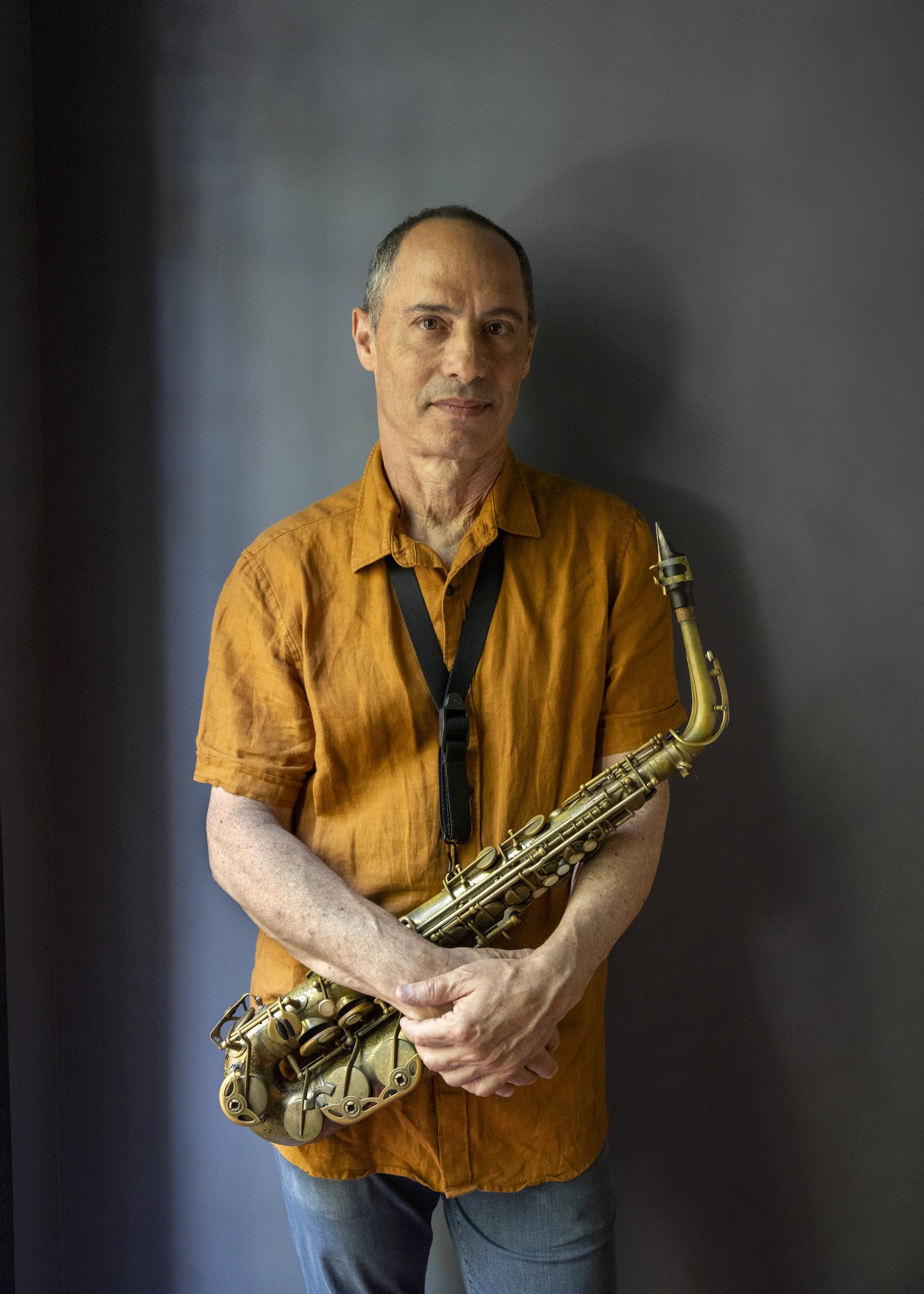


Ned Rothenberg: Solo Improvisation in Bizarre Times
The veteran woodwind master joins the podcast to discuss 'Looms & Legends,' his approach to making "ugly and out of tune" multiphonics musically useful, and why curiosity remains essential to both artistic practice and human empathy.


Today, The Tonearm's needle lands on composer and improviser Ned Rothenberg.
Ned just released his first solo album in thirteen years, Looms & Legends, and it shows why he’s been called America’s most intimate composer and improviser. Ned’s improvisations and compositions showcase his use of extended techniques such as circular breathing and multiphonics, while others tell stories through melody. He calls it music for an imaginary culture—sounds that feel indigenous to a place that doesn’t exist yet.
Ned shared his views on the nature of experimental music, the role of art in society, the importance of personal artistic expression, and his interest in exploring what goes on between jazz musicians during the act of creation. And this summary barely scratches the surface.
(The musical excerpts heard in the interview are from Ned Rothenberg’s album Looms & Legends)
Dig Deeper
• Visit Ned Rothenberg at nedrothenberg.com and follow him on Instagram, Facebook, and Bandcamp
• Purchase Ned Rothenberg’s Looms & Legends from Pyroclastic Records, Bandcamp, or Qobuz and listen on your streaming platform of choice
• Ned Rothenberg - Extended Biography
Record Label:
• Pyroclastic Records - Founded by pianist Kris Davis in 2016
• Pyroclastic Records on Bandcamp
Educational Institutions:
• Oberlin Conservatory of Music - Where Rothenberg studied
• The New School College of Performing Arts - Where Rothenberg teaches
Influences and Mentors:
• Evan Parker - British saxophonist and free improvisation pioneer
• Anthony Braxton - Multi-instrumentalist and composer
• Anthony Braxton - For Alto - Landmark 1969 solo saxophone album
• Thelonious Monk - Pianist and composer
John Zorn and Tzadik Records:
• Tzadik Records - Founded by John Zorn in 1995
• Tzadik Records discography
Collaborators and Ensembles:
• Sync - Rothenberg’s trio with Jerome Harris (guitars) and Samir Chatterjee (tabla)
• Double Band - Rothenberg ensemble from the 1980s-90s
• Power Lines - Rothenberg ensemble, album picked as one of NY Times’ top 10 CDs of 1995
• Crossings 4 - Rothenberg’s quartet with Sylvie Courvoisier, Mary Halvorson, and Tomas Fujiwara
• Paul Dresher - Composer and collaborator on Opposites Attract
• Marc Ribot - Guitarist and collaborator
• Sainkho Namchylak - Tuvan vocalist, toured with Rothenberg in the 1990s
Key Concepts and Techniques:
• Circular breathing - Extended technique allowing continuous sound production
• Multiphonics - Playing multiple notes simultaneously on a wind instrument
• Microtonal music - Music using intervals smaller than the semitones of equal temperament
• Future primitivism - Rothenberg’s aesthetic philosophy combining advanced techniques with fundamental musical elements
• Shakuhachi - Japanese bamboo flute that Rothenberg studied and performs
Notable Albums:
• Looms & Legends (Pyroclastic Records, 2025) - Rothenberg’s latest solo album
• World of Odd Harmonics (Tzadik, 2013) - Previous solo clarinet album
• Inner Diaspora (Tzadik) - Features Sync with Mark Feldman and Erik Friedlander
• The Lumina Recordings - Retrospective reissue of Rothenberg’s 1981-85 solo recordings
• Opposites Attract (New World) - Collaboration with Paul Dresher
• Power Lines (New World, 1995) - Named one of NY Times’ top 10 CDs of 1995
Musical References:
• John Coltrane - Saxophonist and major influence
• Charlie Parker - Alto saxophonist
• Ornette Coleman - Saxophonist and composer (“Dancing in Your Head”)
• Frederic Rzewski - Composer of The People United Will Never Be Defeated
• Víctor Jara - Chilean folk singer
• Bob Dylan - Singer-songwriter
• Joni Mitchell - Singer-songwriter
• Pauline Oliveros - Composer and deep listening pioneer
Jazz Legends:
• Steve Lacy - Soprano saxophonist
• Duke Ellington - Pianist and bandleader
• Billy Strayhorn - Composer and arranger
• Art Tatum - Pianist
• Stevie Wonder - Singer and multi-instrumentalist
• Lester Young - Tenor saxophonist
• Coleman Hawkins - Tenor saxophonist
• Ben Webster - Tenor saxophonist
• Billie Holiday - Vocalist
• Art Blakey - Drummer
• Don Byas - Tenor saxophonist
Composers and Avant-Garde Artists:
• Johann Sebastian Bach - Baroque composer
• Wolfgang Amadeus Mozart - Classical composer
• Igor Stravinsky - 20th-century composer
• John Cage - Experimental composer
• Karlheinz Stockhausen - Electronic and avant-garde composer
• Harry Partch - Microtonal composer and instrument builder
• La Monte Young - Minimalist composer
• James Tenney - Composer and music theorist
• Joe Maneri - Microtonal saxophonist and theorist
• Olivier Messiaen - French composer
Additional Context:
• WKCR - Columbia University radio station that broadcasts 24-hour birthday marathons for jazz legends
• Kennedy Center - Washington, D.C. performance venue
• Village Vanguard - Historic New York City jazz club
• The Knitting Factory - New York venue for experimental music
• Association for the Advancement of Creative Musicians (AACM) - Chicago-based collective
• Levon Aronian - Chess grandmaster and friend of Rothenberg
Philosophical and Political Context:
• Future primitivism - Philosophy combining advanced techniques with fundamental, primitive musical elements
• Art in turbulent times - Rothenberg’s reflection on creating experimental music during political crisis
• Curiosity as essential practice - Rothenberg’s teaching philosophy and approach to life
• Music as spiritual survival - The role of art in maintaining humanity during difficult times
(This transcript has been lightly edited for clarity.)
Lawrence Peryer: I want to start with maybe the beginning of this project. Could you tell me a little bit about why now for a Ned unaccompanied solo record? It's been a while since you put something out as a solo project, and I'm curious what made the moment right.
Ned Rothenberg: I think in fact it was overdue. I mean, I've been doing—solo has been a significant area of my work since the early eighties. It was actually a key element in kind of creating my musical voice. I came to New York at the end of the seventies. I had a group, Bob Ostertag and Jim Katzen called Fall Mountain from which I came from Oberlin Conservatory to New York. We had some success, but for reasons that had nothing to do with problems in the group, health problems and Bob wanting to move on into politics at that point, the group disbanded and I was left at that time with choices between kind of commercial work, which I pursued, but also like, well, what was I going to do?
And I did a very intensive period of solo practice and made my first solo record in 1981. So there were three of them between 81 and 85. And in that period, I toured Europe. The first tour I did in Europe was with Anthony Braxton in 78. And then I went a couple times with Fall Mountain, but after that I'd had quite a flurry of work in the solo context from 81 to 85, put out three LPs at that time, and over the next however many years, there have been a number of solo records and solo tours.
Like one of my mentors, Evan Parker, I think it's pretty parallel in terms of—although he's a pure improviser in that the catholic British school of, "I only play open improvisation." Whereas my work is mixed. I mean, I've done all kinds of things, but the role of solo playing overall, I think, is pretty parallel in that there's a development of a personal musical language which starts from the solo context, because in the solo context you can use all sorts of timbres and sounds that wouldn't necessarily cut through if you had, say, a drummer playing with you or any kind of large ensemble.
And of course there have been intimate chamber settings where I can use this language as well because the people I am choosing to play with have transparent enough focus that we can each use this kind of language. And there's been various things going on since 2013, I guess, when I did the last record for John Zorn's label Tzadik. So yeah, I thought it was overdue. Maybe the exactly right time might've been a few years earlier, but better late than never.
Lawrence: Yeah, I think it speaks to sort of the prolific nature of a lot of your other work, right? Like, it's not like you're not working and it's not like you're not creating, just not in this context.
Ned: Yeah, but it's funny when you use the word prolific, I actually have been accused by various supporters of kind of not doing enough recording and there I'm very much a contrast to somebody like Evan or Steve Lacy or others who document everything. They—I fear I don't want to make a grandiose statement, but there's a certain finished quality that I want in a release. And of course you could argue that maybe I should get over that.
Given that the way music is consumed now, the sacred nature of the album in terms of its order, in terms of its production, for better or worse, people don't consume albums the way they used to. You know, I grew up in the age when I went down to the record store, I bought a new release by—could be anybody—say Charles Mingus and took it home, listened to it almost exclusively for a week over and over, and really absorbed it before I went down to the record store and bought another one, or maybe bought two or three.
Now we live in this age where everything is on the plate and everything, you know, it's like a meal that you could select anywhere in the table and all the music of the whole world is just sitting there all the time. It makes the album, as we shall say, as an artistic statement, much more diluted. But as an artist, I think you actually kind of have to still make it the same way because you can only start with yourself. You can't worry about all the other things that people are listening to.
Some people say the way to deal with that is just put out a lot of stuff all the time. Keep doing it. I—one of the reasons I guess I kind of submerge between the waves and then pop up again is because I've never been good at just keep churning it out. I have to have kind of a feeling of necessity to do something. Yeah, it slows me down a little, I think.
Lawrence: The first set of comments you've made here foreshadows a lot of what I want to explore in this conversation. There's a lot of strands that I want to pull at. But I think something I'm curious about is the framework or the construct for this record, Looms and Legends. And I'm wondering if you could explain and talk a little bit about, you know, what that means beyond just a title. What were you thinking about conceptually with looms and legends?
Ned: I should admit that the title kind of came—I did the recording and then I was like, so what's this called? But I realized there's a kind of interesting binary going on in my solo work where there are some pieces which are really about a sonic fabric where I am trying to overcome, we should say, the traditional role of the wind instrument, playing single notes, playing lines, through the personal sonic language I've developed to where there really is a kind of polyphonic approach and with techniques like circular breathing, it's not limited to the usual spacing and things can happen. I can create a sonic fabric.
That's looms, that's the idea of a fabric where I'm trying to put the listener into a certain world, much in the way that a solo piano, like Bach's solo prelude where it's just constant notes. But there's a movement of harmony. Of course, equal tempered harmony in Bach's case, my special strange microtonal relationships in mine, but where the listener is kind of in this environment where I'm not telling a direct narrative, I'm not telling a story and then contrasted to the other, some other pieces on the record, which really are, I am trying to tell a story.
And in this I am much more in terms of mentors following up—the first fellow I, as I say, went to Europe with was Anthony Braxton, who like in For Alto placed four record sides of all just narrative single note lines. And of course that is what these instruments were originally designed to do. So I am trying to—in some of the other pieces that you could make your own decisions of which pieces of which I think it's not so hard to tell—I am making melodic statements and, whether it be theme and variations or whatever it is, I'm taking you on a line. I'm kind of leading you down a path that's more direct as opposed to the other looms where I'm putting, I'm trying to put you on a landscape and kind of let you look around on your own.
However you may do that, you could focus on what's happening up high. You could focus on what's happening down low. You could focus on the general tone color. There's different kinds of foci in that. Whereas if you're playing a melodic line, there's a single element to focus on at a time.
Lawrence: As we always circle around and struggle with an articulation of some of these abstract musical ideas, I follow you. (laughter)
Ned: Good. Yeah.
Lawrence: You know, you've mentioned, you've alluded to this a couple of times now already, and it was something I was going to ask you about later, but I really want to understand more about this notion of your language and—I was framing it as vocabulary, but regardless of the word we settle on—the Ned behind the Ned playing, the Ned-ness of your playing. Talk to me a little bit about your use of extended techniques. You mentioned circular breathing. You talked a little bit about your sort of microtonal organization, multiphonics. I think what I'm most curious about is the exploration behind that, the development of that vocabulary. What was that about in you? Is it a curiosity? Is it a—what were you trying to do there? What wasn't enough with the instrument?
Ned: I don't want to ever claim that anything wasn't enough. That it's—Charlie Parker and John Coltrane certainly did enough with the instrument, but it is as an endeavor of a creative artist with an instrument. You are investigating all the things that are possible, and there are different approaches. Part of this maybe has to do with this period of about four or five years where I was very much practicing alone and I was also inspired, I should say, by two things.
One was working with electronics, which I did with Bob Ostertag and others that period, and wanting to transform the role that I could play. And this even goes back to jazz playing that I was doing. There's always this feeling of like the horn player. Okay, play the melody now. Now you have a solo. Now sit down, wait for the end, and you'll play the melody again. Or maybe you'll do some—the roles are very strict and yet I—and yes, I always had the feeling that the rhythm section players were having more fun because they were interacting through the whole period.
And then when playing with electronics, it's like, okay, I have this one sound that I make and they're going to make a million other—all these sounds that a synthesizer creates, especially analog synthesizers. I wanted to figure out a way to trade on the same platform that these—that both rhythm section players in jazz and sonic explorers in electronic music. I wanted to find ways that I could interact and expand my vocabulary that way.
I obviously didn't invent some—I didn't invent circular breathing. I didn't invent multiphonics. In fact, I'm very averse to saying I invented anything. I think it's a landmine in terms of—let me just say that I'm averse to saying I invented anything and I probably have invented a bunch of stuff. I don't care. What I'm most interested in is creating context because it's all about context, I should say, and I have people, students who come to me, oh, well, you know, I found these five multiphonics, you know, (imitates horn sounds) blah and multiphonics are a good example.
What are they by themselves? Well, they're mostly ugly and out of tune. That's what they mostly are. What makes them useful musically? To find context. How can you move into one? How can you move out? Wait, there's more than one sound happening. Do the sounds have to come in altogether, or can they be woven? Which back to the loom idea, can they be woven in and out so that you're actually using them as rhythmic devices rather than just out of tune harmonies? That's a key element to the way I work.
A good example is there's one instrument in every jazz band, rock band that's out of tune all the time. Do you know what it is? It's the drums. (laughter) The drums don't—they can't retune for every, you know, unless you're talking about like tabla and Indian music. They are using sounds as a device. They're not functioning in the harmony all the time. And the reason they can function is they keep time.
So for instance, if you take something like these basically out of tune ugly multiphonics, and you can make different parts of them pulsate in time in a fabric, then they don't function like a keyboard. They function more like the drums. They function more like a web that you can relate to things musically. So that's a different context of the same language, and that's the kind of facility that I'm pursuing and that I think that—I realize you have people who then they say, oh, well, that's really cool. Can you play a Bach two part invention on the saxophone? No, of course you can't. It's not designed for that. It does—the timbral and tonal realities are different.
So it's just like a—if a painter says, I'm going to paint, but I'm only going to use two colors and I'm going to blend them together. And certainly there's lots of examples in modern painting where people limit their palette, but then explore all the ways that they can combine a more limited set of colors. That's often what I'm doing and I'm still using the musical fundamentals of rhythm, melody. The melody may be a microtonal melody, and this is something where, you know, I can be actually a lot freer than somebody who's—as much as the equal tempered keyboard is a wonderful thing which so much great music has been done with. It is a cultural construct.
Working with this language that I've developed, I stepped back from that. I kind of—that's why in some ways the music, I think, is not more advanced, it's more primitive. Yeah. That in some kind of aesthetic ways. I use the analogy of trying to compose music that would sound like the music of an imaginary culture or imaginary land that, you know, never intersected with Western equal tempered classical music or the lineage that we're so familiar with.
Lawrence: Yeah. Yeah. I love the quote from you. I'd actually—it's something I'd written down, the indigenous sound of a country that hasn't been discovered yet.
Ned: Yeah, well, I mean, I've pursued that idea, not just in solo music. Paul Dresher and I made a record for New World years ago that with his loop system and a lot of these sounds, and it's a—it's the opposite of a solo record. There's all kinds of things going on, but we were—it's called Opposites Attract. It was done before Paula Abdul had a hit with the same name and yeah, it's—that's very much kind of what we were after is kind of an ethnic music of an imaginary ethnicity.
Lawrence: Was that like an organizing principle around the project? Was it something that it's like, all right, this is a statement of purpose we can work around?
Ned: I've never been as absolute on those kind of ideas that, you know, sometimes the descriptive idea—the description of something occurs afterwards. Certainly we had done some music for dance before we made that record. And yeah, just listening back to what we had done, we had this, oh wow. That sounds like some weird music from some weird place that doesn't actually exist. Yeah, and I think it's partly because we were working—one of the places where I think I'm distinct from a lot of people doing a lot of improvised music is that I am often wedded to pulse.
I really enjoy the—that the basic, when you start talking about a cultural music, usually goes back to dance in some form. And that dance can be, as Ornette said, dancing in your head. I love that. I'll always love that title. It could be dancing in your head, it could be literally dancing. Just because you are working in an area that is quote unquote experimental in terms of one aspect of the materials you're using doesn't mean everything has to be experimental. So often I try to mix things that might be very strange to people with things that might be familiar.
Lawrence: Yeah.
Ned: So that's the jumping off point. And in terms of a statement of purpose, sure, it relates. But I've never been much of a conceptualist, say, you know, like, I—this is, you know, I'm going to do all the things I can do with—another, if we get back to pitch and temperament and all that, you know, there is of course a whole wonderful school of modern microtonal music with people like James Tenney and La Monte Young, and, you know, well the original Harry Partch, where they are very exacting in almost scientific and dividing up the octave into as many parts as they want, and creating instruments that can be very accurate. Very minutely calculate the pitch of all the sounds and such.
But when you play a wind instrument, it's much more like the voice. It's much more like—Joe Maneri, who was a wonderful theoretician and saxophonist, developed a scale for saxophone where he tried to do the Harry Partch thing of dividing it up into a lot of minute intervals, and he did that. But the thing that's very different is that as you change the pitch on a saxophone or a clarinet and you use alternate fingerings, you change the sound all the time. It's not just like hitting a marimba bar. Every time you go up or down and you close or open some keys, the sound is going, oh, the vowel is changing. The tone color is changing.
I'm not working with pitches in this scientific way. I'm really working at it like a singer. And in fact, I can't even maintain the same timbre as much as a singer can. Yeah. Because of both the mechanics of the instrument and the vowels that you have to use to get the sound to speak as you change the fingerings. As I'm doing all this esoteric stuff, I'm very often trying to ground it in something that people can relate to very directly, like an African bell pattern or, you know, a contrapuntal back and forth between two kinds of sounds.
So, you know, often very basic kinds of musical devices which can ground the work, ground this language and give it a context. I'm always talking about when I teach, I feel like context is everything in terms of what makes music work in a certain place and time and what makes the same kind of expression in the wrong context just seem like a strange curiosity. It's really we're talking about how does musicality function.
Lawrence: Yeah. There's something very universalist almost in the way you talk about using the multiphonics as pulse, and then you get in and that very quickly leads to rhythm and dance. And the way you talk about the horn and voice, these are the building blocks. And then you talk about giving the thing that the element for people to latch onto—that tells me it's something almost archetypal that you're searching for, that you're looking to express. Like these are things that go beyond or transcend the cultural context.
Ned: That's—that sounds very ambitious and (laughter) I—yeah, I hope it's true. Like I say, I'm not one to blow my own horn and say, you know, what I'm doing is the most revolutionary thing ever. I think what it is, is it's very personal and if I was going to make the most modest statement I could make, it would be that anybody who knows my work knows it in three notes. And that, to be honest, is the thing that I most love about the musicians who are closest to my heart, you know, it was just Thelonious Monk's birthday and I was listening to WKCR, which does twenty-four hours of Monk. Yeah, he's archetypal. I mean, he almost can play a single note on the piano and you know who it is.
And that is—that whole thing of a musical voice is what I'm trying to pursue. However much—I don't think my music is for everyone. I think some people, for example, there are people whose hearing is just very set up around the equal tempered keyboard and that kind of harmony and, you know, they may not be able to get past the quote unquote out of tune-ness of it. Yeah. I do feel that I've succeeded in creating an identity where anybody who has heard me knows who—for better or worse knows who it is making the noise. (laughter)
Lawrence: Tell me a little bit about how the concept of future primitivism manifests in your work.
Ned: I mean, I think we have been discussing it. It is the whole thing of staying grounded in kind of the most direct kind of musical elements that we appreciate as children. I've always had a problem with the Western thing of the first instruments you hand children when they're four or five years old are violins. (laughter) I love the violin, but give kids a drum, give them a mallet instrument. Give them something that they can bang and make—two sticks, make some noise. Don't give them something that is so hard to make a nice sound on and so hard to play in tune and so hard to play with each other. Yeah.
Then to take it back to my music, even though I am doing some rarefied things on these instruments that take a lot of practice to do and a lot of practice to control. I'm trying to be very direct with them, whether it be a dance element or a vocal element or the key underlying dynamic, I think, in my music and most music, which is tension and release. So for instance, even though I'm not using that equal temper keyboard, I can still do a cadence. I can still do things where things build up and there's a kind of tension and then they release.
That might be by bringing two sounds that are beating against each other because they're out of tune, making a (articulates a rapid d-d-d-d sound) kind of sound and then resolving it just to a single tone that is relaxed. This kind of dynamic is something that's present in just all kinds of music. So yes, it's really this thing about developing a personal language which may be very exotic or strange to people, but grounding it in very basic musical fundamentals.
Lawrence: I asked you that question because for me, that philosophy comes from a much more of a—you know, I'm familiar with the term from like a sociopolitical context. John Zerzan, you know, the anarchists and the sort of—the—I don't know the right way to say it. I'm struggling for the vocabulary, but you know, the return, leaving the sort of industrialized agricultural construct that we find ourself in. And I'm curious, do those political thoughts resonate for you? Are you interested in that line of political theory and philosophy, or do you think about that? Or are you just so immersed in your art that your art is your politic?
Ned: I'm, especially these days, I'm very concerned with politics. But to turn it on its head, I have to admit that compared with many of my colleagues, I don't have any grand ideas about an esoteric piece of art making a huge political statement. There's a lot to unpack in what you just said. So, for instance, the first time I ever heard the term future primitive, I was out in San Francisco and I had just started to mess around with the Native American flute. And I had one that I built according to like, you know, I saw like where you put the holes and stuff. And I met this guy Darrell, and I have to tell you, I can't even remember Darrell's last name, but he had like a street band called The Future Primitives.
And it was a bunch of hippies in San Francisco, it's 1976 and they're literally on the street banging pots and pans, tooting on bamboo flutes, and they had a great vibe. They were, you know, and I thought the whole thing of calling it Future Primitivism—I had never before that time read any kind of academic journals about Future Primitivism. I thought, oh wow. What a great name for what they're doing. I've since then heard a little bit about what you're talking about, but I've never—I think because I do feel that the—I think I should say, I'm not one of these people that believes in high and low art, meaning that Bob Dylan singing with a guitar is just as great a thing to me as Stravinsky or Bach, you know, I mean, it's all expression.
And so when you start talking about politics and having a direct effect politically with art, I don't think you can actually do it without language. Because, I mean, meaning like English or whatever the language is. When I was in school, Frederic Rzewski came to Oberlin and he had just written this piece The People United Will Never Be Defeated based on this Chilean folk song that, you know, and it was a protest thing about Allende and the coup there. And we had this discussion, where, you know, he was trying to make a political statement with the piece. The piece was and is a very beautiful piece of theme and variation on this traditional song—or it was a Víctor Jara song. I can't—I'm not sure whether it was, but my point would be that in terms of like actually making a statement about Allende, he's not going to be able to compete with Víctor Jara who sat there with a guitar and just sang, this is what's happening. Or Dylan, or Joni Mitchell talking about the environment or whatever. I don't have—I would call them pretensions to, I'm not going to write a string quartet and make it about justice in Palestine or something. If you want to say something about that, say something about that.
Your line of thought is interesting just in terms of consciousness, just in terms of being aware, for instance, of my first statement of what is a social construct, what that we're just accepting as reality and what is the real case of like what sound is. So if you want to call that a political statement, meaning that I want to open music to all sound, something like Pauline Oliveros would've talked about. Yeah. I'm very much down with that. Whether that's—I don't believe it's going to bring peace on earth, though. I don't have a kind of New Age idea that, you know, I can say I'm doing my political homework by doing my art.
Lawrence: But at the same time, in the liner notes, you—there's the line, you ask, how and why do we continue to make art in this bizarre time? The bizarre time can be interpreted lots of different ways, the political time, the technological time, the—I mean, there's no lack of bizarre.
Ned: Well, I will tell you something, and I hope Kris Davis, who runs Pyroclastic won't be upset, but the original liner notes that I wrote were much more militant because I do feel that this—it's not just any kind of bizarre time. We're—I think we're in a time of fascism and so the idea of what are you doing messing around with clarinet key clicks relating to, you know, what does that mean when you should be out on the street like screaming at the top of your lungs or something? I mean, horrible stuff is happening.
And what I came up with is that we do need to keep sane through all this. And so I don't have this idea of the artist as some kind of leader in the struggle. I do believe that we need art to stay sane. I believe we need art to keep our spiritual core together. And in this case, I can use the word spirit divorced from deity or if you believe in a deity, great. If you don't—from everywhere from Messiaen to, you know, there are composers who have fallen all along that spectrum.
But yeah, people need to keep their souls together. And I do—if I have any belief in the power of music and art, I think it does do that. It helps you find what you love and the things that you love, whether they be people or forms of expression, help you know who you are and keep you centered in a time when in this case, waves of caustic abuse are coming at you. And that is the most that I can claim for it.
But it's also—I think I'm clear in those liner notes, I'm trying to justify myself because I, as much as I might not believe that music has a direct—this, that this kind of music has a direct political role to play, I do believe that the tree in the forest falling when nobody's around doesn't make a difference. I'm—you know?
Lawrence: Yes.
Ned: I am trying to have an effect and this is what I can claim for what I'm doing.
Lawrence: If you don't mind sitting with me for a minute in that topic, I think it's actually—it's very interesting to me because obviously like a lot of people, I think a lot about like, what can I do? What should I do? Like I sit here and I talk to artists, what, you know, is that useful? And when it comes to justifying, I'm so glad you used the word justifying because it doesn't necessarily have negative connotations to me. You know, it's—I've been thinking a lot about it as sense making. Maybe I can make this argument and you don't want to, or you can't, but I would argue that musicians and artists who are working in these—let's pick some awkward words, boundary pushing, exploratory, experimental, whatever we want to call those realms. I feel that there's a radical, subversive nature to the music, because it's not regimented, because it is searching, boundaryless in a way that it's soothing, it's a refuge, but I find it also incredibly motivational. It's like I want to create and live in a world where what you do is heard. I don't want to live in a world where—as much as I love a 4/4 pop song that's over in two and a half minutes as much as the next person. I don't want to have only that. And I certainly don't want to have only military marches.
Ned: (laughter) Yeah. Well, I mean, yeah, you don't want to have only the—the only thing at the Kennedy Center now is the Glenn Miller Orchestra. You know, like, yeah. But no, I appreciate what you're saying. And as a listener, as a fellow listener with you, I can agree with you. I have to say as an artist, there are a few—there's one thing you said that I don't know whether I want to call it naive or whatever, but the idea of it being boundaryless, I don't think human beings can be boundaryless. We create just by our—there's this thing with music, and this is something that I talk to students about all the time that we're trying to be Mozart. We're all going to be—we can do anything.
And there are these Titan kind of musicians like Mozart or Stevie Wonder who like, seemingly can absolutely do anything. But in fact, even with somebody like Stevie Wonder, the reason we know it's him immediately is because there's something—there's all those things that he's not. He is completely himself. And so while the endeavor of exploring, as you say, is a very worthy one, one of the things that I think makes an artist more realized than another artist is they know what their limitations are and they know how to work within them. And there is actually huge strength in not just knowing what you can do, but knowing what you don't do. Yeah, that's fair.
You know, there is all kinds of music that I love that I'm not equipped to because I would never call myself a complete musician. I've only met or heard of about five in history. Stevie Wonder and Mozart might be two of them. Bach would be another one. Duke Ellington unbelievable, but like, you know, not really an instrumentalist on the level of an Art Tatum or something. So there's always—everyone has their limitations. Duke Ellington became realized partly by meeting Billy Strayhorn. The most Titan level musicians are not boundaryless and there is nothing—this idea that you can be infinitely expansive, and just be looking out. I don't know. I think one of the key things about realized artists is they can look in, they can see what they are.
And that's a very personal thing. And how that communicates to the listener, like to you, is then a personal thing for them. I don't have any sense—this may be where it's something very interesting in doing more, quote unquote abstract music. One of the things I love is the huge range of reactions that listeners have. Yeah. All the way from these—the nerdy—actually the least interesting to me are the nerdy guys who go, oh, you know, you used the drummer with that thing on that reed and oh, isn't that, you know, that was what, you know, Evan Parker does this and blah, blah, blah. You know? Whereas somebody else comes up and goes, I felt like I was sitting under a waterfall and a cat came out and sat on my head. You know, I love that. But it could be—it could be anything.
That's where I feel like this kind of music—however you want to call what I do—has maybe more of the boundaryless quality. It's for the listener. If Bob Dylan comes out and sings "The Times They Are a-Changin'," the listener knows pretty much what they're supposed to learn from that, because he's telling them, and it's right—here it is, you know? Yeah. If I come out, you might have any kind of experience, from hating it to loving it, but like I can't even tell you what the context of your reaction will be. I can't dictate that.
Lawrence: Yeah, I'm really grateful that you've sort of latched onto the clumsiness of my inarticulation there, because that I think, first of all, I take the feedback, but also, your example of Bob Dylan, like, especially early in his career, his voice was so effective because he was within an idiom. He was transmitting within an idiom that was appropriate for—but also it was limited enough that he could function within its limitations. But it was actually—the container was just big enough that it could accommodate him as well. He could spill over it, but it was the right vessel for him at that time. I wanted to ask you about audience and how they fit into your brain when you're creating. And I feel like you've answered the question, but I'd like to come at it again and just—I'm curious, do you ever think about how an individual piece or a full work is going to land? Do you think about audience ever?
Ned: The answer is yes. I only can take care of what I can take care of. And in terms of that aspect, the way I deal with that is by recording and listening to myself.
Lawrence: Mm-hmm.
Ned: And then trying to get the imp on your shoulder who's like, oh yeah, I've heard that before. You know, trying to step back and saying, okay, what does this sound like? I don't find if I sit there and analyze what I'm doing while I'm playing, it's not the best concert. You know, we all talk about being in the moment and there's no question, and I think it's true whether you're playing through-composed music or improv, free improvisation. In fact, through-composed can be even worse if you're sitting there playing some Chopin masterwork, and you're sitting there going, oh, well, oh boy, I didn't play that triplet right. I didn't, you know, you're—it's going to fall apart.
Lawrence: Or if it's not landing, you don't have anywhere else to go. At least if you're improvising and you've—you're getting some audience signal, you're like, maybe I need to kick it up a little. (laughter)
Ned: Yeah. Well, or as Don Byas said, you can always make the wrong note sound right with the next note. Which is a great thing about all kinds of improvisation because that has perils that go past just—because you're helping to create the context with the next note.
Lawrence: Yeah.
Ned: But yes, to the degree that I can step back and there are kind of exercises, whether it be doing Tai chi or whatever things that I do to try to be able so that I can listen to my music not just as the guy who makes it, but a little bit as a knowledgeable audience person, but that's a certain exercise which different musicians do to different extent. I know people who never just—they never want to listen to themselves. That's like they make a record and they never listen to it again.
I do still listen to my old records and one of the things that I actually like about, for instance, shuffle mode, is that I don't always use it, but, you know, especially when I'm driving and certain kinds of things, I love hearing a piece of mine pop up after a bunch of other music that I like and sometimes that really shows me a different kind of context. And sometimes something stands up more than I thought it would, and sometimes it doesn't. I do various things to try to identify the audience experience, but I should also say you can only do that to whatever extent, to a limited extent.
And I also don't have any illusions that my music, you know, it's funny, going back to like my first records, there were some critics who at the time I was annoyed by, but a couple people said things like, you know, really this stuff is pretty amazing. But it'll never reach a wide audience. One guy said, I don't know if this will ever reach a wide audience, but it'll keep weirdos like me up late at night sometimes. You know, that's what he said. And I felt, oh, is that just dismissive? Or, you know…
Lawrence: Or is it exactly right? (laughter)
Ned: Yeah. Yeah. Was it, and—no, I don't—I don't have any illusion that what I'm doing is going to operate on the same level as a Bob Dylan or a Stevie Wonder. It's—you know, I could describe so many ways in which it doesn't engage on the levels that that music does. I do think it engages as art music, and I do think it actually—I do utilize, as I said before, some very basic kind of musical grounding in the musical context. I try to give it so that I find that a lot of people who really say to me things like, boy, I've never heard anything like what you're doing, but it really speaks to me and, you know, and if one person says that to you, that has to kind of be enough to float your boat, because if you're sitting there just chasing the larger audience all the time, I don't know.
I mean, obviously I'm sitting here talking to you and I'm hoping that people will check out your work and find out about my work through this. So I'm hardly trying to stay obscure, but I also don't chase notoriety. I've had my chance to work with some famous people and some of the people I was very impressed with and somewhat less impressed by. And there's people who—I have a close friend who is one of the greatest chess players in history, Levon Aronian. And he's a real music fan, and we talk about this because in chess, of course, if you are a great player, people are going to find you because you play each other and there's a dynamic of it and he goes, but it's amazing in music. I find out about people all the time I've never heard of who are just incredible and nobody knows about it. And I go, yeah, because you know what? It's not a sport.
And one of the terrible things about the internet and we've said there's good things and there's bad things, is that you put on YouTube. And there are people listening to like the classic Billie Holiday track with Lester Young and Ben Webster and Coleman Hawkins all there. And there are people going, oh, talking about the three of them, like they're boxers and who got over on who, when you're talking about—you were talking about deep artists here and the sports model for—which was unfortunately, you know, with the whole idea of the tenor battle or something like that. I've always abhorred that stuff because it really isn't what music is about. It really is not a sport. Yeah.
And that's a wonderful thing because you are going to discover somebody that you never heard of tomorrow. And it's funny because we're doing this interview because I, you know, I have a new record and I get stuff from various things where they say, you know, what's your top ten? Can you name your top ten records released this year? It seems out of context for me because I'm discovering new stuff all the time. Some of it might be sixty, seventy years old, and I want to say, have you heard—yeah. This Don Byas record with the fado singer?
What I—if I was—if I was going to run a music magazine, I wouldn't have musicians list their top tens, I would say what are the top ten things you discovered this year that you'd never heard before that people—yeah. Don't know. And it never ends. It never ends. It's not like there are only so many heavyweight champions, so you can sit there and go through all the fights and say, well, this guy hit this guy, this guy hit that guy. But no, music—that's not music. Lester Young and Coleman Hawkins weren't heavyweight boxers hitting each other in the chin. They were creating a world together. That is a really beautiful thing.
And even now you just, you know, you discover things you want to check out. I had a little back and forth with the pianist, Benny Green. We were talking about Monk and I was listening to the early Monk stuff because it was his birthday with Art Blakey, who Benny played with. And I said, did Benny ever talk to you—I mean, did Blakey ever talk to you about playing with Monk and whether he developed some of his stuff from that? And he goes, oh, well they were contemporary. So they were both coming up in the forties. And I'm like, now I have to go back and listen to Art Blakey with Fletcher Henderson and these people and see if he was already doing those things or whether he got them. That's something interesting to me. Now I'm getting into music nerdism, but that's so much more interesting, I'm sorry, than sports nerdism, which is an obsession of ninety-nine percent of the country. (laughter)
Lawrence: Yeah, I know you—you know, there's a—I know our time together is winding down, but there is a couple of things you mentioned there that are fascinating to me, and one is I also get asked to do the lists and the submissions and what I—the one thing I appreciate about those is the ones that allow me to submit what I want to submit without ranking it. I won't rank, I won't give you one through ten. I'll give you ten if you want ten, good. Good for you. But it seems so antithetical to art, to actually rank it, because even if I could do that, it's only today's ranking. It's only today's ranking. It's only the last hour.
Ned: Wait. And it's so much of it is apples and oranges. It's so much apples and oranges. Are you—you're going to sit there and say, yeah, Stevie Wonder is better than Mozart. Or, I mean, what? Come on. What? We're talking about a vast field. Where are you? Are you going to compare? You know, I don't know, Georgia O'Keeffe and Mark Rothko, they're doing two different things.
Lawrence: Yeah. I'm curious about the notion of curiosity. So much of what I bring to listening to you is you seem like a curious human. I wonder what are you curious about now? What are the next questions you're looking to answer musically?
Ned: Oh, wow. I just want to first say, that's a great question because we—going back to the political discussion, I think one of the things that, you know, everybody's talking about, people don't have empathy. People don't have sympathy. People don't have curiosity. Yeah. The whole thing of like, I know everything about the world and I'm right about it—what that shows is a lack of curiosity and lack of curiosity, I think, is a deadly, almost terminal illness.
Lawrence: It's the precursor element to empathy and sympathy. It really is.
Ned: Exactly. It comes first. Now, you're asking me personally. Certainly, I mean, I'm still—I mean, the wonderful thing about music is I'm still curious about music and as much as I may be somewhat accomplished, professional, and as much as I may teach when I do teach, and just as I said, I made an immodest statement that when you hear what I do, you can tell it's me. I do do something, I think, that is too rare. Which is that I'm interested not in just showing students what I do, but in helping them figure out what they love, what are they curious about? What questions can they ask? And so I try to—I try to kind of teach curiosity.
And then in my personal life, that's where being a musician is so great because music never ceases. The vastness of the ocean of music, there is always another island or cove or there's always another thing to discover. There's always something that's going to blow your mind that you've never heard of. And I feel like—yeah, I feel like people these days are—the only thing that seems to blow their minds is notoriety is like just, you know, like somebody doing something outrageous and getting a lot of publicity for it as opposed to somebody doing something really deep and interesting that you're just like, wow, what is this? What does he or she come up with? And something where you realize, wow, I have to do some work.
I mean, a perfect example which I'm involved in is kind of world music. You know, I've been looking at music from around the world and there's a lot of different kinds of world music that influences what I do. But—I'm trying to think what's the last thing—I knew about Georgian choral music, but I didn't really know about the choral music that is related to it in Armenia and throughout the Balkans. And, you know, I've—so I've heard some things in the past few weeks that like, just realized that that whole area of choral music is something that I have to check out, you know, and be ready to have my mind blown, and hear names that I've never heard, and find out about things that happened in history that I'm completely unaware of. And that's the thing that's exciting. And that's why—that's why the attack on curiosity, the attack on empathy and the attack on education that we're dealing with right now is so frightening.
Lawrence: Yeah. Insidious. Ned, thank you so much. Oh, so fun talking with you. Thank you. Thank you. I really appreciate your time and yeah. Oh, I love the record. I love the record. It's been such a joy spending time with it in preparation for our time together, so thank you.
Ned: Oh, well, thanks so much.
Lawrence: By the way, if somebody had told me in my conversation I was going to get a Paula Abdul name check, I would've… (laughter)
Ned: I—yeah. One thing that people I think do get surprised by me is they expect me to be some esoteric guy who like, doesn't even know who Paula Abdul is, but you know, I do. I do. And I love pop music. And I've played, you know, with pop musicians in Japan. I'd say, yeah. I mean, I can function to some degree in that world. My voice is not in that world, and so sometimes the—you know, I'm old enough that I've done a little bit of everything.