

 Apple Podcasts
 Spotify
 YouTube
 Amazon Music
 Castbox
 RSS Feed
 Overcast
 PocketCasts
 Nick Fraser: Still Screaming Into the Snare Drum
Toronto drummer Nick Fraser discusses 'Areas,' his long creative partnership with Kris Davis and Tony Malaby, and what committing to acoustic music costs when electronics define the contemporary sound.
Today, The Tonearm’s needle lands on Toronto drummer and composer Nick Fraser.
Nick Fraser is one of the most distinctive voices in Canadian improvised music. He has played with Anthony Braxton, Roscoe Mitchell, and William Parker, and has led projects that range from raw free jazz to something much harder to name.
His latest record, Areas, just dropped on Elastic Recordings. It’s a trio date with saxophonist Tony Malaby and pianist Kris Davis. Electroacoustic interludes by composer John Kameel Farah thread through the album, built from processed duo recordings of Fraser and Malaby. The album has weight and atmosphere in equal measure, and it’s unlike anything I’ve heard this year.
We talked about the making of Areas, what a long-term group actually sounds like from the inside, and where his music is headed.
(The musical excerpts heard in the interview are from Nick Fraser’s Areas)
Dig Deeper
• Visit Nick Fraser at nickfraserthedrummer.com and follow him on Instagram, Facebook, and YouTube
• Purchase or stream Areas at Bandcamp
• Elastic Recordings — the Toronto imprint releasing Areas
Collaborators on Areas:
• Kris Davis — pianist and composer; also visit her label Pyroclastic Records
• Tony Malaby — saxophonist and faculty at Berklee College of Music
• John Kameel Farah — Palestinian-Canadian composer and pianist; hear the Farahser duo album at Bandcamp
• Ben Monder — guitarist, who subbed for Davis at the Toronto album release concerts
Tribute and Influence: Brodie West:
• Brodie West — Toronto saxophonist and composer; “There Are Other Ways” is a tribute to his work
• Ways — Brodie West’s duo project with drummer Evan Cartwright, which the tribute track honors
Long-term Collaborations:
• Lina Allemano — Toronto/Berlin trumpeter and composer; Fraser has played in the Lina Allemano Four for twenty years
• Drumheller — Fraser’s decade-long cooperative group with Brodie West, Rob Clutton, Eric Chenaux, and Doug Tielli (2003–2013)
• Hamid Drake — Chicago drummer whom Fraser has been encouraging Brodie West to record with
• The Imaginary Brass Band — a trio featuring Fraser alongside Doug Tielli and Heather Saumer; recorded the song “Sketch 57”
Previous Trio Recordings:
• Zoning (2019, Astral Spirits)
• Too Many Continents (2015, Clean Feed)
Musical Reference:
• Olivier Messiaen, Quartet for the End of Time — Fraser drew on Messiaen’s harmonics when composing the title track “Area”
Toronto Scene and Organizations:
• Association of Improvising Musicians of Toronto (AIMToronto) — the nonprofit Fraser co-founded with Rob Clutton, Scott Thomson, Ken Aldcroft, and Joe Sorbara (now largely inactive; linked here is an academic roundtable with founding members)
• FACTOR — the Foundation Assisting Canadian Talent on Recordings; co-funded by the Canadian federal government and private radio broadcasters
• Nick Fraser at the University of Toronto Faculty of Music — where Fraser teaches
(This transcript has been lightly edited for clarity.)
Lawrence Peryer: I would love to start by asking you something about the beginning of the record itself—not only the decision to open the album with a piece you didn’t compose yourself, but the inclusion throughout the record of those various musical interludes. What’s that all about?
Nick Fraser: Sure. The last record I made was called Farahser, and it was a duo record I made with John Kameel Farah, who is a pianist and composer based mostly in Berlin, though he’s from the Toronto area. The record came out in 2024, but we had recorded a day of free-improvised piano and drum duos. In addition to being a pianist, John is also an electronic composer, and we just decided to take these recordings and craft some pieces out of them. I really loved that process and wanted to keep it going.
I recorded duos with Tony Malaby, the saxophonist, at the session for this record—duos of me playing the inside of the piano, scraping the harp of the piano with a drumstick, which creates this kind of whale sound. With the sustain pedal down, all the strings resonate and you get this giant reverb sound. I wanted to use them, but they didn’t feel quite complete as pieces. I guess we could have just put way more reverb on Tony’s saxophone so it would match the reverberation of the piano. But I thought somebody who knows more about electronic music might have different ideas and different strategies about how to transform them into something complete.
And John did. They’re quite different from the original improvisations. So I figured we’ll just use them. They’re scene setters, palate cleansers.
Lawrence: I think there are a couple of points on this record—and I noticed a little bit of a recurring theme as I was preparing—where there seems to be this reflecting or mirroring that other artists seem to get you to do in relation to your own music. I’ll dig into what I mean there a little more later so you can dispute my theory as we get further into it. (laughter) But I’m curious about your relationship with Farah and how working with an artist like that—someone doing something a little different from how you normally approach composition, performance, or production—gets you to think about your own music differently. Is there an intellectual element, or is this just about feel and vibe?
Nick: It’s about feel and vibe—it’s about variety, too. In the past I’ve made some electronic music; I used to experiment with very low-tech, four-track tape stuff. It’s not generally how I think about or imagine music these days, but I like it. So it’s refreshing to work with an artist who will have this kind of transformative effect on something that’s already been recorded.
There’s also this thing—and this might sound silly—where I feel like having a purely acoustic recording almost puts you in a stance as a purist or a classicist if you’re not using any electronics. Electronics just seem to be so prominent in all music today. Again, it’s not calculated, but it’s just something I noticed when I listened to the record. I thought, oh, right—these parts sound more contemporary, and these other things sound less contemporary, just by virtue of being purely acoustic.
Lawrence: That’s really interesting—as you were saying that, I was thinking that by not allowing some of these modern flourishes or new tools into the palette or the toolbox, you run the risk of almost making an unintentional statement. You come across as a purist or a classicist when it’s not necessarily what you mean.
Nick: Exactly. I think there’s a lot of territory to be mined with acoustic music and acoustic sounds, and I’m committed to jazz as acoustic music, particularly live. I’m not crazy about playing gigs where the drums are amplified and so on. I like smaller-scale work. But this isn’t a live performance—it’s a recording. You have the luxury of treating some of the things you’re working with.
It’s not just treatments, either. It’s transformation. If you heard the original improvisations that John was drawing from to make these electronic pieces, they don’t really sound anything like what we ended up with.
Lawrence: That’s neat.
Nick: Yeah.
Lawrence: It’s a cliché, but the studio really becomes another instrument, another collaborative tool. I love that. Is it safe to say—you talked earlier about intention, about what, if anything, you were setting out with this record—was there a statement of purpose, or how did it come to be that this music has such an atmospheric tone and direction? Is that something that unfolded as you were in it?
Nick: Not a statement of purpose. What I noticed was that this set of music I wrote for piano was harmonically a bit deeper compared to things I’ve written in the past—just more chords, and more complicated chords. The tune called “Area,” for instance, has some chords drawn from Messiaen’s Quartet for the End of Time. And even some of the titles that John came up with for his pieces have a slightly dystopian, post-apocalyptic feeling. The cover art, I think, is Rothko-esque. So it’s possible that because I wrote more harmony for this project than I have in the past, that gave me a certain atmospheric zone I was working in that I wanted to support with the electronic pieces. I’m not sure.
Lawrence: When you’re in the composition process, are you sitting down and saying, “I’m now composing a set of material for the trio”? When you talked about writing for the piano—were you composing for the piano, or were you composing for Kris Davis?
Nick: I think I’m more composing for the piano, but Kris is the person I want to have play it. She’s a phenomenal musician. What I love about her is that she uses the whole piano—she really uses the very bottom range and the very top range—so she’s perfect in a group like this where there’s no bass, because she really can fill out the sound. She’s also very structurally minded in terms of her improvising. I think she’s a really nice foil for Tony Malaby, because he has a sort of deconstructive energy—although he might push back on that. I can kind of just slide in between them.
I gave Kris a lot more to play than I gave Tony. Some of the pieces are essentially a piano part, and Tony’s part is sort of open. My part is open, too, but since I wrote the tune, I have an idea of how it’s supposed to go.
Lawrence: It’s somewhat infrequent that I get to speak with an artist who has had the luxury of keeping a group together—especially in jazz and creative music—to be able to return to the same home over a period of time. I’m always fascinated by what that allows. What’s possible, and what the three of you can do together—or what they could do with your compositions today—that maybe wasn’t possible ten years ago, or that you weren’t thinking about ten years ago.
Nick: I actually work with a fair number of long-term groups now. With Lina Allemano and her band the Lina Allemano Four, we recently celebrated our twentieth anniversary. I’m playing in a band called Peripheral Vision that’s been going on twenty years. There’s the quartet with Rob Clutton and Andrew Downing on bass and cello, which was together for a long time. And then there’s the trio with Kris. It’s true—we’ve been together for a long time, and we’ve known each other for longer than that. Though I want to say there hasn’t been a ton of activity in the ten or twelve years we’ve been playing.
Lawrence: Three records. Is it three?
Nick: This is the third record of the trio. We did a larger tour in 2019—we played some Canadian jazz festivals and out on the West Coast, in Seattle and so on.
But it goes back to the question of whether you’re writing for the piano or writing for Kris. The more we play together, the more I hear those things as the same. Writing for the piano is writing for Kris. The history of a group means you’re not actually starting at square one when you go to rehearse a piece—you might be starting at square 27. My friend Lina spends a lot of time in Berlin, but she still keeps her Canadian band together because we get to where she wants her music to be sometimes more quickly than other people might. When she writes, that sound is ingrained in her mind. So you’re not writing neutral music that can be played by anyone—it can be played by anyone, but it’ll be materially different when it is.
Lawrence: Do you think this trio—you mentioned it hasn’t been overworked—would you work it more, or do you think you’ve got the balance right? Is this the right balance for this music and these people?
Nick: Of course I’d always like to do it more, because I love playing with them. I find my energy as a bandleader pops up every few years. Every few years I decide, hey, I’ve got this record in mind, or I’ve got this book of music, and I’m going to try to find some people to play it with—or I’m going to see what Kris and Tony are up to, or try to get Tony up to Toronto and play with the quartet again.
I’ve got a new group called Special Topics—with some younger people here in Toronto: Max Stover, Kae Murphy, and Josh Cole—that has been scratching my bandleader itch for a while. But I also love collaborating with other people, so it’s really cyclical. Sometimes I’m focusing more on my own music, and sometimes I’m focusing more on Brodie West’s music, or Lina’s, or whoever’s.
Lawrence: I’m curious about the way your appreciation for Brodie West manifests in this record. I know there’s the one track—could you tell me a little about what Brodie West and his music mean to you?
Nick: Sure. He’s a close friend and a real inspiration as a composer and an artist. He’s thoroughly committed to doing his own thing, and I’m really happy to be part of that. I think he’s a great saxophone player and a great composer, with a highly personal approach that I’ve never come across in quite the same way anywhere else. You can say that about anyone, but his approach is such an amazing synthesis—and so personal—that I feel like nobody else comes close.
He loves rhythm, he loves drums. He has a band called Eucalyptus that has two drummers and a percussionist, and he has a band called the Brodie West Quintet that also has two drummers. He has a duo with Evan Cartwright called Ways, which is the one I pay tribute to on this record. He made a duo record and did a duo tour, and is close friends with Han Bennink. I’ve been encouraging him—he did a duo gig a number of years ago in Hamilton, Ontario with Hamid Drake, and I said, it’s your thing: you love drums, you have a duo with a drummer, there are two drummers in all your bands. You should just call Hamid up and make a duo record with him, because that was a great gig.
His focus on rhythm obviously gives me, as a drummer, a lot of room to play with. We did a gig on Valentine’s Day one year, and Josh Cole, a bass player, posted about it afterward. He said, “A love story between one man and the quintuplet.” There’s a lot of complex rhythmic music out there, and I feel like it often loses the folkloric element. Brodie’s music doesn’t do that. It’s very relational and folkloric—sort of about us as people and how we’re playing together, rather than about the concepts, if that makes sense. He might push back on that, though. He says it’s formalist—just about the rhythms.
Lawrence: That’s fascinating—that the same music can be both things depending on perception. One of the beauties of it.
Nick: Exactly.
Lawrence: What does it mean for a piece to devolve? What does that require of the musicians? Is that a direction they’re given? Is the composition dictating it? I’m so fascinated by that notion.
Nick: Well, let me ask you—do you feel like there are pieces on this record that devolve?
Lawrence: It depends on how you define it. There could be a dissolution into complete, out-and-free playing. There could be a dissolution to sparseness and ambience.
Nick: When you say “devolve,” to me it evokes something where some kind of focus has been lost—where things have fallen into something different from the intended outcome.
Lawrence: Interesting. So there’s almost a negative connotation—I’m picking up that it’s hitting you that way a little.
Nick: A little bit—but obviously that happens sometimes. For me, when I’m playing, I want to keep a kind of focus and an eye on the arc and the endpoint, and be patient. If something has, quote unquote, devolved into free ambient space, I’m still trying to maintain real focus on the details and not play in a general way—not be saying to myself, oh, I know what this rubato free space feels like. I don’t want to be defining it while I’m playing—I want to be listening for what it is and what I can turn it into, if that makes sense.
We just had a CD release concert in Toronto, and Kris unfortunately couldn’t make it. We ended up getting guitarist Ben Monder, whom I’d never played with before. He’s fantastic—there’s real patience and a real willingness to sit with something and develop it. My friend Michael Herring, Ben’s bass player, has this image of the parachute game—you know, when you’re a kid and everyone holds the edge of a parachute? He says everybody should be keeping their end of the parachute up. There should be no slack. Everybody should be focused on holding their spot and doing their thing to give the parachute integrity. I love that image in terms of playing music. And it’s true—sometimes we don’t have that, and we have to deal with it. Maybe that’s what’s happening when things devolve.
Lawrence: This is the mystical realm of creativity that’s fun to peek into. The piece I was thinking about was “Sketch 57.” Maybe another way to approach a similar line of inquiry is the relationship between what you write as a composer versus those places in a piece—or moments in a performance—where things are more undetermined. As a listener with passing knowledge, that’s where the parachute could go slack: you don’t know if it’s going to stay tight, and then what do you do when it doesn’t? You have to recover.
Nick: Exactly. That’s part of the drama of the music.
“Sketch 57” is ten minutes on the record, but the part I wrote is less than one minute. It’s a form. You could improvise on it as if it were a conventional jazz song form, but that’s not what we did. After we play the material, Kris starts improvising—she’s repeating some of the chords for longer than they’re written, then moving to others, putting in her own—and she’s playing as if it were a conventional song form, but she’s making up the form as she goes. Tony responds very well to that kind of thing. He’s not going to say, “What’s happening? Where are we?” (laughter)
But it doesn’t have to work out that way, either. I recorded that piece on a different album by a group called The Imaginary Brass Band. In that case, again, it was a long piece, but we played the material one time and then went into a very stylistic improvisation that was a complete departure from the energy of the written material. The question of whether you’re going to continue in the vein of the written thing or just discard it is always a very significant decision—and we didn’t decide. It just unfolded that way.
Lawrence: As part of the album release performances, did you perform that piece with Ben?
Nick: No.
Lawrence: Oh, interesting.
Nick: No, we just improvised. I didn’t know how this material was going to translate to guitar. I didn’t want to ask too much of him. In “Area,” some of those chords have about ten notes in them. There are only six strings on the guitar, and if anyone could do it, it would be Ben Monder—but I just didn’t want to have to figure out a way to translate the music to guitar. So we improvised, and it was quite different from the music on the record. But we were still selling the record. (laughter)
Lawrence: I love it. A little bait and switch there.
Nick: It was also my fiftieth birthday.
Lawrence: You reserve the right, then. It’s your day. Tell me a little about the Toronto community—it seems like there’s a lot going on in the creative music realm there.
Nick: I think so. I get to play with a lot of people I really like. The thing I like about Toronto is that there’s a sense in which everybody—maybe not everybody, but a lot of people—are doing lots of different things. I play a lot of conventional jazz gigs, and I played in a rock band called Deep Dark United for a number of years. I played percussion in a kind of West African banjo fusion project for a number of years. All these things coexist, and nobody feels like they need to specialize too much.
Someone like Ryan Driver writes songs; he has a band where he sings jazz ballads exclusively—he calls it psychedelic lounge music. He plays improvised music with Titanium Riot and with a band we have with Karen Ng and Lina called The Adjacence. He has a band called the Titillators, where he has invented his own instrument called the Street Sweeper Bristle Bass. None of these things conflict. Whereas in New York, I feel like people want to make themselves stand out by doing one thing—although that might be changing, because people seem more wide-ranging in their tastes and activities than maybe in the past.
There’s also the fact that in Canada we’re really lucky to have some arts funding that’s always under threat and waning, but still there. That kind of thing gives people some freedom to function outside of a capitalistic, market-driven frame.
Lawrence: Do you spend time writing grants and pursuing funding? Is that a part of your life and work?
Nick: Oh, yes. This particular record didn’t have any funding, but it wasn’t for lack of trying. Even popular music in Canada has infrastructure—there’s an organization called FACTOR, which stands for Foundation to Assist Canadian Talent on Records. It’s partially funded by the federal government and partially funded by Canadian radio broadcasters. They fund a lot of pop music. I haven’t had much luck with FACTOR. I’m only bringing it up to say that the arts infrastructure in Canada is heavily dependent on government funding, and I don’t know that I’d have much of a career if it weren’t for that.
Lawrence: It seems so civilized. (laughter) So simple and so civilized. Could you tell me a little about the Association of Improvising Musicians of Toronto?
Nick: Sure. It’s sort of defunct now, I guess—it still shows up in my bio. In the early 2000s, some young improvisers were looking to enter that infrastructure, to have a nonprofit organization that could apply for grants, put on concerts, and get people paid. It was myself, Rob Clutton, Scott Thomson—who is now the artistic director of the Victoriaville Festival, a creative music festival in rural Quebec—the late Ken Aldcroft, a guitarist, and Joe Sorbara, a drummer. Those were the founding members.
We just tried to put on concerts and elevate improvised music and creative music in the general Toronto scene. I don’t know that it worked, exactly. It educated me in terms of how to navigate some of the funding structures that exist in Canada and how to build on the existing infrastructure. But I don’t know that we necessarily accomplished what we set out to do.
Part of it was collaborating with international artists—we were able to collaborate with William Parker and with Anthony Braxton. After the organization dissolved, we were later able to do a large ensemble project with Roscoe Mitchell. It was very cool. It was a good way to approach festivals: we had Anthony Braxton on board, so what could we do? And it worked. We did a recording in 2007 or 2008 with a large ensemble conducted by Braxton, recorded live at the Guelph Jazz Festival.
Lawrence: It’s interesting—when I talk to musicians and artists who are part of collectives or nonprofits, whenever musicians band together in these ways, it reminds me of how subcultures and countercultures work. When you start to come together, you realize there are other people who do this weird thing you do, who are into this same thing. Even if it accomplished nothing else, that’s great—letting everybody know they’re not alone. There’s a motivating power in that.
Nick: Yeah, that’s true. That’s beautiful.
I recently talked with a drummer who told me there was a place called the Indigo Café that used to put on shows a long time ago—in the late 1990s. He said, “I walked in there, and you were just screaming into your snare drum, and I thought, wow—you can do that?” (laughter) He was just saying, thanks for that. Thanks for letting me know that you can just do stuff.
I love that. Sometimes I think about how this stuff happens. I also teach at the University of Toronto, which is its own kind of community building. The students overall are amazing, but sometimes I just want to shake them and say, just do something. Don’t think about it—just do it. I was a guest speaker at a friend’s philosophy of art class and talked about the history of the snare drum—how the snares were originally made from cat intestines that had been dried and stretched out, and how that made the drum louder and scarier for the military, because it projected further and indicated more of a threat. None of that would exist if people hadn’t just said, “Yo, let’s see what happens if we do this.” I feel like people should do that more. They should just try things.
Lawrence: I’m a big fan of “why not?”
Nick: It’s funny—you can’t always see your own house because you live in it. For one thing, I would say free improvisation is a kind of pillar for me. Even when I write tunes for improvisation, I don’t feel like I’m a capital-C Composer, where the work exists as a discrete item that could be played by anyone. When I look at this record we just put out alongside my very first record, Owls in Daylight from 1997, there are many ways in which they’re the same. There’s free improvising; there are pieces; there are some crude tape pieces on that early record that function as palate cleansers. There are sections where people are playing solo, sections where people are playing as a trio or duo—a lot of shifting orchestration. The tunes are sketches; they’re not very involved. They’re jumping-off points for free improvisation, but they’re specific.
There’s also a tension or paradox in jazz: people talk about finding your own voice, but they also talk about not doing the same thing all the time—about evolving. And I sometimes think those things are actually in conflict, because the things you like to do make up your artistic voice—those things are the content. I doubt I’m going to make a radical change and put out a pop record or a straight-ahead jazz record. I doubt that’s coming. Stranger things have happened.
Lawrence: So what happens in terms of—for lack of a better way to put it—a release cycle? You’ve composed the songs, reconvened the trio, put the music out into the world. Will the trio be able to perform at all, or do you immediately move on? What mode are you in now?
Nick: I would certainly perform. It’s complex right now—I don’t want to get too deep into it. When Tony was up here, he asked whether I was still going down to New York to play. Tony lives in Boston these days and teaches at Berklee. Going down to New York was something I would do periodically—once or twice a year—and I didn’t make a conscious decision to stop. But with recent developments in the world, it started to feel a little less welcoming and a little more difficult. Not because of the musicians and community in New York—people are great, they want to play, musicians are not the problem. But collaborating in a cross-border trio with two Americans just means something different than it did five years ago—which, boy, that’s too bad. I’m open to it.
There’s also the fact that Kris is a jazz star now. She’s been on the cover of DownBeat. She’s in Dave Holland’s band. She’s busy—it’s hard to nail her down. (laughter)
Lawrence: And she’s a mogul with the label, too.
Nick: Yes, exactly.
Lawrence: I saw her a couple of months ago with her trio. Something that stands out to me about Kris’s playing is that you get the history of her instrument—the modern history of it. She can play the blues, she can do the jazz thing, but you can hear everything through the Third Stream and modern composition. She’s a very modern-sounding musician—it’s just a full manifestation of the piano.
Nick: A twenty-first-century musician, for sure.
Lawrence: Really something else, Nick. Thank you.
Nick: Thank you.
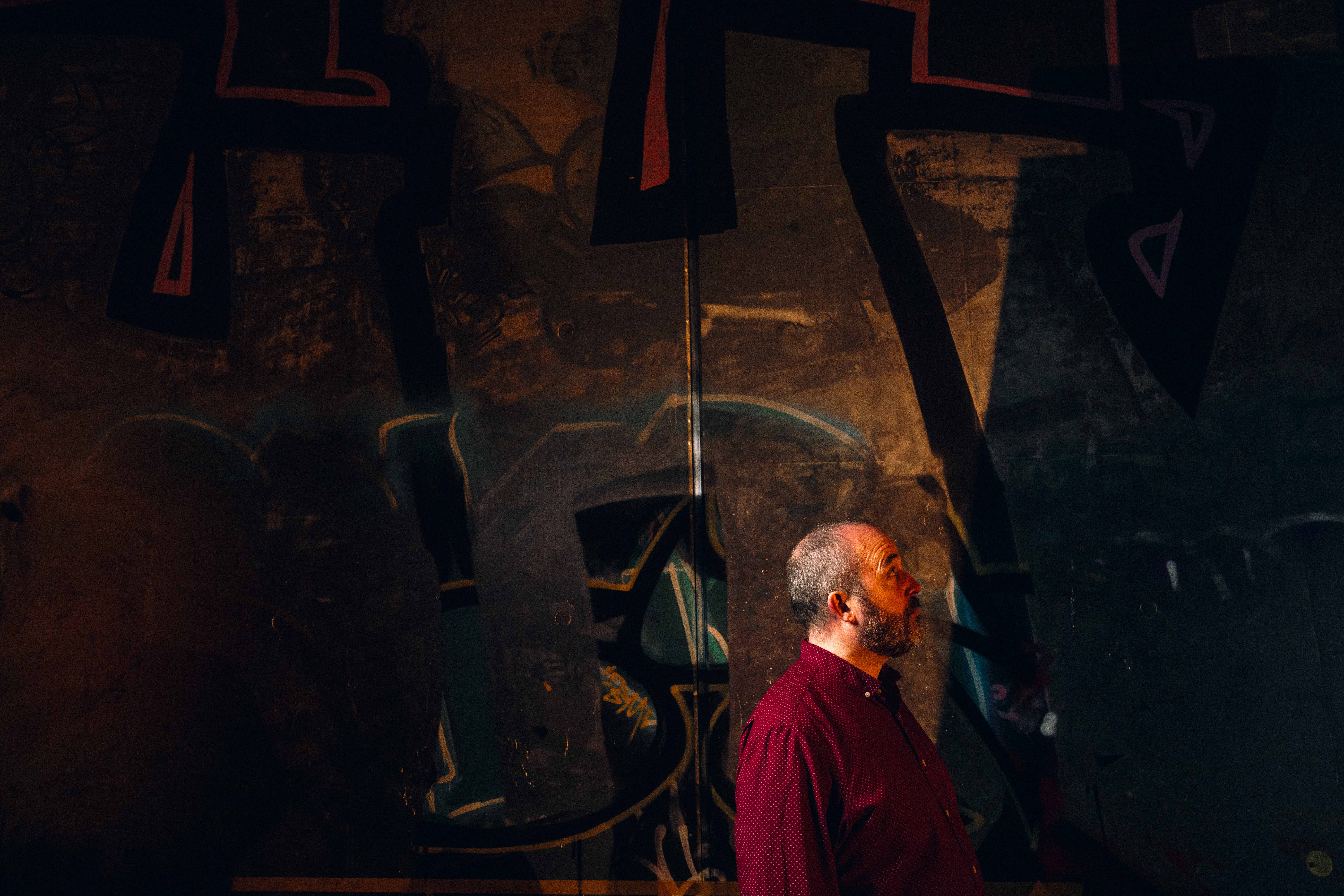
Drummer / Composer
Nick Fraser has been an active and engaging presence in Canadian music for 30 years. He has worked with a veritable “who’s who” of Canadian jazz and improvised music and with such international artists as Tony Malaby, Kris Davis, Marilyn Crispell, Anthony Braxton, and William Parker. Nick’s recorded works as a leader include Owls in Daylight (1997), Towns and Villages (2013), If There Were No Opposites (2021), and his new album, Areas (2026). For 10 years, he co-led the co-operative group Drumheller, who released four critically acclaimed recordings between 2005 and 2013. Other projects that occupy Nick regularly are the Florian Hoefner Trio, his duo with John Kameel Farah, Ugly Beauties, Peripheral Vision, the Lina Allemano Four, and Titanium Riot.
“Fraser not so much plays the drums as hurls himself whole body and soul against skin and metal… truly talented.” Bill Stunt, CBC Radio.
“The Toronto drummer is perhaps a little too progressive for the hidebound Canadian scene… Fraser is a deft and sensitive percussionist with a hint of an enigmatic streak, a feeling for economical gestures, and an innate sense of form.” Mark Miller, The Globe & Mail