


Sam Wenc: The Experimental Language of the Pedal Steel Guitar
The Philadelphia-based pedal steel player discusses ‘Language at an Angle’, his debut under his own name, and what Susan Alcorn taught him about tradition, freedom, and the instrument she loved.


Today we’re putting The Tonearm’s needle on guitarist and composer Sam Wenc.
Wenc is a Philadelphia-based artist who has spent nearly a decade building one of the more distinctive bodies of work in American experimental music, mostly under the name Post Moves.
Now he’s released his first album under his own name. It’s called Language at an Angle, and it came out on Lobby Art Editions in January. The record grew out of a year of live performances—from Philadelphia to Japan—and it captures Sam doing something specific with pedal steel guitar: striking it, bowing it, treating it as both a sound source and a physical object. The result sits somewhere between drone, jazz, and a kind of American folk music you can’t quite place.
Sam’s here to walk us through the record, his move to Philadelphia, and what it means to finally put his own name on the work.
(The musical excerpts heard in the interview are from Sam Wenc’s Language at an Angle)
Dig Deeper
• Visit Sam Wenc at samwenc.com and follow him on Instagram
• Purchase Sam Wenc’s album Language at an Angle from Bandcamp or Qobuz, and listen on your streaming platform of choice
• Lobby Art Editions — Sam Wenc’s label, releasing Language at an Angle and his previous catalog
Susan Alcorn:
• Susan Alcorn — official website of the pedal steel pioneer to whom Language at an Angle is dedicated
• And I Await the Resurrection of the Pedal Steel Guitar — Alcorn’s landmark 2007 solo album
• Susan Alcorn: Revolutionary Voice of the Pedal Steel Guitar — The Tonearm’s tribute, including a full conversation with Alcorn on her album CANTO
• Susan Alcorn obituary — WRTI
Collaborators:
• Sam Yulsman — pianist on Language at an Angle; studied with George Lewis at Columbia
• Bark Culture — the Philadelphia trio of Victor Vieira-Branco (vibraphone), John Moran (bass), and Joey Sullivan (drums); members appear in Wenc’s live band
• Victor Vieira-Branco — vibraphonist and Bark Culture leader
• Bark Culture — Warm Wisdom — the trio’s 2024 debut album
Venues:
• Roulette Intermedium — Brooklyn venue where Wenc held his album release show
• The Stone — New York experimental music venue referenced in the episode
Musical References and Influences:
• George Lewis — composer, trombonist, and Columbia University professor; Sam Yulsman trained with him
• Okkyung Lee — South Korean cellist and improviser; Wenc cites Alcorn’s improvisations with her as influential
• Marshall Allen / Sun Ra Arkestra — Marshall Allen, still active in Philadelphia’s Germantown neighborhood, is mentioned by Wenc as part of the city’s deep musical lineage
• Olivier Messiaen — composer whose work Susan Alcorn famously transposed for pedal steel
• Víctor Jara — Chilean singer-songwriter; Alcorn covered his songs
Additional Context:
• Mississippi Records — the independent archival label Wenc manages alongside his own music work
• Sam Wenc — Post Moves: Heart Music — released on Where to Now? Records, representative of his work under the Post Moves alias
(This transcript has been lightly edited for clarity.)
The Tonearm — Sam Wenc
Lawrence Peryer: I am curious to start with what made this the time to put out a record under your own name?
Sam Wenc: I've been thinking about that question—now that the album is out, it's having me reflect on it a bit more. I had recorded under the name Post Moves since about 2012. The origins of that name and the music I was making then was a songwriting project that eventually became a three-piece band. When I started to move into more solo-based work and more formless, experimental music, I decided to keep the name just because I liked it. People often mispronounce my last name, so I figured I'd just keep this moniker going.
But as time went on, I felt more distanced from it and wasn't quite sure why I was continuing to use the name. And then—was it last year or the year before—I released an album of songs, written on guitar, with vocals, lyrics, and all that. Something about that felt like a real closing of a loop. It had been about nine years since the last songs record, if you want to call it that. I was like, yeah, this just feels right—it goes back to its original form—and then I put it to rest.
There are practical things, too. It was always a little awkward when I'm primarily performing solo and introducing myself. I just want to say my name rather than—it makes it feel a little self-important when it's a project name, but it's just me.
Lawrence: What is the proper pronunciation of your last name?
Sam: It's pronounced "Wentz."
Lawrence: Wentz. I would not have gotten it. I'm usually pretty good, but I would not have gotten it.
Sam: It trips people up. I'm fine with it because most of my life it's been pronounced "Wink," so I've just adopted that as another adjustment to my last name. A couple generations ago it was Slosky—my Polish great-grandparents—and they cut it.
Lawrence: I was wondering if we're pronouncing it wrong or if you're spelling it wrong.
Sam: (laughter) It's funny—a few years ago, I guess before I moved to Philadelphia, the quarterback had the last name Wentz, spelled W-E-N-T-Z. So sometimes I've gotten: are you connected to the Philadelphia Eagles quarterback? And I said—
Lawrence: 500 years ago in the old country, maybe. (laughter)
Lawrence: Tell me about the genesis of Language at an Angle. My understanding was that it grew out of a bunch of live work—rather than have me guess, articulate it for me, if you don't mind.
Sam: I think an important thing to note about this album is that it's the first album I've done that is a total reflection of my live set. Prior albums had always been different studio improvisations, things that I wouldn't and couldn't perform live as a solo performer.
This set of music—it was becoming clear that it was a single piece of music. This is how I see it. I perform it as a single piece of music. When it came to recording it, there were these discrete movements of sorts that broke it up into eight tracks, but I see it as one unit.
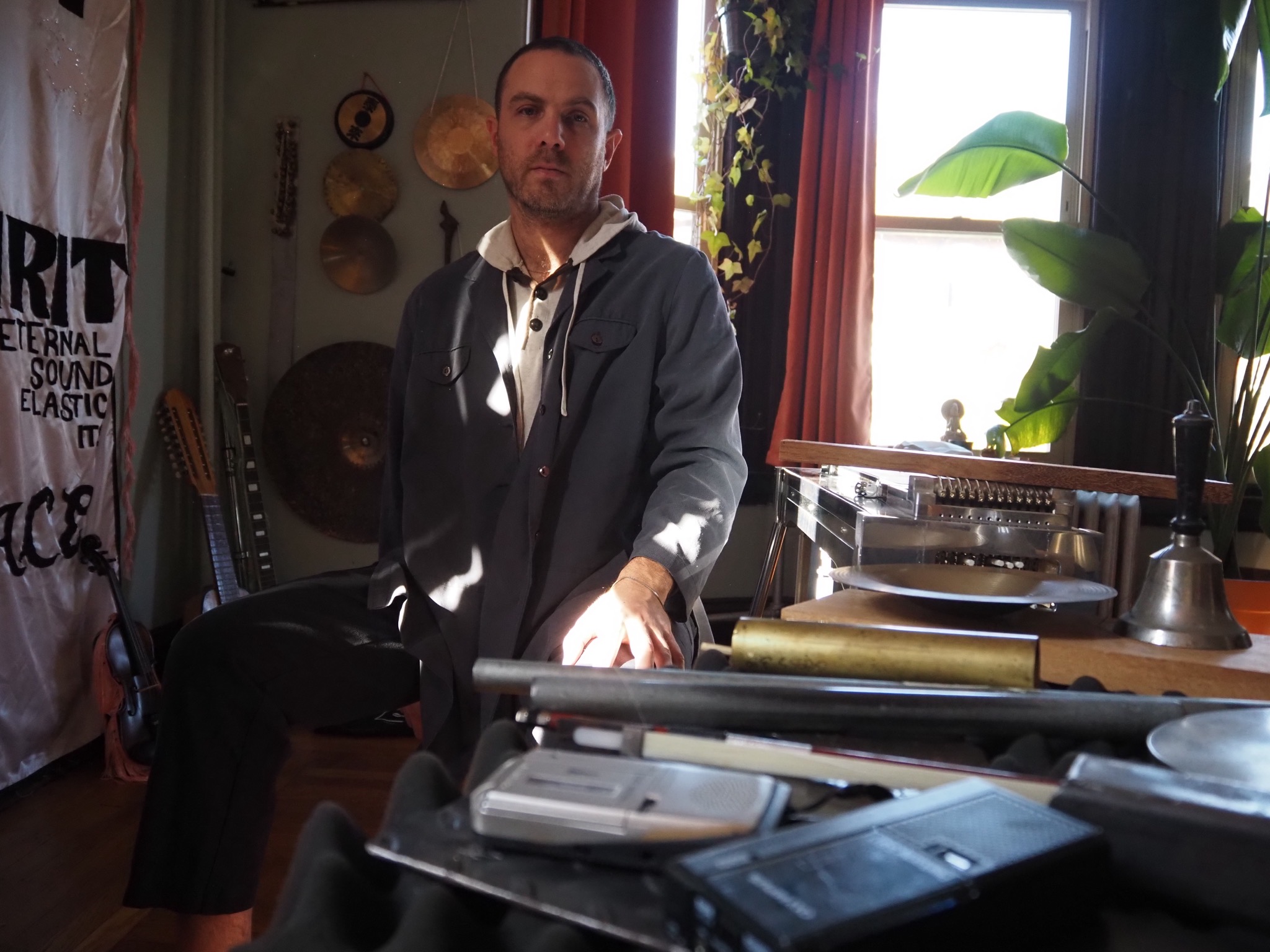
I think a lot of it also reflects the years I've been working with the pedal steel guitar—working with different approaches, different arrays of tools and modifications, things that would get at different harmonic potentials of the instrument. Often that comes about with metal pipes that I'm bowing across strings, or cymbals that I'm gyrating and creating friction, or balancing pieces of wood over the pickup and getting different textural things. That was becoming a language of sorts for how I was performing.
But I think it took time to figure out those tools and their compositional language—because at the end of the day, I'm curious about these sounds and the potential of harmonics and timbre and texture insofar as they serve some sort of larger compositional arc. I'll often use these tools in a prepared way in improv settings and just do improv things. For my own music, I really care about melody and things coming together. I think that was taking shape over live performances. I'd reflect after a show and write down what was working, what didn't work, down to really granular levels—when I am approaching—if I position my arm in such a way with this particular implement, I can get the circular feedback. Like on the first track, "Limitless of Blue," there's this kind of positive feedback cycle that occurs purely from the friction being caused by this inverted eight-inch cymbal that I'm rubbing against the strings. So you're getting both—the strings are vibrating, but then that vibration is turning into a positive feedback cycle, and you're getting a whole array of overtones, a complex and rich harmonic field. It just took time to know what was going on. It was a lot of distilling—oh, that's what's happening. Okay, now that I know what's happening, how does this fit into a composition?
Lawrence: Is the pedal steel particularly sturdy in terms of being able to work with it—extended techniques and other implements? Does it stay in tune? To ask you differently, what makes it so suited to extended techniques, manipulation, and abuse?
Sam: I remember a friend's dad came up to me after a show I played, and he had such concern on his face for the treatment of the guitar—kind of banging at it. But even though some of the movements and gestures can appear forceful, I see it as really intimate—a way of intimacy—my body working with the body of the guitar. That's something that really took shape through developing this album: really feeling an intimacy in a bodily way.
It became less about melodic content, if you will, of the material—it was born out of the physical approach, the physical, rather than "I'm going to pluck these notes and strings, because that's a pretty thing." The pedal steel—there's something about its horizontal nature. You step into it, you rest your legs under it, so you're almost embracing it. There are times where I'm really hunched over and almost in a bear-hug position with it. In the same way one can, with a piano, look down and see the whole fretboard laid out—there are so many voicings you can achieve, whether you're playing straight, with a slide, or if you place a block of wood up near the pickup and get this sort of crackly, destabilizing texture. If you put it down towards the neck, it gives a different feeling. The geography of the guitar becomes very alive and present, increasingly so over the years I've been playing, and that geography is pretty essential for me continuing forward.
Lawrence: The bodily relationship to the geography of the guitar—I'm really curious about that particular guitar as a compositional device or tool. You have experience performing and writing in other contexts, with a standard guitar or what have you. Can one sit at the pedal steel and compose the way you might at another chordal, harmonic instrument? Or is it really about the sonic worlds—I'm struggling to exactly articulate it, but could you talk about the guitar as a compositional tool?
Sam: I think it certainly can function like that. I think the greats certainly walked those lines—really approaching it in this compositional manner of charting out music and writing things. Obviously it's not an instrument that lives inside the canon, so sheet music and things like that aren't so inherent, but there are certainly players. Dave Easley—I think that's his name—is a pretty well-known jazz pedal steel player, so you can certainly see there's a real compositional intent going on there.
I think I've really appreciated just marveling at the mechanism of it, almost treating it like a machine. And that's not to be underemphasized—it's beautiful as this really intentionally built instrument. Looking at it as wood and metal parts, pulleys and levers—you flip up the underside of the pedal steel and it's got a whole system of levers and pedals. So I think it really can operate in both compositional approaches: Susan was transposing classical pieces for the pedal steel—Messiaen, and Coltrane's "Naima" she would transpose.
Lawrence: You don't think of it the way you think of sitting down on your bed and picking up a guitar and strumming. You can go sit at the piano and find a melody, block out chords—and I think it's partially driven by my ignorance of the instrument, but how does one approach the pedal steel as a compositional tool? Because it's not obvious to someone who doesn't spend time around one.
Sam: There are certainly—sometimes I will just sit and it will just be me with my traditional way of playing it with finger picks. You can make a whole 1-4-5 pattern without moving the slide. You're keeping the bar on a particular fret, and then you're engaging the foot pedals to bend notes, changing the chordal structure of it. So there are a lot of times I'll just sit and be like, I just want to play some pretty chords—which would be akin to picking up the guitar and strumming it.
Obviously it's more stationary—you're not really getting in bed with it. But I suppose you could try. (laughter)
But yeah, for as much as I love to unearth or deal in the rich, complex harmonic language or potential of the instrument, I just always will love this sweet, simple, saccharine sound of the pedal steel. It's just incredibly lyrical. All you need is one note—that just sustains, a little vibrato on the slide, and you melt.
Lawrence: It does sentimental really well.
Sam: It does. And I never want to—it's not about denigrating that or intentionally trying to get rid of that core sound. I want that present in the music as well. I just want to arrive at it perhaps from a different vantage point.
Lawrence: You've mentioned Susan Alcorn a couple of times now, and that mindset and approach to the instrument is very resonant of a lot of the things she said when I spoke with her a couple of years back.
Lawrence: She talked about the obvious way the instrument is—I think she referred to it as being tied at the hip of country music—and that traditional players of the instrument aren't really open to experimenting with it. It has a very traditionalist strand. Of course she could do that, but that's not what she did. I'm curious—did Susan free the instrument up for you, or were you already along those lines when you encountered her?
Sam: I think Susan in some ways reflects a really unique trajectory of, say, an instrumentalist who—she started and spent many, many years in the country-western scene. She has deep roots there. And I think a complex part of Susan's life was, for instance, her outspoken political leanings and how that was often at odds with the really conservative, fixed mindset of the players and musicians who occupied the country-western space and scene. That difference could be felt not just along obvious political lines, but even in relating to the pedal steel. There are those who are traditionalists who think anyone who does anything outside the realm of what the pedal steel should do is bastardizing the form—is blasphemous. And of course that's, in my eyes, a pretty abhorrent way to see things—abhorrent and unrealistic—to say that there's some demand upon any individual to conform to some tradition.
So her playing was always between those two things, because she still would play country things. And the last time I played with her, we played back to back. She came up to me afterwards and was saying nice things about what I was doing, but also making sure she said: don't skip over the old thing—the traditional music, the original forms. There's a lot of gold to be found there. Not that you're getting too far—but just rounding out your relationship with this instrument. And she was saying something else there, too, about how you're not supposed to sequester yourself in a bubble and live in a particular community and only be around people who have the same thoughts and feelings and beliefs as you. You'd be living in an illusory state. We live side by side with people that we have stark disagreements with about how we would live a life.
That's what I heard in how she conducted herself. There aren't many people who could go play a country-western gig and then go play a Berlin jazz festival and then go play some improv gig in New York at The Stone. She lived in all those spheres. When I got an awareness of her music, I was starting to break down what I'd been doing. I had been playing pedal steel for probably about four or five years at that point, and mostly I was doing—not country-western, but I was playing other people's projects: songwriters, folk, Americana stuff. Doing a lot of pads and just giving that pedal steel treatment. And then slowly—what if I put a lot of reverb on this? What if I used effect pedals to make an ambient soundscape? Oh, that's cool. But then it came to her music. That was like, oh—she painted such a rich and complex portrait of this instrument, the potential of it.
Seeing her—she had this YouTube channel where she would upload videos of her in her home, covering Messiaen pieces, doing original compositions, covering Victor Jara songs. It was all over the place: Astor Piazzolla tango pieces, and then I'd see an improv video of her with Okkyung Lee. It has to be said, too—[the pedal steel world is] incredibly dominated by men, by white men, and Susan being the forebear, I would argue, of this approach to the pedal steel as a woman—I just think enough can't be said about that, her defiant spirit—really someone with great integrity and humility. That always came across in the music.
Lawrence: There's a lot in there. Her comment to you—to not neglect or deny yourself the exposure or the education of what can be gleaned from the tradition—that reminds me a lot of, even in the more straight jazz world, this idea of really understanding where the music came from, the lineage, before you try to transcend it—or as part of your studies, integrating all of that and really knowing it. But there's also this idea that in the avant-garde, on the creative edge, there's a conservatism there, too, sometimes—equally as—I won't use the word you used because it's a strong one—but all those strands of purity tests are so unnecessary in music.
Sam: I agree. I have that when I'm performing in more improv spaces—I have this insecurity because I want to play some melody in there. I want to get a couple of pretty notes in the mix. And it's like, oh gosh, is this even allowed? And yeah, dogma ruins all. There you go.
And particularly in whatever you want to call it—free, out-improv, avant-garde—for there to be a purity test of sorts, how free is that? I get most interested—I'm most interested as a performer, particularly in live performance—with the notion of invitation. And invitation doesn't mean all soft, cuddly, non-threatening. The music and the artwork and the literature and all the things that I enjoy—I feel a challenge being presented by whoever it is, but I also feel like I can trust them. They're opening a space for me to enter, and they're not giving me the answers. There's some work required on my end, but that's the exchange—a space where it's safe to be uncomfortable, where it's safe to find yourself in different moments of doubt or uncertainty. But you'll also have this underlying sense of welcoming. I think that is my principal interest in music.
Lawrence: It's really funny—as you were saying that, I was thinking about times when I've seen music where it is—whatever the adjectives are—it could be dissonant, let's just say challenging. It's uncomfortable, and it might even be viscerally, somatically uncomfortable sometimes. And yet when you're engaged by that music, when it turns into "yeah, I like this feeling" or "this is exciting to be this outside my comfort zone"—that's a very special moment. When you can find the entertainment in that discomfort—and I'm going to stand by that word—that's really special.
Sam: The word that comes to mind for me, hearing that, is that it's a very alive moment. You feel very alive in those spaces and those moments. And it doesn't mean it's all easy, and it doesn't mean it's all hard—but it's like, I'm right here, I'm here with this thing, and this is a direct experience. As our culture increasingly descends into different modes of complacency and convenience—
Lawrence: Madness. (laughter)
Sam: Madness. But finding those spaces where you can feel alive—what are we doing if we're not doing that?
Lawrence: Where does the title of the album come from? Does it somehow relate to the music? Is it just a turn of phrase you like? Is there any significance you're interested in sharing?
Sam: When I come around to naming albums or track titles, there's a baked-in gut feeling—being discerning, but also not questioning too much, because then I'd be like, why call it anything?
I think I was thinking a lot around the notion of language and vocabulary, and I was thinking back to the earlier conversation about some of the processes I was using, tools and whatnot. It felt like I was developing a vocabulary, developing a language—attempts at language—always formulating and never quite arriving at a totally concretized idea. And then it got me thinking about—I also want this to coincide with the fact that a lot of the music is informed by, and even the track title is informed by, a long-standing meditation practice. A handful of the titles came out of a particularly long duration of sitting, which is also something that informs the title itself. When you do so much sitting on a cushion, staring at a wall with your eyes open, you are confronting so many habits of mind—the things that you think you have solidly codified about an experience, or about yourself, or about whatever it is—and then it's releasing from that grip and the grasping for a totally defined approach or outlook.
So from there, I feel like the notion of "at an angle" is coming into play. My mind is fixated—I'm looking at this thing one way, but maybe you look at it in other ways. The name was initially one of the track titles. After this long sitting period, I had jotted down about half of the track titles from that immediate experience after that meditation. Language at an Angle was one of them.
Lawrence: Something that's interesting about your musical biography—and you talked about it earlier—is this idea that you were in a band context that eventually evolved into a more solo context. Now on this record, put out under your own name, you reach out for certain collaborators.
Sometimes when you're in a band, especially if you're trying to be a band where it's a partnership and everybody gets to participate—they're not just there to execute the leader's vision—you have your palette to a certain extent. Certain bands can be experimental and can introduce new sounds, but those are your people that you're working with and composing around. Whereas when you're developing a project like this, there's something more intentional about it: I'm going to choose this person, I'm going to choose this collaborator. I'm curious if that resonates at all, and can you talk a little bit about the collaborators and your approach to collaboration on this project?
Sam: I think that's a really astute and spot-on way of looking at it. Often, even though I was doing—as Post Moves—whatever you want to call it, experimental music records, I would flesh them out. I'm playing drums and vibraphone and all these other things that I can hack my way through, but I'm not well-trained in that capacity.
I knew this record and this music—something about it came about at a time in my life where there was a real determination to bring in collaborators, some that I had long wanted to work with. I think of my friend Sam Yulsman. He came on my first ever tour in 2012, back with the indie rock band I was in in college. But Sam trained with George Lewis at Columbia—he's a musician, a pianist, but also a composer. He happened to move to Philadelphia in the last couple of years, just a little bit after I did. Having him perform on this record is really—I just know his sensitivity to sound and harmonic fields. I knew that his touch would bring out aspects of what was there: in the music there was space, a lot of space for someone to enter and expand from the foundation laid by the pedal steel composition.
I've had the real pleasure to bring together a band to perform this material. A couple weeks ago we did an album release show at Roulette in Brooklyn, and this Thursday we're doing another version of it in Philly. That includes some players who weren't on the record, but I knew they were players I had a similar feeling towards—Victor Vieira-Branco on vibraphone. He didn't play on the record, but he's playing in the live band and is just opening new potentials in the music. Joey Sullivan on drums—actually the live band has Victor, Joey on drums, and John Moran on bass, who have a trio themselves called Bark Culture, who are, I think, one of the best groups going in Philly or the Northeast in general. They have this language that they bring into this material and it just makes the music feel really alive.
Obviously it's fulfilling this compositional idea I've had. But I also love arriving at that moment, and think it's a necessary moment to let go—to finally say, okay, I've brought this horse to the water. Being discerning about the players, of course, but there's another way to have this vision articulated. I welcome the variations and the opening of new doors that I wouldn't be able to open myself.
Lawrence: Not to minimize anybody else's contribution, but I was glad you brought up Sam Yulsman, because the interplay with the piano seems to be really like a hallmark of this recording—an important part of this album.
Sam: I agree. He understood—similarly to how I was talking about my approach, some of the more extended things I do with the pedal steel—he would hear something and be like, oh yeah, this is not a place where I play a melodic line. I'm going to do harmonic overtones, with the piano open. I don't know another word for it other than sensitivity. Touch is really critical to this album—when it's really rough and jagged and gritty, that's just as important as these moments that are really tender and really soft and require a soft touch. I want all those living together.
Lawrence: It seems a little audacious that you chose to mix the record yourself. You spoke a moment ago about letting go when it comes to other collaborators, and I think of doing the mix yourself as the ultimate not-letting-go. (laughter)
Sam: Well, money's always tight, so there's that. There's a little bit of—yeah, I do the bulk of recording at home. You just start in on it and you're like, okay, I think I'm getting this. But I brought in John Dieterich to master it, who I think did a lot of really subtle and beautiful things to get it there.
But when it comes to mixing, there were other decisions I was making that are—maybe put more in the realm of sound design. I do want to—that's another articulation of what I'm interested in. Working with stereo imaging and different things: I'll take a bass clarinet line and run it through a micro-cassette recorder, then pitch that down 12 semitones, and all of a sudden the bass clarinet is this garbled mess of gritty, crunchy textures. And I want to put that in the back right ear at a low level. It just comes back to sensitivity—what kind of sound world could this be?
I'd love to let go of the mixing at some point. At the end of the day, I still have my controlling tendencies—my flaws. And you didn't even bring up the fact that I released it on my own label and did all of that. Maybe I'm just a total control freak.
Lawrence: The thing about mixing is—I did expect part of your answer would be about necessity or budget, but it's also one of those areas, especially with this type of music, where the music can really suffer if you get it wrong. Sometimes in rock music it can be charming when the mix is weird—it's part of the flavor of a song or an album. But with this more abstract, creative music, the mix can really make or break a record. And so you have to be careful. The way you described it is also how I've heard other artists talk about it: in this type of music, the mixing is very adjacent to the arrangement.
Sam: The arranging—yeah, it is part of the compositional process.
And I have my insecurities about my mixing. I just taught myself over the years. I don't know all the right plugins and all that, but I taught myself how to figure it out to the point where it works for me. When I send it to friends and say, "How does it sound—give me an honest opinion," I generally feel like I've arrived at a place that's okay, that's on the right path. But maybe at some point it'd be nice to let go at that stage—maybe it's dependent on the material.
Lawrence: Tell me a little bit about Philadelphia. It's such an intriguing city, being from the Northeast. I've spent some time there. It's a beautiful city. You mentioned Sam moved there. Is there something cooking there? Is there a scene developing? Did you walk into a scene? And before I let you answer, I'll also ask: do you think the change of place changed the music at all?
Sam: I don't want to—I can't claim to be a lifelong Philadelphian. I've been here three years, so my answers certainly don't sum up everything. Of course scenes were happening here. I think it often gets thought of as a rock town—a lot of bands, rock music, different clubs—and I think that holds true. I have a lot of friends in that kind of scene. It also has a crazy deep lineage. Marshall Allen still lives a few miles north of me and plays all the time. There's just a rich history of jazz and Black music here—
Lawrence: There was this little-known guy named John Coltrane, I think, that came from there? (laughter)
Sam: Just a little speck of dust in the history of music.
I played gigs down here before living here. I was in New York for about five years, and something I always appreciated here is that things can happen pretty quickly and easily. I can set up shows at bookstores within a month, a few weeks' notice, and bring in different kinds of artists on a bill that may not make sense to other people. I just always want to be in close, intimate spaces with people performing and seeing shows.
And obviously the pull of New York is intense. People who grew up here or spent time here can often find their way to New York as a real proving ground. But the inverse—I think it has this other effect. Much like I was talking about New Haven, too: people who are here, it can actually be a really intentional decision to say, no, this is the community I want to be around and foster. And there's a tremendous spirit here of people making art and music and culture, doing so in defiance of—I don't need New York to validate me. There's no big prize at the end of all this, and I think a work ethic comes along with that. People like the group Bark Culture—Victor, Joey, and John—they just hit it hard. They play every Tuesday night at this record bar, they tour, and they're in different bands. Joey plays in Florry, a folk-country-rock band.
It's hard to pinpoint Philadelphia as the reason this music came about in the way it came about, but it's also not not a reason. Something I definitely have here is cheaper rent and more space. That's a reality. I get to actually have a studio space in my home that I can go into and just play. I live on a quiet block, but in a city—so making noise is fine, as long as I'm not playing at 1:00 AM. All those little things are really important to feeling unencumbered in making the music. When I lived in New York, that was harder for me to achieve.
Lawrence: Yeah, I bet.
Sam: And it's continuing to evolve. Sam moved here, and there's a bunch of different—Chad Taylor moved here, this drummer, Mikel Patrick Avery, drummer—I think they both moved from Chicago. It is one of the last quasi-affordable cities—
Lawrence: Certainly on the Eastern Seaboard.
Sam: And at the same time, no place is perfect. We just had this crazy snowstorm—it's been two weeks since I've gotten my car out. It's like, all right.
Lawrence: I remember those. I lived in New York for about 20 years, and for the last couple of years I had a car in Brooklyn. I remember a snowstorm in particular where it was like, I don't know if I'm ever going to see my car again. What's going to be under there when this goes away? (laughter)
Lawrence: Before I let you go, one other quick question. Tell me about the live work you're going to be doing this spring and into the year as it unfolds. What's the program going to be? Do you go out and work this record? I buy a ticket, I show up—what do I see? Although I might ask you to put me on the list, but let's pretend I bought a ticket.
Sam: The show I did in New York at Roulette and this one coming up this week with a big band—I imagine those will be the only ones, though never say never. There could obviously be other opportunities, but I imagine that's probably the last real effort at presenting material in a large-ensemble manner. Essentially, for those to happen, I need to make sure there's a good enough paycheck to be able to pay eight people. So there's just a practicality, and then there's also getting everyone's schedules aligned for rehearsals.
I tentatively have a week-long Midwest tour coming in the first week of March. And then I actually have a couple shows in Mexico City in April. I think where things have gotten with my performances is that they don't really—I keep wanting to move into kind of boundaryless spaces. What you could reasonably expect is: you'd probably hear some of the material that's on the record, but it would change and move into a new, different space. That could be stuff I've been working on compositionally, or it could be just a hybrid improv-composition thing. I think those are the spaces I'm more and more interested in for performance—where I'm coming with 50 percent of a composed idea. I want to check those boxes and get into those spaces, but I also want to make sure I'm living in a performance space where I can make more improvisatory decisions.
composer
Sam Wenc is a composer, improviser, and interdisciplinary artist working with sound, text, performance and installation. He has released music on Longform Editions, Where to Now, Moone Records, Noumenal Loom, Sweet Wreath, and his own label Lobby Art Editions, amongst others. His work has been supported by Elektronmusikstudion (Stockholm, Sweden), Art OMI (Ghent, NY), Foundation for Contemporary Arts, Roulette Intermedium (NYC), Creative Alliance of Philadelphia, and has performed throughout the US, Canada, Peru, Mexico, and Japan.
He is co-founder of Lobby Art Editions, a record label that highlights and releases works by artists exploring boundaries of genre and media.