

 Apple Podcasts
 Spotify
 YouTube
 Amazon Music
 Castbox
 RSS Feed
 Overcast
 PocketCasts
 Steven Bernstein: The Trumpet's Blank Slate
The veteran trumpeter and arranger joins the podcast to discuss the twin albums 'ResoNation Trio' and 'Ultra Resonance,' Laurie Anderson's lesson that you never need permission to make art, and why this music dies if it stays in a museum.
This week we’re putting The Tonearm’s needle on trumpeter, composer, and bandleader Steven Bernstein.
Amongst his many activities, Steven leads Sexmob and the Millennial Territory Orchestra and serves as Laurie Anderson’s musical director. He’s out now with an entwined set of albums. ResoNation Trio pares him down to valve trumpet, bass, and drums with Scott Colley and Nasheet Waits. Ultra Resonance is producer Scotty Hard’s full reinvention of that same recording. We talk about why a trumpet trio gave him a blank slate, what Burning Spear has to do with Ultra Resonance, and what it means to still be playing Levon Helm’s music twenty-two years from when he started.
(The musical excerpts heard in the interview are from Steven Bernstein’s albums, ResoNation Trio and Ultra Resonance)
Dig Deeper
• Visit Steven Bernstein at stevenbernstein.net and browse his projects — including Sexmob and the Millennial Territory Orchestra
• Purchase ResoNation Trio and Ultra Resonance from Royal Potato Family, Bandcamp, or Qobuz, and listen on your streaming platform of choice
• Read the All About Jazz review.
The Trio and Collaborators:
• Scott Colley — bass
• Nasheet Waits — drums
• Scotty Hard — producer of Ultra Resonance
Bands, Projects, and Company Kept:
• Laurie Anderson with Sexmob, Let X=X (Live) on Nonesuch
• Levon Helm Studios and the Helm Family Midnight Ramble, Woodstock, NY
Musical Touchstones:
• Burning Spear, Garvey’s Ghost (1976) — the dub companion to Marcus Garvey that seeded the Ultra Resonance concept: Wikipedia · streaming
• Miles Davis, Panthalassa: The Music of Miles Davis 1969–1974, reconstructed by Bill Laswell — a precedent for reworking improvised recordings: Wikipedia · streaming
• Butch Morris, who gave Bernstein some of his earliest New York gigs, and his theory of Conduction
(This transcript has been lightly edited for clarity.)
Lawrence Peryer: You said that ResoNation Trio is a bit of a blank slate because of the paucity of trumpet trios. I hadn't really thought about that much before, but I would imagine there are some amazing opportunities in that you're not carrying a lot of the baggage of tradition.
Steven Bernstein: Exactly. I always would talk about the slide trumpet, and why I was so attracted to it was that there was no baggage. When you play an instrument like the trumpet, there's just so much stuff. Freddie Hubbard and Woody Shaw, and then Miles and Dizzy, and Kenny Dorham and Clifford Brown and Louis Armstrong. And of course, someone like me who loves history—all that stuff's in my ears. So with slide trumpet, I just felt completely free, like I could do whatever I want.
And now—this is, I'm almost sixty-five years old, and this is like the first trumpet record I've made. It took me this long to feel confident enough to do it. I realize that just now that you said it, but I chose a way to do it that allows me to not rely on my predecessors.
Lawrence: Tell me about the attraction of Scott Colley and Nasheet Waits. To me it makes conceptual sense, because it's like, all right, these are the two other guys to go out into the unknown with.
Steven: I've known Scott forever. Scott's from California, as I am. It's very unclear whether we met in high school—he's a little younger than me. He certainly knew about—our schools were rival schools in the jazz world. We both had really great teachers. His was Eagle Rock, down outside LA. Mine was Berkeley. But we were friendly rivals. We all knew each other, and we would all end up at these Monterey Jazz Festival competitions. We were all staying at this motel in Monterey, and he remembers the two bands setting up together and playing. But he must have been really young.
Then when he moved to New York, I had been there for a long time already, but he moved to my neighborhood and we had a lot of mutual friends. So we hung out socially, but never played together, because I was really involved with the whole East Village scene and he was on tour with Carmen McRae. So it's like, there's this guy, Scott, a Californian, and he's our cool friend, but he's on the road with Carmen McRae. You can't get much different than that—I'm at the Mudd Club and he's with Carmen McRae. But that's the way it was.
Lawrence: He's playing uptown.
Steven: Yeah. But what happened was, he started playing with Andrew Hill. I had met Andrew Hill when I was quite young. I remember talking to Andrew Hill about Scott, and he said, "Well, Scott is a modern-day Richard Davis." I heard Scott and Nasheet play with Andrew Hill, and I was like, "Yeah, whenever I get to make this kind of music, I'm going to do it with those guys."
I played with Nasheet pretty early. I put together a gig that didn't really work. There was a club called the 55 Bar. We all had our scene at Tonic and the Knitting Factory, and the woman who ran it said, "Look, why don't you do stuff that you just want to try at this place? It's a little place." And I did a gig with Nasheet and Medeski and Mark Helias. But I've always thought Nasheet was just unbelievable. It was always going to be only those guys. I really had to wait to do the recording, because they're both very busy, until they were free. But it was always, "No—when I make this music it's going to be with these two guys, and that's it." I have played two live gigs without Nasheet because he's so busy. But I knew when I wanted to make the record, it had to be those two guys.
Lawrence: He was just out here a couple months ago with that Coltrane 100 thing they were doing with Joe Lovano and Linda May Han Oh. Oh my God, I love watching her on stage, man. She is just—
Steven: She's fantastic.
Lawrence: Yeah.
Steven: She's a great musician and a great composer. She's a great bandleader and a great side person. But Nasheet is just magic. And the interesting thing is, when I met Andrew Hill—the jazz program I went to at Bennington in the summer of '76, which means I was fourteen years old, which is just the most bizarre thing to think about. Peter Apfelbaum is a year older than me, and he was, it's a weird word to use, but he's kind of like a child prodigy. He could play like an adult when he was young, and I was his sidekick. We both got scholarships to go to this program. Nasheet's dad was there, Freddie Waits. There's a picture of me and Freddie Waits playing together when I'm fourteen.
Lawrence: Wow. I don't want to drag you too far into that muck, but when you were a fourteen-year-old getting into those worlds, were you immersed in the music? Was this your music already?
Steven: Oh yeah. That's the crazy thing. I always knew—I was obsessed with Louis Armstrong. But you know how memories work: you often say things, and you say them long enough that they become real, but they're not really real. When my parents moved about five or six years ago, we were going through boxes, and I found a scrapbook I made about Louis Armstrong and his funeral. Now, Louis Armstrong died in July of 1971. I was born in October of 1961. That means I was nine years old. As a nine-year-old, I was already obsessed with Louis Armstrong. Why? I can't really tell you.
What happened was, in Berkeley, California, we had the first elementary school jazz program. Phil Hardymon was kind of the main focus behind it, and Dick Whittington was second in command, and Herb Wong—a lot of people know the name Dr. Herb Wong. You've probably seen it on a lot of record albums, because he produced records and wrote liner notes, and he was a big advocate for music. He was a principal, I believe, at that time, and he got the funding. It was his idea, I believe, to start an improvisation program for kids. The two stars of the program were Peter Apfelbaum and Rodney Franklin, who could just play music somehow on multiple instruments, and they could improvise. So they were kind of the linchpins of this program.
Out of Berkeley, after Peter and me—there are so many people, I don't want to miss anybody. There's Paul Hanson, Craig Handy, Benny Green, Joshua Redman. I'm missing a lot of people—incredible musicians who came to this program. Dan Wilensky, Peck Allmond. Phil Hardymon left, but it continued on. And that program is also where Ambrose Akinmusire came, Jonathan Finlayson, Elena Pinderhughes, Samora Pinderhughes. And so much in between.
Peter saw potential in my playing when I was in sixth grade, and he said to me, "Listen, I want you to be in my band next year," because he had his own band. He said, "But this summer I'm going to give you some records to listen to. When you're done with these records, you're going to be in my band." And the records were Freddie Hubbard's Straight Life, Horace Silver's Blowin' the Blues Away, Lee Morgan's The Sidewinder, and a Maynard Ferguson record.
So the summer between sixth and seventh grade, I'm sitting there—and I don't know if you know the beginning of Straight Life, with Freddie Hubbard and Jack DeJohnette. Freddie goes (imitates jazz trumpet line), Jack's like (imitates manic drum part)—
Lawrence: A call to arms.
Steven: Yeah, that's my introduction to music. And then Peter's like, "Seventh grade, let's go, let's start hearing music on the weekends." So we go to Keystone Korner. The first concert we saw was Eddie Harris. The second concert was Rahsaan. Within two years I'd seen Sam Rivers, Sonny Fortune—
Lawrence: Wow.
Steven: —Oliver Lake, multiple times, and Rahsaan for sure, multiple times. So I'm hearing all that music and we're checking this stuff out. And then, I think it was the summer between eighth and ninth grade, Peter goes, "Okay, check this out," and he's playing me the Art Ensemble. So I'm hearing all this stuff. And when you're young, you don't have the scientific way of looking at the world, where people who are older go, "Oh, this is really complex music and it takes a lot of technique, and this is something that's maybe more raw and can be played in a more natural way." You just go, "It's a record, and it either moves me or it doesn't." We loved Albert Ayler.
So we get to this program at fourteen and fifteen years old. People used to refer to that as energy music. You just get there and play for half an hour or an hour. Of course, when you're fourteen, it's easy to do that, because you're just blowing into your instrument and putting all this energy and emotion into it. We find some other students, of course, who are much older than us, who like playing that kind of music. Because at the time when I grew up, everything was post-Coltrane. There weren't really bebop musicians in the Bay Area when I grew up—everything was post-Coltrane. We found some other people who wanted to play like that, and we get into a room and start playing, and I look, and there's Jimmy Owens just sitting there staring at us. I'm sure he must have been thinking, "What are these little white kids doing?"—little kids, like an hour straight. But I'd heard Albert Ayler records and I'd heard the Art Ensemble, and that's how the music went. So we were doing our version of it. So yes, I've always been attracted to all kinds of music, because like I said, it was Louis Armstrong that first got me, but by the time I was fourteen I was already enamored of Albert Ayler.
Lawrence: When you were a kid growing up in that area, it's one thing to get turned on to the music. It's another thing to actually be able to see the artists who are creating the music, and see it come across on stage. Were you in that silo, or were you cognizant of—were the Grateful Dead in your consciousness? Were the other things going on in the Bay Area happening for you?
Steven: That's a very funny story. I was such a jazz fanatic that I was completely oblivious to all of that music. I thought the Grateful Dead were a local band, because a lot of times kids in high school would be like, "Oh, I went and saw the Grateful Dead this weekend," and I was like, "Okay." I remember my sisters went to see them. In sixth grade, there was a place called Keystone Berkeley, and that's where the Jerry Garcia Band would play. You'd pass it and sometimes it would say, "Monday night, Jerry Garcia Band." One time it was a music store, and someone pointed out this hippie guy in a poncho and said, "That's Jerry Garcia." And I went, "Okay, that's Jerry Garcia. That doesn't mean anything to me." I thought Jerry Garcia was a local Mexican blues guitar player who played Monday nights. That's who I thought Jerry Garcia was.
Lawrence: Sometimes he was. (laughter)
Steven: Yeah, sometimes he was. Because I was like, "Okay, he plays Monday night, he's not even good enough to get the weekends." So that's who I thought Jerry Garcia was. Then I get to Columbia University. I don't know how much you know about East Coast prep school culture, but I'm there with all these kids from Andover and Choate and all those places. One guy goes, "I saw the Grateful Dead in Egypt." I said, "Really? In Egypt?" He goes, "Yeah, the Sphinx—remember when the Grateful Dead played in Egypt?"—whatever that was, '78. And those rich kids would say, "Jerry was looking at me when he played." I'm like, "Who's Jerry?" He goes, "Jerry Garcia." I said, "The guy who plays Monday night around the corner from my high school played Egypt?" (laughter)
And then it all started to click. And then I saw the Grateful Dead—and that's a whole other story. The first time I go to a Grateful Dead show, I went with Olatunji. We came in the back door at the Oakland Auditorium, hanging out, because I was with Olatunji, and it was a whole thing.
Lawrence: Wow.
Steven: So I kind of got to see the Grateful Dead from the inside. I didn't have to be one of the unwashed masses. And I really dug it, and I understood it. I was like, "Oh, I get it, man, I understand why people like this music." And then of course I've gone on to really, really like the music. I think they're an amazing band. A lot of jazz musicians don't get it. I really like the music. I've recorded a lot of Grateful Dead songs, but I also wrote symphonic Grateful Dead arrangements for Warren Haynes—that stuff is actually going to be coming out. Warren Haynes has a symphonic record. It was recorded a while ago, but it's coming out this fall.
And when I met Phil Lesh the first time, through Levon, I told him, "Man, you've got to understand, that music was mother's milk to me, because I didn't know I was listening to it." And then when I heard it, I realized, "Oh my God, I've been hearing this music my whole life." I just thought it was a style of music. I didn't know it was a band, because it was so prevalent growing up. It was coming out of every hippie van, and every hippie guy—a couple of women who'd be selling pottery on Telegraph Avenue would have a boombox and they'd be playing this country-rock, spacey music. I just figured that was a style of music. And then I suddenly realized, "No, that's all the Grateful Dead. I've been hearing this growing up." It was just always wafting through the air. It was coming out of every commune when you'd walk by, out of the Cal dorm rooms where you'd hear these speakers. It's everything, actually—in my DNA—but I didn't realize it.
Lawrence: That's so fascinating. Wow.
Steven: Yeah.
Lawrence: To shift gears a little bit—when you're composing and arranging, I guess less so about arranging, but when you're sitting down to write, do you already have the ensemble? Are you saying, "Oh, I need some new MTO tunes," or do you have a songbook, and you just say, "It's MTO time, I'm going to go find some cool new things I wrote"?
Steven: Interesting you ask that. Someone asked a very similar thing, and they asked if—in a way—do I do songs between bands? It kind of works both ways. Sometimes I'll be in an MTO mode, and I'll be like, "I want to write some new music for MTO." I see there are scraps of music everywhere, and I'll be like, "Oh, let me build this out." I used to write all on paper, but now I tend to start ideas on paper and then put them into the computer. So I'll basically have the MTO band in the computer and start assigning things.
And the great thing is, I don't play piano. I'm like the only arranger who doesn't—I just arrange from my head, basically. I use this little Casio, which John Lurie got me hooked on, that only plays four notes. It's only a four-note polyphonic instrument, and I use that to check pitches, but basically I write from my head. And then, because you input the music into the computer, you start to hear it back, and that fuels what's next.
Now, with something like the trio, I had so much stuff written that I wanted to do something with one day. It was, "Oh yeah, there's this, and there's this and this—oh, these are all going to be great for trio music." Each piece had a different kind of formulation. Some of it was a complete piece, with a melody and a counter-melody and a chord structure. And some pieces might just be, "Here's one phrase, and an idea for a drum texture and a bass thing, and let's go." And that's why you have those guys.
I was telling someone that as much as it's improvisation, it's also really spontaneous composition. If I improvise something, you call it improvising. If I take that same improvisation and write it down, it's called a composition. What's the difference? It's the exact same thing. And some of those pieces are that, because often I'll be playing something and I go, "Oh, that's good," press record, boom, boom, boom. "Okay, let me play it back and write it out, because that's a good idea." Now it's a composition. Why was it not a composition five minutes ago? You know what I'm saying?
And I think it's one of those things about Western civilization—something I call a false hierarchy system of music. Which goes to a bugaboo of mine, which is that, well, I play so much different kind of music. I play with Levon Helm—I still play with the Ramble band—and Sexmob music is related to that kind of music as well, way more blues-oriented. People often think of that as simple music, while if music is very mathematical and has a lot of intervals, and is maybe a little more difficult to listen to, and has time changes, that's "difficult" music. Now, I've heard people who are virtuosos of that kind of music sit with Levon Helm and be unable to play that music.
Lawrence: Sure, I bet.
Steven: It's all difficult music until you learn how to do it. Music is music. There are just different kinds of music—it's not like one is more difficult than others. All music is difficult, and no music is difficult. The difficulties are very different, because it's way more subtle, what makes music like Levon's, and music like the blues, what it is. It's easier to play the flat, one-dimensional version. It's much easier on blues music, obviously, than with very complex music with a lot of intervals and time changes. But to truly play it and create the magic—that's why people want to go hear music. We were even talking about that yesterday with Nate Chinen. He was talking about being in the room with Levon, and he goes, "Yeah, the vibrations, it was so vibrational." I said, "See, that's the magic. You used the word 'vibrational.' That's the power of music." People like us are drawn to it because there's something about the vibrational magic of music that turns us on.
Lawrence: Yeah. You brought up the Rambles, and I was going to ask you about it later. It's beautiful that they still happen, right? It's an institution not only for music fans in that region, but so many artists really value their experience, either having gone through there or being part of it. It's been a while since it's actually been with Levon, right? A decade or so.
Steven: This November will be twenty-two years I've been doing Rambles. And I think it's been fourteen years that Levon passed away.
Lawrence: What do you still get out of it?
Steven: Unbelievable—that power, that vibration, the vibration of that room. It means so much to me to be there. It's so magic, and Amy's done an incredible job of continuing the band. We bring in new music every concert—there's new music, and we bring in new arrangements. And Amy's son Lee plays drums, second drums, and sings. So it's this incredible continuation. We were there when he was born—Amy was pregnant with him on the road—and there's something so powerful about playing music that's that direct.
It's also been really great because Amy really enjoys deep cuts—the not-obvious Band songs. Levon didn't want to do that many Band songs, but we ended up doing them, and we really do some amazingly cool songs. And part of who I am is, I love this idea of being able to play the music of Duke Ellington, playing the music of Nino Rota, playing the music of Sun Ra—this stuff I'll be doing in San Francisco coming up, playing less psychedelic music. I love the idea of continuing the tradition of music and feeling like, "Yeah, I'm actually part of this at this point." I've played the Band's music a lot longer than Robbie Robertson did. Twenty-two years. The first version of the Band, I don't know how long it lasted, but it wasn't that long.
I feel part of this heritage. And for me, it's also the only gig I do where I'm not the bandleader. I don't know what's going on in the business. I just show up. If they say they want a new arrangement, I bring a new arrangement. I go there and I play the trumpet. Think about being a trumpet player—you can't be a half-assed trumpet player if you're going to play trumpet. I already practiced today. You've got to wake up and practice every day. You don't miss a day on the trumpet. It's a very demanding instrument. So it's the only gig where all I'm doing is playing the trumpet, and I love it. There are many things I do, but if trumpet's part of it, you really have to be committed to it. So I love a gig where all I'm doing is playing the trumpet. That's my gig, and I'm playing up there at Levon's property. We're up in the mountains of Woodstock. It's just, as Levon would say, "Hey son, couldn't be no better."
Lawrence: I talk about this a lot with artists—when you mention the deep cuts in the Band's catalog, to me there's something fundamentally sturdy about those songs. They stand up to a rollicking ass-kicking, but they're also delicate and gentle. It's important popular music and popular folk music, but it needs to be played—
Steven: Yeah.
Lawrence: —or it dies. That's the thing about the classic-rock generation that I have no problem with—cover bands, tribute bands, band members who keep going when certain members leave or die. This music's not meant to be in a museum, and that's what will happen if it doesn't get played.
Steven: I agree with you, Lawrence. I absolutely do.
Lawrence: And you're doing your part, man. (laughter)
Steven: I am definitely doing my part, man. I tell people, we've been playing Duke Ellington's music basically at every single gig with Sexmob. In thirty years, I'd say we've pretty much played a Duke Ellington piece on every single gig, and we do it in a way that people might not even know it's a Duke Ellington tune for a while, because it's grooving in a way where we put our own rhythms on it, our own sound on it. That's keeping Duke Ellington alive.
Lawrence: And again, it speaks to the strength of the composition that it can withstand you interpreting it.
Steven: Yes, it can withstand Sexmob. It takes a strong melody to withstand Sexmob. (laughter)
Lawrence: I love that. All right, so now we get to something I've been dying to talk about with you, which is Burning Spear. That guy. So he's another one. I went and saw him with my son a couple years ago up here. I hadn't seen him in a while, actually. It was so captivating. And then about two-thirds of the way through the show, he rips his shirt off, and I would've thought he was fifty feet tall. I was like, "It's the Spear, it's the mighty Spear." It was stunning, man.
Steven: Wow, that's incredible.
Lawrence: It was so good.
Steven: That's so good to know.
Lawrence: Yeah, he was just here a couple weeks ago, and I couldn't go, and it broke my heart, man. I'm so glad he's out there doing it.
Steven: I had no idea he was still doing it so strongly. It's fantastic. Well, I'll tell you a funny story. My friends toured with him in the late eighties. He had an all-woman horn section called the Burning Brass. I ran into my friend Pam, the trumpet player, and she's like, "What are you doing? Oh, we're in the studio with Spear, come hang out." And I got to hang in the studio with Spear, and they're passing—"Oh, here, have a Guinness"—and he shares a joint with me. So I got to actually smoke a joint and drink a Guinness with Burning Spear.
Lawrence: Wow. Did you get to see him work? I'm always curious about how he works.
Steven: I did not, no. They were just listening, just in the studio mixing some stuff and hanging out.
Lawrence: Man, what a cat.
Steven: My friends toured with him. They went to Nigeria with him—there was a tour with Fela and Burning Spear together, and they have pictures, and it's all women. You know how Fela was with women? I have a picture right on my wall of my friend, the tenor player, with Fela on his couch, sharing a joint, in like 1987. A white woman, you know what I'm saying? But as far as his working method, I have no idea.
Lawrence: So imagine the two of them reasoning together—the Spear and Fela.
Steven: Oh my God. Oh my God. Wow.
Lawrence: Two prophets. Mad prophets.
Steven: Yeah, for sure.
Lawrence: Wow.
Steven: Well, one madder than the other, that's for sure. I think Spear seems pretty stable compared to Fela. Fela was pushing the envelope.
Lawrence: Yeah, for sure. I'm curious about the role of Spear in the genesis story of Ultra Resonance, and specifically why you didn't make that explicit to Scotty when you were working on the record.
Steven: Just because I've been working with Scotty for so long, I didn't even think about it. I've been thinking about this idea forever. Scott and I have been working for thirty years together, and the last Sexmob record started with Scott's loops—I wrote compositions on top of him, and then he did this. So we've been working together for a long time. So I just told him, "Look, I have this idea. I'm making this record, I have it in the budget, and I want you to create a secondary record." And I just left it at that.
Then what happened was, we were driving home from John Medeski's sixtieth birthday party, and we're in the car, and it's a long drive. And not only that, I took kind of a wrong turn. We were up in the woods—I mean, I kind of knew where I was, and I had the GPS, but I was like, "Oh, I don't want to go this way, it's too dark and too windy, let me go this other way." And it ended up adding another forty minutes to the trip. So I was like, "You know what? Let me play this record." And we're listening, and he goes, "This is so cool." I said, "Well, this is what inspired me for this idea in the first place." And he was like, "Oh, wow."
So I just didn't think of telling him that, because I just did it. I was like, "Come on, Scott, we're going to make this record." It's something I've been thinking of—I literally have been thinking about this since I started making records. The very first Spanish Fly record, I was kind of going—because it had some really cool mixes on it—and I was thinking, "God, wouldn't it be cool to have a dub version of the record?" Well, we had no money, and I was a young guy, so no one would listen to me anyway. And now I had a budget to do it, and if I say I want to do that, someone's going to say, "Well, that sounds like a cool idea, try it."
Lawrence: Did you ever hear the Laswell record he did with the Miles Davis tapes?
Steven: Oh yeah. Oh, absolutely, yeah.
Lawrence: I was curious about that when I was listening to this record. I wondered if you were familiar with it.
Steven: Check this out—I wrote horn arrangements for a Laswell-produced Lee "Scratch" Perry record. So it's me and Peter Apfelbaum on horns and Bernie Worrell on keyboards. I've got to say, I've had some magic experiences, really, because I love so much music, and people know, "Oh, Steven knows about this, and Steven understands that." You can't play music unless you love it. Every once in a while some guy will say, "Oh, why don't you call me for this?" I say, "Well, you don't love loud rock music, and if you don't love that kind of stuff, it's kind of hard to play with me, because that's part of the gumbo." It's all in my gumbo. If you're not into Albert Ayler and you're not into Lou Reed, it's going to be hard for you to get into the gumbo.
Lawrence: Yeah. And you don't want somebody who can fake it just because they can play the notes.
Steven: Right, you want someone who actually feels that stuff.
Lawrence: You're an interesting connective figure, because there are people five or ten years older than you, even going up to Zorn, and then cats that are five or ten years younger than you—you mentioned Medeski. You're sort of a bridge figure in my brain, between not only scenes and musics but communities, or maybe that's a way to say it—or just generations. You get to move in these really interesting circles.
Steven: Yeah, I think it's a good observation, because I've known Butch Morris since I was fourteen. When I got to New York, that's the kind of music I wanted to make. I used to go hear Butch play cornet. Not that it's like the music from ResoNation Trio, but it's in that river—do you know what I'm saying?—of that kind of music. They used to call it free bop, whatever names there were for it. I had heard him play with this band, the Saheb Sarbib Multinational Big Band, and I called him up my first summer in New York. I called up Butch, and I said, "Hey man, I really liked that band, just so you know, that's the kind of music I want to make." And he says, "Well, Steven, they have a record date, and I've been composing, I have them play my—why don't you show up?" And he doesn't call and say I'm going to show up. So I just show up to this record date, a nineteen-year-old kid living in a dorm.
It's the entire East Village. The trumpet section is Roy Campbell and Ahmed Abdullah. The saxophone section is Jemeel Moondoc and Mark Whitecage. And then people like Paul Shapiro and Dave Sewelson. Lee "Mixashawn" Rozie was on it, and all these East Village people. It was a huge East Village band of what we used to call free musicians, but it was a big band, Saheb Sarbib.
At the end of the session, we're hanging out. The baritone player, Dave Sewelson, says to me, "Oh man, why don't you come tomorrow? We're playing at the year-end with this band, the Microscopic Septet." At the time, John Zorn was the alto player in the Microscopic Septet. So I meet all the guys in the Microscopic Septet, and hanging out with them that day are Wayne Horvitz, Elliott Sharp, and Bobby Previte. So now, in like five days, I've met the entire East Village, and they didn't really have a trumpet player. And again, I was a bridge, because I was younger than those guys, and I was more trained in fundamentals than they were, because I came from big band. A lot of those guys were self-taught autodidacts. So I was a bridge between guys like that and then guys like Medeski, who was super well-trained, doing the conservatory music. I'm not saying those people weren't trained, but I had started so young, I'd had both flavors in there.
So I was there when the East Village was just the East Village guys, and then these other people started to come. And because I was so young—now, when young people get to New York, they meet people their own age, they all go to jazz school. So you meet someone your age: "Oh, do you go to Juilliard? Do you go to Mannes—Manhattan School of Music? Do you go to the New School?" When I met someone my age in New York, it was, "What neighborhood are you from?" So I met the East Village guys, but then I also met all the guys from the Upper West Side—I met Arturo O'Farrill and Pablo Calogero and Adam Rogers and Ben Perowsky. Pretty soon I was playing in bands with Melvin Gibbs and Vernon Reid, and those guys were from Brooklyn. I think I was twenty when I started playing with them. Those were all New York guys. The East Village guys were a lot of people who were older than me who moved to the East Village, and Melvin and Vernon are a little older than me, but not that much—they were all New York guys. So that's also a big difference. I was so young, a lot of people just thought I was a New Yorker, because I was a nineteen-year-old on the scene playing gigs. Any nineteen-year-old was basically a guy from New York if you're nineteen.
Lawrence: Nostalgia can be really corrosive in a lot of ways, especially if you're trying to be forward-looking with music and art. I remember seeing Sonny Sharrock at the original Knitting Factory, in that old storefront, and just having my brain melted in that little shitty room.
Steven: I know, and it was so incredible, because it was the return of Sonny Sharrock. That's right—even though he had never really gone anywhere, he was just basically at home playing his guitar. Those were some magical nights.
Lawrence: Yeah. It's phenomenal. So much music.
Steven: Yeah.
Lawrence: Something else I wanted to talk to you about—I look at your touring schedule, and again, it's this reflection of the diversity of music you're involved with, but also the diversity of the size of the rooms. You might play a concert hall, a massive place with Laurie Anderson, and then you go back down into a creative-music listening room, or up at the barn. Can you talk a little bit about the role of place in the music—what you're experiencing, what it's doing to the music? Is that part of your consciousness at all?
Steven: I don't know if it's part of the consciousness, because it's always been like that for a long time. But I will say, an interesting thing: we played with Laurie Anderson at Central Park on Friday. First of all, we'd only done the music in Europe. We've barely played with Laurie and Sexmob in the United States. We did one show in New York and a little West Coast tour, and that was it. And this is a whole brand-new show, with extra musicians. The band was ferocious. And I was saying, "God, it's so fun to play a hometown show," where everyone understands English as their first language. Someone's always talking, they really get it, they're talking back to Laurie.
And then I also realized—oh, wait a second. When you're playing in a concert hall, and you show up to the fanciest concert hall, like the Hamburg Elbphilharmonie, literally the greatest, fanciest modern concert hall in the world, and you show up at one-thirty and you get your dressing room, and there's the beautiful catering, and you set up—you're playing a certain way, you're playing the hall. Now, if you're home and you're playing outdoors in Central Park, we just rocked—not that we don't always rock, but it was way more ferocious. Because you're outdoors in Central Park, obviously you're going to play a different way than you are in the fanciest concert hall in Hamburg. That's just the truth.
So I think there is that, but ultimately, when we're playing music, we're just playing music and trying to communicate. And I think, really, at the highest level, that's what we're all trying to do. None of that stuff really bothers me anymore. I've been so lucky, I've had such incredible opportunities. Two years ago I did a career retrospective at Zankel Hall at Carnegie Hall, and sold it out. So now when someone calls and says, "Oh, we've only sold six tickets," I just go, "Well, you guys need to do a better job advertising your shows."
Lawrence: Sounds like it's a you problem, it's not a me problem. (laughter)
Steven: Yeah. "I sold out Carnegie Hall, I don't know what to tell you." And I'm also at the period in my life where that stuff doesn't bother me, because I'm not really trying to achieve anything. I'm just kind of here at this point, trying to enjoy this ride as long as it goes. When you're young, you're really striving, and I feel like I've been lucky enough to achieve basically whatever I wanted. The old joke was, "How do you get to Carnegie Hall?" Well, I did—I got to Carnegie Hall, man, played my own music. I was on stage with all my friends at Carnegie Hall. I had Vernon as a guest, and I've been playing in Vernon's bands since I was twenty, and of course he became this big famous guy, but to me he's just Vernon. To look around and be like, "Man, I've known these people." Peter Apfelbaum was on stage, who I've known since I was twelve. Doug Wieselman—I turned twenty-two on the road with Doug Wieselman. Ben Perowsky's on stage; Ben was in high school when I met him. And on stage with Laurie, and there's Sexmob—these guys have been with me for thirty years. We've been together for thirty years, and here we are with, I think, one of America's greatest artists—or the world's greatest artists. I think Laurie is amazing. She's so inspiring, she's so pure as an artist, and she's so inspiring to be around. I think she's a real inspiration for the trio record. I think being around her gave me the courage to do this, because Laurie's whole thing is, "You don't need to ask permission. You just make something. Just make something, don't even worry about it, just make it, make the art. That's what you do—you just make the art." Because I've got to say, it was a trio record, and I was like, "Is anyone going to want to listen to this? It's just me playing with bass and drums, this could mean anything." I didn't even ask Laurie, because I know if I asked Laurie, she'd be like, "Of course it will." It's always, "Of course, do this. You want to make some art? Make it." It's really life-affirming to be around a person like that.
Lawrence: There are artists who reach a point—or who even establish a relationship with their audience earlier in their career—where people go along for the ride with you. When I get the press release that says there's a new record from you, I'm like, "Oh, okay, cool." It's not like I have to be convinced to listen to it. It's like, "What's this guy doing now?" So, first of all, who would you even ask for permission, right? Is there some council—? (laughter)
Steven: Well, the thing is, I used to have Hal Willner as my go-to guy, and I don't have him anymore. Hal left way too early. I'm not a kid anymore. I don't have anybody to—I don't know what you'd call it—a sounding board. I have no sounding board. Greg Tate was like that too, but not so much with music, more life in general. Greg was a good person I would talk to about life. These people you look at as, they're only a little bit older than you. We all need to ask somebody, "Well, what do you think?" Whenever I had a record, before I was done, I would play it for Hal—"What do you think?" And I don't really have anyone like that right now. I just have to go, "Okay, well, I like it, I'm putting it out."
Lawrence: That's heavy. That's a heavy change.
Steven: Yeah, because it's not anyone I feel understands both what I hear and the bigger picture. Most people, if they have their opinion—it's not that I don't respect them, but I have my own opinion. I don't really need someone else's opinion. I just need a sounding board of somebody whose point of view I really respect, and I understand that they have a very wide picture in their head. I have a very wide picture in my head, and most people just don't have as much. Some people hear the electric thing and they're like, "Wow, man, that's weird." Some people who are really jazz people—that's not for many people. But every once in a while, I'll see it in a review, someone who's really a jazz person, they didn't grow up listening to Burning Spear, hearing hip-hop since it first started in New York. I'm that generation—Afrika Bambaataa was the DJ at Danceteria when we used to hang out, when all that stuff started happening. I'm like, "How come I know all this music?" It's funny, the same thing as the Grateful Dead—when hip-hop first started making it on the radio, I'm like, "I know what this stuff is." And I realized, "All right, I'd be at Danceteria, and that's what Afrika Bambaataa would be spinning, that kind of music." We didn't know what it was, but it was that stuff.
Lawrence: There's something a lot of artists I talk with—the way they refer to themselves or their work is as research. It's a word that comes up a lot, and I love it. It's so evocative to me. And you said that the only reason left to put out a record is to experiment and discover something new.
Steven: Yeah.
Lawrence: I feel like that's in the spirit of research, exploration, whatever word you want to use. Was there a moment in time where that realization came to you, where you were like, "If I'm going to keep doing this, I've got to have this mindset"? Or was it less overt?
Steven: I think it's a bit of a blessing in disguise that we've had a glut of recordings now, because anyone can make a record. It used to be that to make a record, you either had to have a label or raise a lot of money to get into a studio, because it was very expensive—they weren't home studios, you had to go into a recording studio. It got to the point where anybody with an iPhone can make a record on their iPhone and put it out on YouTube or Bandcamp or TikTok. You heard the whole—I don't know what the number is—but every week, the amount of new music that comes out in the world is equal to the entire history of recorded music up to modern times, basically. I think that's really what made me realize, personally, that if I'm going to put out a record, there has to be a reason. There really has to be a reason, because there's just too much music out there.
But in a sense, if you look at my records, I've always thought that—it just seemed natural. The natural thing is, "Let's just make a new record and make a difference." The only records that are vaguely the same are the first two MTO records, and those are from the same recording session, so it's basically the same record. The MTO record called Popular Culture is in the style of those first two records, in the sense that it's my arrangements of popular songs, but now they're much better, because it's twenty years of playing and arranging later. Every other record's completely different. All the Diaspora records are completely different, all the MTO records are different—there's MTO Plays Sly. That's just the way I am, that's my personality, I guess.
Lawrence: There's a lot of music, and I thank you for all of it.
Steven: I thank you.
Lawrence: And I thank you for your time today. It's great connecting with you.
Steven: Lawrence, I really appreciate it, and thanks for the kind words about the record, it really means a lot to me, man. Can I ask you a question, as a guy who has listened to a lot of records? Is there a precedent—when you hear the trumpet trio record, do you say, "Well, that kind of reminds me of this"? I'm just interested, when I talk to music people like you who've listened to a lot of music.
Lawrence: That's a very fair question. I don't consider myself—I'm not a musicologist.
Steven: Uh-huh.
Lawrence: It sounds fresh to me. It sounds fresh to me, and I'm not just saying that because you're sitting here across from me. I enjoyed it. I really loved the work Scotty did on the session. That, to me, is—if you had sat down and said, "I'm going to convene a focus group to determine what record Lawrence would want to hear," that's in my wheelhouse. I love ambient, I love spacey, I love slow music, and I like it when it's performed by virtuosic musicians.
Steven: Well, if we're ever in the same place, make sure you find a way to get backstage to say hello.
Lawrence: Be well.
Steven: All right, then.
Lawrence: Take care.
Steven: Thanks. Bye.
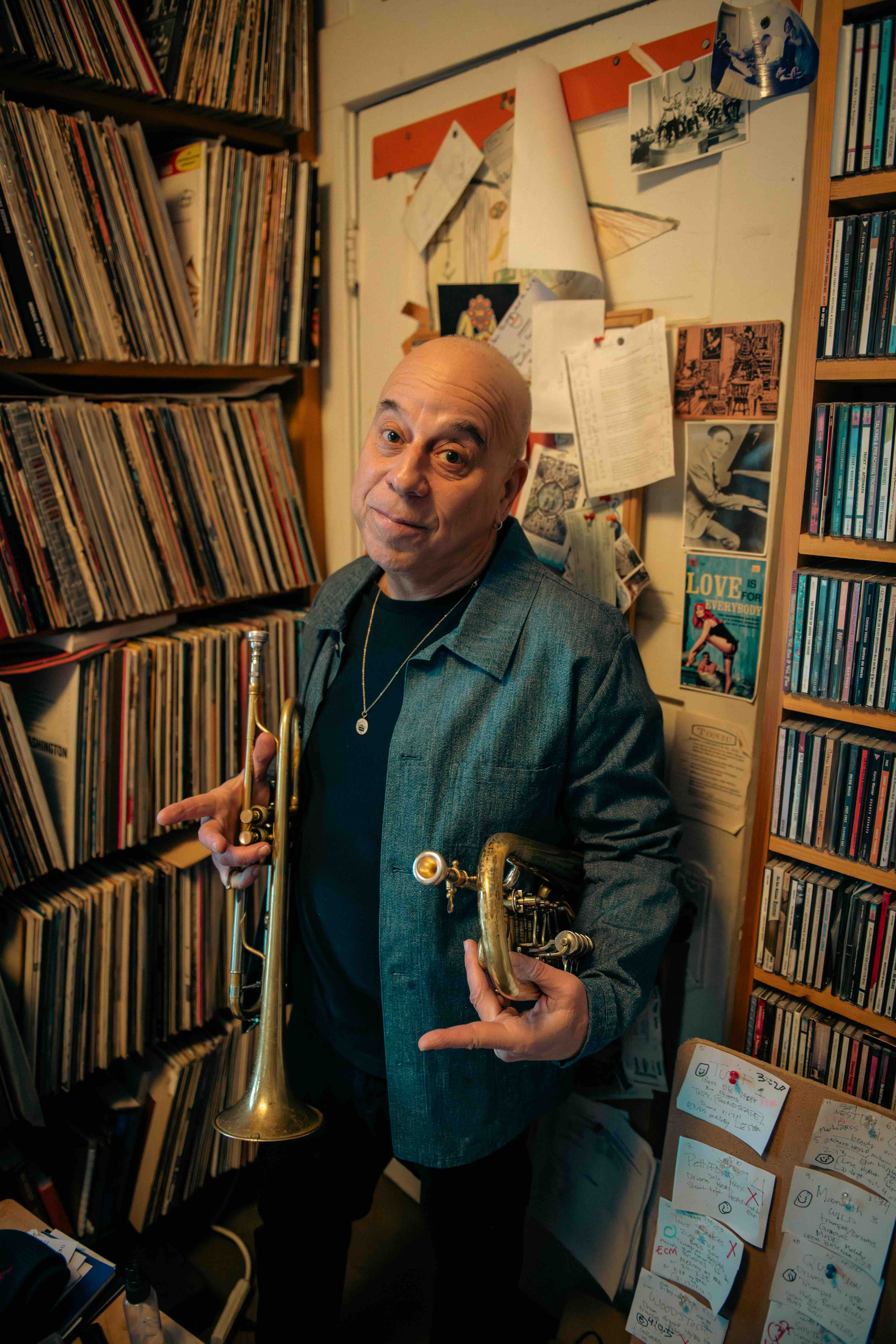
Trumpeter/composer/bandleader
Steven Bernstein is a trumpeter, composer, arranger and bandleader whose career bridges jazz, experimental music, film, and dance with a voice that is unmistakably his own. A master of the rare slide trumpet and a veteran of the New York City music scene, Bernstein has spent decades reshaping what contemporary creative music can be — equal parts deep tradition, risk-taking, and joy. His work as an arranger and collaborator spans an extraordinary range: music for films by directors Woody Allen and Robert Altman; compositions choreographed by Alvin Ailey American Dance Theater and Twyla Tharp; visionary projects with legendary producer Hal Willner; and long-standing collaborations with artists such as Lou Reed, Levon Helm, Roswell Rudd, Henry Butler, Bernie Worrell, and Sam Rivers. Bernstein’s role in Levon Helm’s late- career renaissance contributed to three GRAMMY Awards. Bernstein is best known as the founder and guiding force behind two of the most enduring and imaginative ensembles of the past quarter-century: Sexmob and Millennial Territory Orchestra (MTO).
Now celebrating 30 years together, Sexmob is a quartet that consistently pushes the boundaries of the live music experience. Formed in 1996 out of a weekly residency at New York’s Knitting Factory, the band — Bernstein with Briggan Krauss, Tony Scherr, and Kenny Wollesen — performs without setlists, allowing compositions to evolve organically through improvisation and spontaneous transitions. Rooted in jazz tradition yet irreverent toward genre boundaries, Sexmob has toured extensively for three decades,… Read More