

 Apple Podcasts
 Spotify
 YouTube
 Amazon Music
 Castbox
 RSS Feed
 Overcast
 PocketCasts
 Suzanne Ciani: The Buchla's Orchestral Homecoming
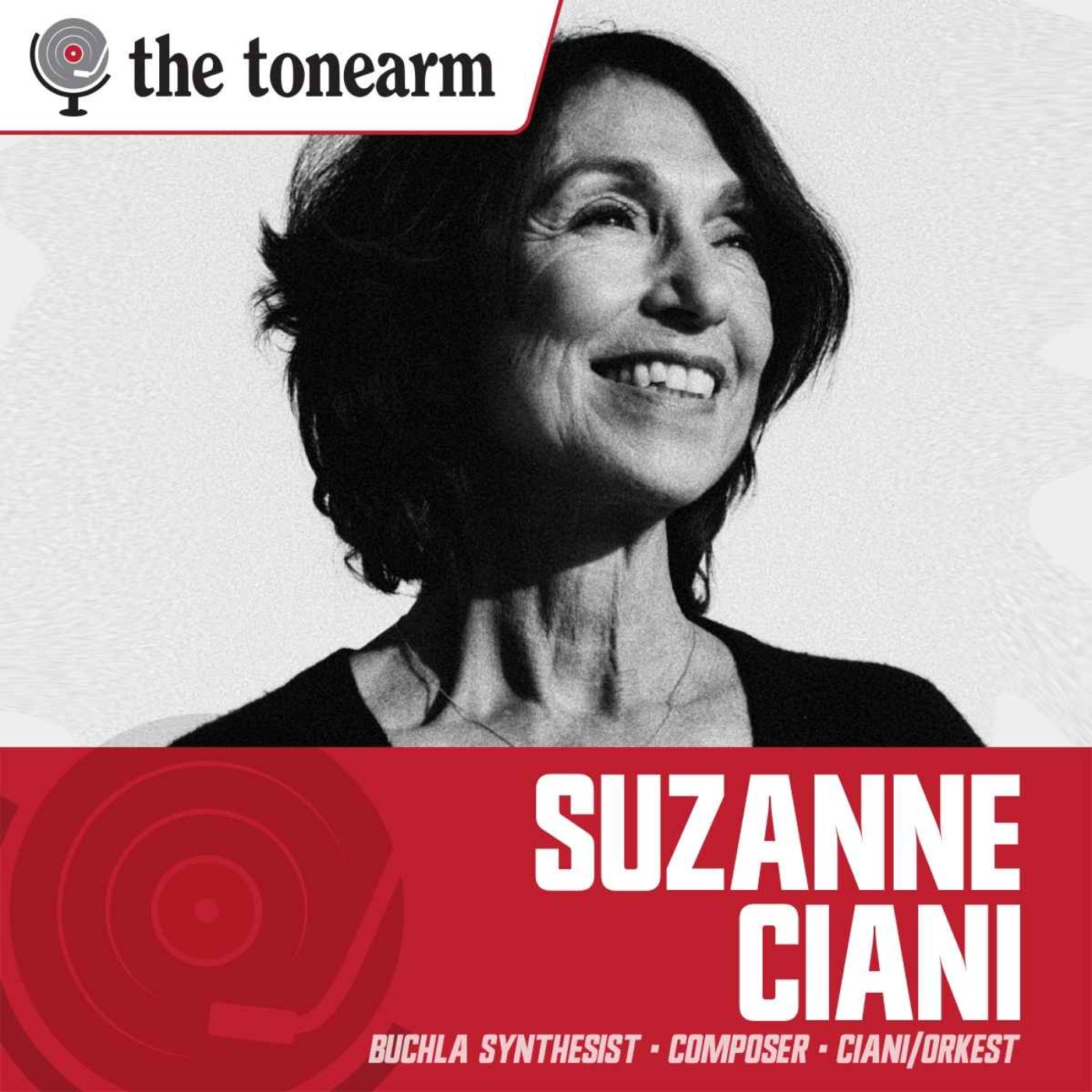
The electronic music pioneer joins the podcast to discuss 'CIANI/ORKEST,' her live album pairing the Buchla synthesizer with the 50-piece Metropole Orkest, and why she has always heard the instrument as orchestral.
This week, we’re putting The Tonearm’s needle on five-time Grammy-nominated composer Suzanne Ciani.
Suzanne has spent decades innovating electronic music on the Buchla synthesizer, an instrument as intimate to her as any acoustic musician’s.
Suzanne has multiple projects out this year: CIANI/ORKEST, a live album with the fifty-piece Metropole Orkest, conducted by Simon Dobson; a collaborative live album with British electronic producer Actress; and the score for John Wilson’s idiosyncratic new documentary, The History of Concrete.
We talk about why an artist who’s needed total control throughout her career said yes to an orchestra, a producer, and a filmmaker all in one year, what it’s like hearing an instrument built for one pair of hands answered by fifty more, and her pet peeve about volume at live shows.
(The musical excerpts heard in the interview are from Suzanne Ciani’s CIANI/ORKEST.)
Dig Deeper
• Visit Suzanne Ciani at sevwave.com and follow on Instagram and YouTube; her catalog is on Bandcamp.
• Purchase CIANI/ORKEST on quadraphonic vinyl from AKP Recordings and digitally from Bandcamp or Qobuz. You can also listen on your streaming platform of choice.
Collaborators:
• Metropole Orkest — the 50-piece orchestra behind CIANI/ORKEST.
• Simon Dobson — composer and conductor of the album.
• Actress and Suzanne Ciani, Concrète Waves (Werkdiscs) — on Bandcamp, with coverage from The Quietus.
Instruments and Makers:
• Buchla U.S.A. — the modular synthesizer at the center of Ciani’s work, designed by Don Buchla.
Film:
• The History of Concrete (dir. John Wilson, 2026), which Ciani scored — film page on Letterboxd.
Live and Catalog:
• Age of Reflections — the immersive concert series behind Ciani’s cathedral performances.
• Seven Waves — on Bandcamp.
.(This transcript has been lightly edited for clarity.)
Lawrence Peryer: I saw you perform a few years ago here in Seattle. It was part of one of those series you do where you perform in churches.
Suzanne Ciani: Oh yeah, Reflections.
Lawrence: It was Reflections. It's such a wonderful way to experience a presentation of electronic music, really something. And I'm curious about the experience. From your perspective, how does a room, how does place, influence, inspire, impact you—in any way? Or does it?
Suzanne: Well, one thing is just the functionality of the room. I play in quadraphonic. I've noticed in some of the larger cathedrals, they were designed originally to create an echoing effect, to glorify, an ethereal kind of presence. So in Grace Cathedral in San Francisco, I had a six-second decay time. I have to mold my sound to the reality of the space. In fact, I don't use any reverb at all in some of the cathedrals. I like to do things with precise delays, delay time, with percussion. All of that is hopeless and impossible in the big reverberant space. So—is it inspiring to be in a religious environment? The truth is that when I'm playing, all I can see is the instrument. I know that there are light shows going on, and all these magnificent hundred-foot-high projections, but I don't get to see that. So I see it afterward, in the videos. That's great. But otherwise, I'm kind of just focusing in on what I do. So I do make an exception, however, in those concerts, because the promoter specifically wants me to include something from my past, from Seven Waves. I don't know if you noticed that at all, but I did include, along with the live Buchla, some previous recordings or tracks, because I had the multitracks from Seven Waves. It was part of my archival project to get all of those transferred, so I could weave in little elements from Seven Waves.
Lawrence: That's really neat. That's fun.
Suzanne: It was fun. No, I really like it. It's just that it's more work for me. (laughter)
Lawrence: Something else I remember about that night was that it was blisteringly hot in there. So many of the buildings here, especially anything more than ten or fifteen years old—there's no HVAC in Seattle. It was very warm. But I think that adds to the experience. It's just another element.
Suzanne: As long as nobody faints. We have had that happen. I've played in a church in Brooklyn, and they had to carry somebody out from heat exhaustion. So it's not always—if the place is packed, it can cause a little damage, I guess.
Lawrence: Before I move on to asking you about some of your current work—it's been a busy time for you—did you know you had an audience out there? You mentioned when the place is packed, and the place was packed in Seattle. Were you always aware that there was an audience for you, who would come out for you and see you live?
Suzanne: Absolutely not. I started this whole live performance back in the late sixties and seventies. I did have some curated audiences, people in the business, that kind of thing. But the public? No. There was no understanding of what this was. I grew accustomed, actually, to not having an audience, because they didn't have a listening for it. So for me now, I'm aware that there is an audience, because the kids are interested in performing and playing on live analog modular. Nothing could make me happier than to have a listening that I can play into, where they know what I'm doing. I'm always surprised—some of the audiences are getting very big. In fact, one of them is so big coming up that it's really impossible to set up the quadraphonic in an appropriate way. I mean, if I were playing at the Sphere in Las Vegas, it would work, because that's a really customized audio spatial environment. But the way we set up venues nowadays is just to bring a bunch of stuff in and set it up, especially if it's outdoors and there's no reflection of the sound. I don't really want to play in those big spaces, because I don't think it's appropriate. I think we need better infrastructure to accommodate this type of performance. So I'm going to give it a try. They talked me into it, but we'll see what happens.
Lawrence: Have you seen any performances at the Sphere?
Suzanne: Yes, I made it a point to go. I had to do my research—this is my thing. And it was magnificent. It was The Eagles.
Lawrence: I saw the Dead there.
Suzanne: Oh, you did? Oh, good. It was great.
Lawrence: It was pretty phenomenal. It was impressive. I appreciate the clarity of sound without the volume having to be—there's no distortion there. It's kind of ridiculous, actually.
Suzanne: It's great, isn't it?
Lawrence: Yeah.
Suzanne: I really have a pet peeve about volume. I just went to a concert Monday night—and all the concerts that I go to, it's kind of a defensive thing—they just jack up the volume so loud that it's painful. And what is the point of doing that?
Lawrence: It's a proxy for emotion, I think, or something.
Suzanne: Exactly. It's got some kind of a filler, making up for what's missing.
Lawrence: There was a little bit of a delta in time between the recording of the CIANI/ORKEST record, or performances, and it actually becoming a released record. Did you have an ongoing relationship with that process, or did you move away from these recordings and then sort of rediscover them three or four years later? I'm curious what the evolution of your relationship with these performances has been.
Suzanne: Well, in the beginning—because I have my own record label, Atmospheric, and Atmospheric is basically a quadraphonic label, so I do quad vinyl. My first release was my comeback Buchla concert in 2016. I can codify the sound into a stereo-compatible recording, but it can also be decoded into quadraphonic, and that's my commitment—to do quadraphonic. So I was interested in doing this album because it was quad. I processed the orchestra through my spatial Buchla. But it was impossible to get it going. There were just too many people involved. We had the video from the government in Amsterdam. We had the orchestra, and nobody knew who was in charge. It was just a people problem, really. So I did give up. Kamran came in, and he has the patience of a saint. I don't know how he does it—maybe because he's not as closely connected with it. Maybe he has less of a frustration level, or pain. So I let him carry the ball, and he carried the ball all the way to the touchdown. So it's great.
Lawrence: Something else I'm curious about—you've referred to the Buchla as being sort of orchestral in nature. Now you're hearing an orchestra perform your work, which is often a very solitary thing for you. I saw you do it, I watched you do it in real time, and there are such different modalities—whether it's the touch interface, or dials and knobs, and an orchestra is working from scores and rehearsals. I'm curious about the blending of those worlds, what it was like to hear your music. You're now in dialogue with it, in what I would think is a different way, and I would love to hear you talk about that experience.
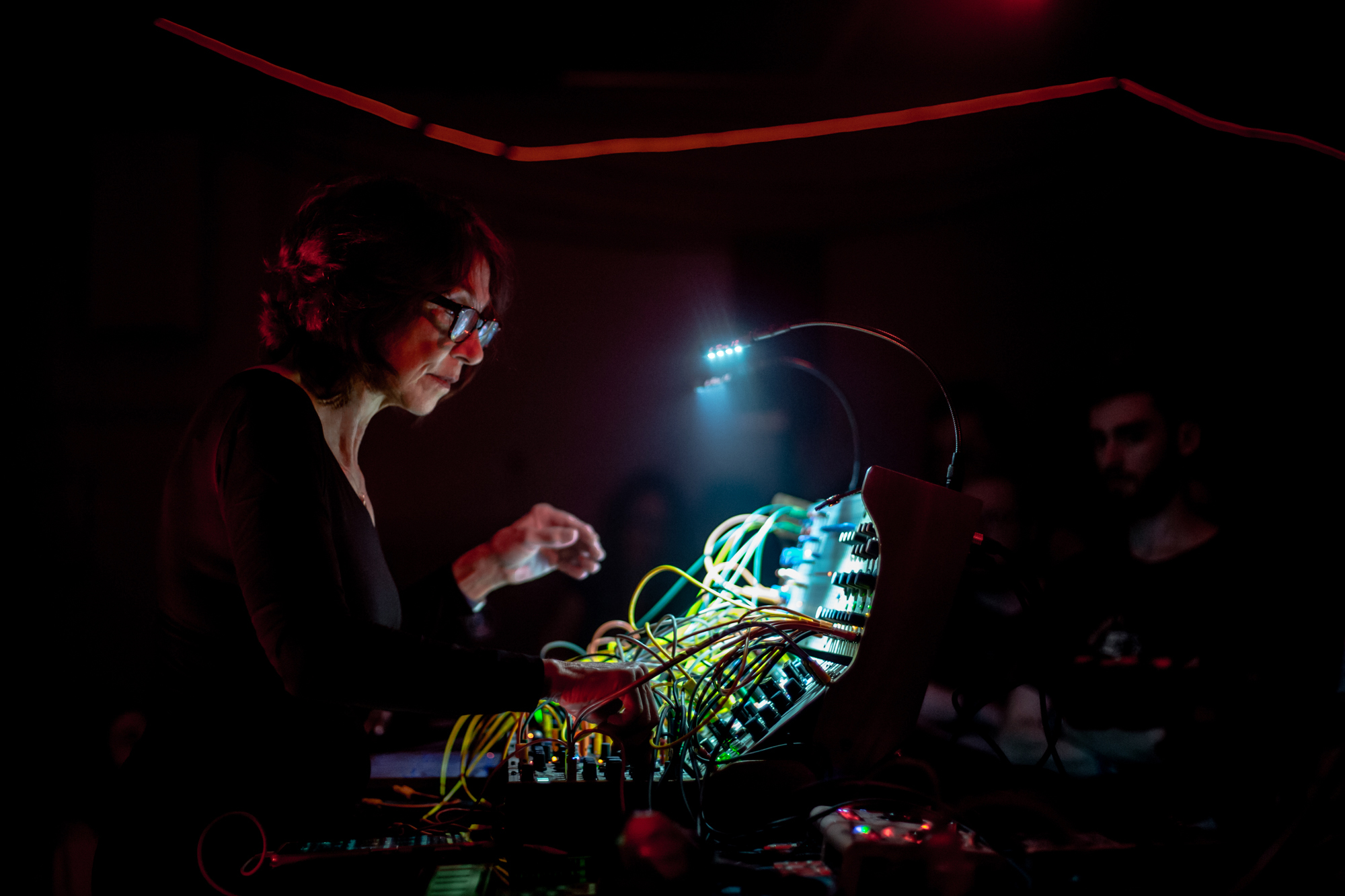
Suzanne: Yeah, there's a lot packed into what you just asked. One thing is that I think the instrument is a compositional instrument, not so much an orchestral instrument—because that implies Switched-On Bach or something. And I don't use conventional sound, or the approach of conventional sound. I mean, certainly I bring to bear certain things I've learned in the traditional classical musical world, which is the way frequency ranges function. You have the bass, the low middle, the middle, and the higher, and there are certain ways of handling that integration of sound that I do port over from the classical world. When I'm playing with this orchestra, I'm really just one more instrument. I'm a compositional instrument, so I have a lot more say about what's going to happen, in general, with the music. But my job is to take a little bit of a backseat, so that the orchestra has space to do its function. For me, I'm used to being on board and interactive every second. I'm playing, I'm moving—my job really is to keep the thing alive and going. On the other hand, I have to say, the experience was completely overwhelming, to be on stage. The decibel level of acoustic sound was transformative. I loved it. I just adored it. It was truly, truly amazing.
This really was a collaborative project. I had started the concept of this project four years earlier, when I was teaching at Berklee College of Music, and they had merged with the Boston Conservatory. They had jazz performers and live musicians, along with the technology department. And so I thought, what a perfect opportunity to combine worlds, these different kinds of instruments. So I started a project that was orchestra and Buchla, and we had a lot of problems to solve to integrate that—because, for one thing, there's conducting, and then there's the improvisational nature of the Buchla. How do you get those two things? As you noticed, one thing is married to the printed page—but not completely, because modern contemporary musicians do know how to improvise, and you can hear that in the ORKEST recording. There are moments where the trumpet takes off, the guitar takes off, and I take off. There are improvisational openings that are right there. So that's something you do not find in a traditional orchestra. I am grateful for the sense of what an orchestra is. I don't think we have another orchestra like that in the United States. We're starting—I stay in touch, I go into the San Francisco Conservatory, and I pay attention to the now-combining of music technology with traditional instruments. That's a mandate now. Everybody wants to do that. Even at Berklee College of Music, where they had a head start, you could not enter the school as an electronic musician. You had to play an acoustic instrument. It's only within the last two years that that has changed, that there is some credibility now with this new instrument. And that's going to open up. I'm very excited about this time in our musical culture, because we're seeing—oh my God—we're seeing analog modular have a second chance.
Lawrence: Yeah, it seems like a very interesting extension of something. I speak with a lot of artists about—artists who are, let's say, forty-ish and younger, maybe a little older, but definitely forty and younger—their experience of conservatory is completely different. When I talk to artists my age and older, versus the younger artists, there's much more merging, even between, say, a jazz and a classical department, or the classical musicians are allowed to take improvisation classes—whereas in the past, that was, you don't do that. And so what you're articulating here seems like the logical extension of that, of the academy, if you will, broadening its horizons to be more about creative music, and not about jazz versus classical versus electronic versus acoustic. And that can't be anything but good.
Suzanne: Yeah, it's the methodology too, because the thing that we love about these analog modular musical instruments is the freedom that they give us. We are not married to repeating or realizing a preexistent composition precisely, and being judged on: did we hit the right note, whatever those calibrations are. So it is improvisatory, and it's also compositional. So integrating it is much easier in the modern vocabulary of musicians. But it's still untamed. I mean, how did we integrate it? The Buchla—I don't use MIDI. So all those things that kind of tie things together—I'm very comfortable with that. I can't say I don't like MIDI, but I don't like it. And I've used it. I've done many studio albums. I did studio albums before there was MIDI, when you couldn't interlock anything and you couldn't synchronize anything, and you did it by hand. My whole career, in the beginning, was starting a two-inch machine manually to get it to lock up with something else. Anyway. What I did—I used a Korg drum machine, a little tiny drum machine. When you're on the road, you want small, you want light. Everything has to go through that filter of: is it packable, is it small enough? So this little tiny drum machine—I could feed the quad into that, and it could output a click. So they really followed me. I was in charge of the tempo. And the conductor—he was brilliant. Simon Dobson. He was also very young, and resilient, and open to take it on. I mean, he's a classical conductor with tattoos all up his arms, so you knew that something was going on there. He was fine with it. And we had a wonderful feedback system. We all had headphones on, and he could talk to me. He could say, "Hey, wait a minute, you need to do this, you need to do that," or whatever. So we had communication. When we did it at Berklee, we didn't have that, and we had a system of cards. He would hold up a card with a number on it, and it would be like, when are we going to do the next thing? But this was much more functional.
Lawrence: You're starting to get into a realm I wanted to ask you about—I'm curious about the role of trust in a project like this. Performing with a larger ensemble, versus being the one-person show that you typically are, or have been, often—and to turn over your music to collaborators at such scale. Different arrangers on the different sections. Obviously, an orchestra. Is trust part of it for you? Do you think in those terms? Or am I making stuff up? (laughter)
Suzanne: Let's just say I have no fear. I don't go there. Really, fear is debilitating. So I'm an optimist. I go in—and I think the arrangers were absolutely brilliant. They astonished me. They went way beyond what I would have imagined. In this case, the heavy lifting was divided, and I think it produced an incredible result just because of that. And somehow it integrated. They were given an electronic starting point, and they all picked up the same kind of sensibility to that. I think that's why, even though they were individual arrangers, it all worked together—because they had just enough musical outline. I've worked with four sixteen-stage sequences, so those are notes on paper. That's a definite starting point for notes. I think it was helped by the fact that the same arranger did the opening and the closing, so it had nice bookends. I think the energy of the performance had a beautiful shape. My compositional form is the wave. I've always been inspired by waves, on many, many levels. One of them is that I've always loved that energy system of the build and release of that energy. And that's what you have here. You listen to this album, and it has that kind of structure.
Lawrence: There's certainly the peak, and the wave crashing, during—I think it's "The Vamp," that piece. When I was listening to that, I was like, man, this could be a King Crimson record. (laughter) I would give any of my prog-rock-loving friends that piece and say, I think you'll find a home here.
Suzanne: Right, right. Yeah.
Lawrence: I talk with artists about this a lot. I'm so intrigued by the notion of narrative in instrumental music—how a composer or an instrumentalist can invoke narrative without words. We might be talking a little bit less about explicit narrative here, but there's certainly a journey. That's how I heard what you were articulating—that they managed to craft an experience through that set of music.
Suzanne: It is. For me—a lot of people do a visual, they get visual responses. I don't think about the visual. I do think about the story, and the energy, and the origin. For me, I come out of the ocean. That's a starting point, and then it grows. You do something, and it gets more and more free. This is a very classical idea, where you had theme A, theme B, then you had the development—where you could complicate things and take them out of their keys—and then you came back at the end to familiar territory, and maybe you repeated something and gave a sense of ending. And so that kind of storytelling, I do naturally follow that kind of energy.
Lawrence: Having the opportunity to speak with you is funny, in that there's a lot of information about you now, over the last decade or so. There's the film, and I've heard other interviews with you. I feel a sense of familiarity with your story, or parts of your narrative that you've put out there. This idea of the water and the waves and nature as sort of fundamental to your work—as does your embrace of quad. And I'm curious: do those two things relate to each other?
Suzanne: Well, nature is pretty spatial. We don't compress nature into two pinpoints in front of us. It is immersive.
Lawrence: At the risk of prying open your head and peering inside—what is the work you're doing? Are you channeling nature? Are you in dialogue with it? Are you attempting to recreate it? What is that?
Suzanne: Nature is just my starting point. That's my starting point. After that, I'm about freedom, and the Buchla gives me that. The Buchla is an improvisatory instrument. It's just such a joy to interact with, and it gives back. People say, "Oh, well, do you know what's going to happen? Is it all a surprise?" Yes, you know what's going to happen. But still, it's like—you can take the same ingredients for your salad dressing, and it's different every time, and sometimes it's great. That's what it is. I think of it as cooking. I wrote a paper in 1967 about how to play the Buchla, because I got a National Endowment composer grant, and I called it the Buchla Cookbook. So for me—maybe because I'm coming from a different direction, I see things from that direction. I am a woman. I don't know if that means anything at all, but I'm comfortable in a lot of things that I didn't find outside of that comfort zone. For instance, I've always been comfortable with very slow sound. The machine loves to repeat, loves to make a beat, loves to do dance music, loves to pulse—but it can also go very slowly, more slowly than a human can go, and keep a dependable rhythm. Something that gives you a kind of confidence, that things can go on. My first album, Seven Waves, was all about making a safe space. It was immersive, in the sense that I wanted you to be in it and experience the safety zone. Why was it safe? It was safe because it was slow, and the slow was dependable. The rhythm was dependable. You didn't have to try to get humans to play a slow, dependable rhythm—very hard. If they want to be dependable, they've got to pump that drum. And so this was a different metaphor, to do it slow.
Lawrence: When you collaborate now—I'm thinking specifically about the project with Actress—you've developed opportunities to work with people who come from much different contexts: musical scenes, or maybe musical education backgrounds. There's a very populist, if you will, or humanist view that it seems you have. I don't hear any tone about people needing to come from a certain training or have a certain background. So I'm really interested in that meeting of the minds that happens for you. Where do you meet with a collaborator, and how do you find that out? What's the dance that happens when there's an opportunity to work with somebody who comes from such a different place? How do you negotiate that?
Suzanne: I remember going into the commercial world in New York City, right after graduate school. I had been finally trained as a classical composer. And I met musicians and producers and people in the recording studios. I had one person I worked with—he could not read or write music. He could walk into a room, and a rhythm section locked. And I learned, from that moment on, that this is a language that has many sources, and that it's—yes, he wanted me because I could read the string parts and I could play with the group. I didn't want to play string parts. I wanted to play the Buchla, and I refused. Actually, I'm always very stubborn. He wanted me to buy an ARP string ensemble, and I said, absolutely not. And so he bought it. He said, "I'll buy it, and you play it." And so I did. There I was, with all the string section, doing this—and it was kind of fun and weird, and maybe dangerous, because of the union. But I know that music comes from so many different places, and that they're all valid. I couldn't collaborate for years and years and years. All my years of doing my solo studio recordings, I tried collaborating. I couldn't. I needed to be fully in charge. I had a very specific thing that I wanted to do. I had to do it. I certainly had support. Mitch Farber was the person who did a lot of arranging for me when I was doing commercials in New York. He'd stay in the room. He maybe never opened his mouth, but he was there, and it was a form of collaboration—a psychic collaboration. But I could never submit myself to somebody else's ideas about what I should be doing. So it wasn't until I got into my later years, now, where—I'm in my last hurrah here. I'm eighty years old now, and it's time to have a little freedom and fun, and just see what happens out there.
Lawrence: Yeah.
Suzanne: Yeah. No reason.
Lawrence: It's interesting to hear you talk about that experience, because I can't help but wonder if that need for control, if you will, is a reaction to the commercial work—where you don't get to call all the shots about the finished product. So in your art life, you do get to control and call all the shots there. It seems like maybe there's an action-reaction going on there. But that's me playing armchair psychologist for you. I'll bill you separately for that. (laughter)
Suzanne: I hate to disappoint you, but I had total control in advertising. Total control, because they didn't know what I was doing. There was no language for it, and they were mostly afraid. I'd come into the studio with this big, complicated machine, the Buchla. I worked as an artist in commercial work. I pleased myself. My statement about this was: I am going to do what I do, and if you don't like it, feel free to go someplace else. And I meant that. It wasn't an angry statement. It wasn't a defensive statement. It was—the way I work creatively is that I have to have total freedom, or I can't do it. And I think that's true about creativity. If I need somebody to do something for me, my first job is to give them space.
Lawrence: Yeah, I get that. Tell me about The History of Concrete.
Suzanne: Isn't it funny that concrete keeps coming up in my life? I had Waves, then I had Concrete Waves, then I got Concrete.
Lawrence: It's like this reduction, and you're finally here, cast in concrete. (laughter)
Suzanne: It is very bizarre, and very logical, on some level, I don't know what. I got a call. It was an important call. It was from the big producer who did—you know, I'm very bad at names, and I don't remember anything, so I can't really drop names, because I never remember them. But anyway, this very important director called me and wanted me to participate in his protégé's work. John Wilson. They wanted it right away, and I didn't have time. I really didn't have time. And so I said, well, I can't—but I can. I can send you lots of music. I have a huge library now. That's how it started. So that's how we did it. And then I went to Sundance and saw the premiere. And now I'm going to do something in New York at the end of the month, at John's little studio. It holds about forty people, but we're going to play the album with the film that was made at the time of the recording. So that's going to be fun—but I know there'll be no tickets and no seats. It's fun. I love John Wilson. I have to be honest, I didn't know who he was before, but as soon as I spoke with his people, I went and watched the whole series of How to with John Wilson, and I adored it. I just love that independent spirit.
Lawrence: It's been a big time of work and output for you. We've talked about several projects here. We opened the call talking about you traveling and being on the road. Is the urgency related to what you said before—that it's just the time in your life to say yes to things? Are you busy? (laughter)
Suzanne: Yeah, I am busy, but I don't try to be busy. For instance, I don't have an agent. I only deal with what comes toward me. I don't try to make work, but I do receive. And maybe my next step is to stop receiving—I don't know. So far, so good. They take good care of me when I'm on the road. It's difficult, but not as difficult as it could be if I didn't have all the support. For me, packing up a booklet at the end of the night—a hundred cables—takes a little time, but I usually get somebody to help me, some young aspiring analog musician, and they do a great job. So my fans are very supportive.
Lawrence: I would have to think it's very exciting for someone not only to have the opportunity to play that role for you, but to be around the instrument. I know the excitement of holding a nice guitar, or sitting at a nice keyboard, or whatever it is—they're not simply inanimate objects.
Suzanne: Well, that's also part of my mission—to speak the word of the Buchla. Because Buchla did the very first one, maybe by a few minutes; Bob Moog did one. But Buchla was stubborn, and he stayed with the authentic nature of the instrument. He didn't put a keyboard on it. And he was, as I say, the Leonardo da Vinci of analog musical instrument design. I wanted, in this second round that we're experiencing now, this renaissance of interest—most of the Eurorack stuff is inspired by its origin in Germany, and it didn't get the Buchla influence. So I'm trying to bring out the beauty of this instrument, and hoping, in ongoing instrument design, that people will incorporate some of the really unmatched, brilliant ideas that Don had—one of them being quadraphonic.
Lawrence: Yeah, that's beautiful work. And you've made beautiful work along the way. Thank you so much for making time to do this. It's really been a treat for me to be able to talk to you, and I very much appreciate you making time.
Suzanne: Thank you, Lawrence. Thank you.
Composer
Suzanne Ciani is a five-time Grammy award-nominated composer, electronic music pioneer, and neo-classical recording artist who has released over 20 solo albums including "Seven Waves," and "The Velocity of Love," along with a landmark quad LP “LIVE Quadraphonic,” which restarted her Buchla modular performances. Her work has been featured in films, games, and countless commercials as well.
She was inducted into the first class of Keyboard Magazine's Hall of Fame alongside other synth luminaries, including Bob Moog, Don Buchla and Dave Smith and received the Moog Innovation Award. Most recently, she is the recipient of the Independent Icon Award from A2IM, The Golden Ear Award, and the SEAMUS Award.
Suzanne has provided the voice and sounds for Bally's groundbreaking "Xenon" pinball machine, created Coca-Cola’s pop-and-pour sound, designed logos for Fortune 500 companies, and carved out a niche as one of the most creatively successful female composers in the world. A Life in Waves, a documentary about Ciani’s life and work, debuted at SXSW in 2017 and is available to watch on all digital platforms.
Ciani is a graduate of Wellesley College and holds a Masters in Music Composition from the University of California, Berkeley.