

 Apple Podcasts
 Spotify
 YouTube
 Amazon Music
 Castbox
 RSS Feed
 Overcast
 PocketCasts
 Terri Lyne Carrington: A Dance Record for Dark Times
The NEA Jazz Master and four-time Grammy winner joins us to discuss 'Trip the Night Fantastic,' the second album from Terri Lyne Carrington + Social Science, which sets deportation, prison abolition, and climate collapse to music for the dance floor.
This week we’re putting The Tonearm’s needle on drummer, composer, and educator Terri Lyne Carrington.
Carrington has just released Trip the Night Fantastic, the second album from her group, Social Science. It’s built for the dance floor but unflinching on the topics of deportation, prison abolition, and climate collapse.
We talk about trusting collaborators before they’ve earned it, playing to a rare, fully attentive crowd at Newport, and calling herself a “frustrated drummer” on a record built from words as much as rhythm.
(The musical excerpts heard in the interview are from Trip the Night Fantastic, the new album from Terri Lyne Carrington and Social Science.)
Dig Deeper
• Visit Terri Lyne Carrington at terrilynecarrington.com and follow on Instagram, YouTube, Facebook, and Bandcamp
• Purchase Trip the Night Fantastic from Candid Records, Bandcamp, or Qobuz, and listen on your streaming platform of choice.
• Candid Records
Social Science:
• Aaron Parks — piano; wrote “Climate Song”
• Matthew Stevens — guitar; proposed the album’s title phrase and wrote the “Solidarity Song” riff
• Morgan Guerin — multi-instrumentalist and the album’s co-producer
“Riddim Song” Collaborators:
• Fatoumata Diawara
• Debo Ray
• Brenda Navarrete
“Blues Song” and June Jordan:
• June Jordan — the poet’s official site
• “These Poems” — the poem set to music on the album
• aja monet — the surrealist blues poet who performs it
Related Recordings:
• We Insist 2025! with Christie Dashiell, the Max Roach reimagining that interrupted this album — Bandcamp
• Waiting Game, the 2019 Social Science debut given to its label without an advance — Bandcamp
• Max Roach’s We Insist! Freedom Now Suite (1960) — JazzTimes on the reissue
Institutions and Festivals:
• Berklee Institute of Jazz and Gender Justice — founded and directed by Carrington
• Newport Jazz Festival — where Social Science played on August 1, 2026
Also Mentioned:
• 13th — Ava DuVernay’s documentary
• Best Alternative Jazz Album — the Grammy category Carrington helped create, first awarded in 2024
(This transcript has been lightly edited for clarity.)
Lawrence Peryer: You had a busy weekend, didn't you?
Terri Lyne Carrington: I did, yeah.
Lawrence: Tell me about taking this music to the people.
Terri Lyne: Oh, it's been great. We've only done about three or four gigs. We were in Newport August 1, and it was pretty amazing. People were very touched by the music. Some people were crying. I think people are sensitive right now to a lot of things that are going on, and it felt very powerful. We felt good.
Lawrence: Yeah, it almost feels like the record has something for everyone who is waiting to be connected with. So many different topics and issues are covered.
When you play a place like Newport versus, say, your own show or an album release party, where people are there to hear you and they kind of know what you're going to be about, versus maybe a broader audience that's just there to dance or to sit in the sun and drink their wine and eat cheese—what's your experience of that from the bandstand? Do you feel the difference?
Terri Lyne: Yeah, I mean, you can always feel when there's people just at a festival to have a Sunday outing, or even just to be out in the sun and hear some music, but they're really socializing and, like you said, eating their cheese, drinking their wine.
The difference is when you have a very attentive crowd, even at a festival, and they're really tuned in and listening. And I think Newport is one of those festivals where the audience is tuned in. Same with Monterey, as far as those outdoor festivals go. It's always nice in general when you feel like the people are with you, because sometimes you're not sure people are being entertained or engaged with.
Lawrence: This record does not force the listener to make the choice between being entertained and being engaged with intellectually or emotionally, and that's something that is a real accomplishment, right? To me, I felt like I went back in time a little bit. I was like, man, this is the late eighties, early nineties, kind of R&B, before everything was really digitized.
Even the flow of the MCs you had felt obviously very contemporary and very current, but it had this classic sound, and it's engineered so well. It's a listening record.
Terri Lyne: Thank you. I spent a lot of time on the mixes, so I really appreciate that comment. I'm very much into music from the seventies.
Things started changing sonically in the eighties and into the nineties, of course, but I like that old-school sound. And I think there's a way that it's also become modern again. Hip-hop sometimes sampling old-school music has made it sound modern again as well.
Lawrence: Tell me a little bit about the album title. What's the play on words going on there, and what should I be taking away from it as the listener?
Terri Lyne: "Trip the Light Fantastic" is a reference from a John Milton poem from the 1600s. Matthew Stevens came up with that when we were trying to think of titles that were dance related, because this was our version of making a dance record.
He came up with that and I said, yeah, that's great. Let's flip it to Trip the Night Fantastic, to reference the darkness that's happening around us right now. That's what we're trying to trip up while we dance.
Lawrence: The incubation period between when you met Aaron Parks and Matthew Stevens—there was quite a chunk of time between when you met them and when you first recorded with them. Was that just about the logistics and the scheduling that I know so many musicians face, or was there a deeper preparedness that needed to happen?
Terri Lyne: Well, it wasn't when I met them, but when we decided to get together and try to make some music, start this band. There was some time that passed, not a whole lot, before we started getting together, but it took time to make the first album, which came out in 2019.
So that record took the better part of three years. From the point when we first got together and started playing and writing some things, until the record came out, it was three years. So I think that might be the time that you're thinking about. This record took a little over two years.
I knew that I wanted it to be quicker than the last one, because the last one was really drawn out, also because of schedules and things like that. It would have been even faster, but I put We Insist in the middle. So this one was about 80 percent done, and I realized I want to attribute Max Roach, and it's during his centennial.
So I stopped everything and worked on We Insist 2025. And then that came out, and then I continued with this one.
Lawrence: Did that break influence the material at all? I mean, it feels so damn timely. The record and the lyrics feel so ripped from the headlines. And then the other side of it is like, man, these things are all too common and all too timeless in a sick way. But I'm curious about your experience of the subject matter and the record taking a couple of years.
Terri Lyne: Actually, it didn't really affect it. Maybe one song, but for the most part everything was written already. I really tightened up production stuff, and then there were still a few more guests that we needed to confirm, but for the most part, yeah, it was all done before I stopped working on it.
So you're right, it's too bad that some of this stuff is more timeless than we'd like to think.
Lawrence: How do you think about the balance between socially and politically focused music or lyrical content, and the music itself as a standalone expression, a standalone work? Do you think at all, or get concerned at all, with the music being rooted in time?
I mean, I would love it if twenty years from now the lyrical content on this record was irrelevant. (laughter)
Terri Lyne: Exactly. That's the goal.
Lawrence: That'd be pretty wonderful. But do you think about that at all—that this roots the record too much in time?
Terri Lyne: I don't think about it, because I think that is one of the beauties about art.
It does represent the times that it was created, and it says something about that time, and it's beautiful when people look back and you can see what was happening during that time—the news, or the headlines, or reading something. You can feel it in a different way when you're observing it through art.
So I don't think there's anything wrong with that. And I don't think there's anything wrong with, as you said, the standalone art. Art for art's sake. I think we are creative beings when we decide to do this for a living. It's because we have this well of creativity that needs to be expressed. Sometimes it's going to be about everything we're experiencing in life, and if you're more about humanity and your neighbor and the collective versus the individual, then you're going to include things that affect other people.
It's about community. But then sometimes the same artist may have a moment of just reflecting on their own life and their own personal life, and things that aren't community related. So I think we have the freedom to do both. I know I would get bored, even as a listener, with people that only focus on themselves and aren't thinking about how we're connected. These social justice issues—well, that's one way that you're connected to other people, because we're all experiencing some of this stuff together.
So yeah, I think both are valid, and I try to encourage my students at Berklee to think about big picture, and think about their legacy and what they're leaving behind. You know, even as young as they are, to start thinking in that way, and start thinking about a mission, a personal artistic mission.
Lawrence: Have you seen, in your role as a teacher specifically at Berklee, have you seen the consciousness or the awareness of the young people change in the last decade or so? What's your experience of what young people are going through and how they're metabolizing the world right now?
Terri Lyne: Yeah, I think it's a little different, of course, from when I was their age, and I think that they are more sensitive.
In some ways it can worry me, or it can even frustrate me, because we're thinking you have to deal with stuff, you have to plow through, you have to be strong. And sometimes you're just not getting that from some of this generation, and it seems like things affect them a lot more.
But on the other hand, that can make for some great art, and that can make for a different kind of vulnerability with your creative process. So I try to not really get into being judgmental in any way, but accepting what I see and what's happening now in the trends. Though I think some of them may be a little more fragile sometimes.
I understand being scared. I was talking to a student not too long ago. They were talking about being scared about the climate and about global warming. I mean, those are real things, and I understand the fear behind all that. So it's a lot to deal with. But at the same time, Buddhism says, "Suffer what there is to suffer and enjoy what there is to enjoy, but always remain faithful."
Suffering and joy are just two parts of life, so let's not get attached to one or the other. And that's how I try to live. I think that this generation is also more in tune with some of this social justice work, but that's always been the case. It's always the younger generations that are on the front lines of social justice work, but they also need guidance from people that have more experience in certain ways.
Lawrence: I asked you that specific question because it's something that I've been trying to navigate and make sense of in my own experience. I've had some other contexts where I've talked to college-aged students. I've gone into the classroom and talked to them about various things, or I have a college-aged son and I see the kids.
There's some days where I think the most heroic thing I know is just the fact that they haven't all given up.
You know, whenever I start to think like, oh, these kids are a little soft, or they're a little weird, or they're a little sensitive, or whatever—when my judgmental brain starts to kick in, I think, yeah, and I would fold. If I had to contemplate the next forty years, I would fold. I give them a lot of credit.
Terri Lyne: Yep. I do too.
Lawrence: I'm curious about your experience being the lyricist for this record—the lyrical voice, if not always the actual voice, the interpreting voice. Can you talk about your experience as a lyricist, putting words in people's mouths and hearing your words?
Terri Lyne: I have always liked to write songs. I've been doing it for thirty years at least. It's just a craft that's gotten better with time. It's something that I always liked to do and wanted to express myself that way. One thing on my bucket list would be a book of poetry.
So yeah, I've been collecting some of the things that I've been writing over the years. Also, I have to write speeches and things like that fairly regularly. So I think I've just developed a way with words, and I am somewhat clear on what I want to say when it comes to the music and these albums.
So it just kind of made sense for me to write the songs and collaborate with people on them. It's a very satisfying feeling to do that, because of course I play drums, but that's satisfying in a different way. I teach—that's satisfying in a different way. I compose music, which is extremely satisfying. But then also writing texts is satisfying in a different way.
So I realized that all these things just make up the whole of me, and it's difficult to actually separate them. If somebody told me I had to just do one for the rest of my life, that would be very frustrating.
Lawrence: Could you pick? (laughter)
Terri Lyne: Woo. Let's see. Wow. I would have to think about that, to see what would have the most impact, because at the end of the day, that's what I want to do. I want to figure out—if I had to pick one, I'd have to try to figure out which part of me would have the most impact on my community. So at this moment, I don't know which that would be.
Lawrence: I wanted to ask or talk a little bit about a few of the specific pieces on the record, along the lines of lyrics. I'm really interested in "Riddim Song" and the different languages used. How do you evaluate a vocal take when you don't know what fidelity the words are being adhered to?
Terri Lyne: Oh, that's interesting. I evaluate it as if I do know what it means, because I'm not necessarily evaluating the meaning. I'm evaluating the emotion and how it strikes—assuming, if it's a language I don't know, and it's people that I trust, assuming that the words are just fine.
But I'm trying to make it have an emotional feeling, because I feel music that I don't understand the language of. I think we all can. That's not a hard thing to do. I really enjoy producing, and in fact I think that would have to be the one I would pick. If I had to pick one thing, it would be producing, because I like to see a vision through from its inception to the end.
And that's what producing music, or producing anything, really is. But yeah, "Riddim Song," it has Fatoumata Diawara. She's someone that we've talked about working together. So this was kind of the first time—the second time, actually. I played on one, on a video, a song that she put a video out during the pandemic, or right after the pandemic.
We hope to do more stuff that's kind of geared toward women empowerment and the unity of sisterhood. So that's the vibe of this song. With that in mind, I wanted to have other voices involved to express that unity. So Debo Ray is singing Creole—she's of Haitian descent—and Brenda Navarrete is rapping in both Spanish and English, and she's of Cuban descent.
Lawrence: You mentioned the word trust. I had a little drawing here around that word. There's a lot of trust expressed through this record. Not only what you and I just talked about with the lyrical interpreters, but your collaboration with Morgan Guerin and so much of the music—or what maybe we could call the sonic architecture of the record.
It's a manifestation of trust, of turning so much of your vision over, or bringing someone else in to collaborate on your vision. What's that experience like for you, and what goes into developing that kind of trust? Do you start from a position of the trust is there for you to lose, or does somebody have to earn it?
Terri Lyne: Ah, I think that's, well, a philosophical approach to many things, not just music. I think you meet people and you can either trust them kind of right away, or you could make them earn your trust. I'm the kind of person that waits for somebody to show me that they're not trustworthy, and I give people the benefit of the doubt when I need them.
Music is similar, right? I don't think we're very different. Herbie Hancock and Wayne Shorter say, "We don't play music, we play life." So I try to adopt that as well. And so, yeah, I think sometimes—I won't say I trust to a fault, but people can sometimes do more than they think they can, which sometimes is great for them because it pulls more out of them, but then creates headaches for me down the road.
So I've noticed that as a theme. I'll call somebody to do something, and maybe I don't even give them enough direction or instruction because I think they're going to get it, or interpret it in the way I think they should. Then I realized, okay, I have more work to do. This is going to take more time than I thought.
And that's a reoccurring theme. So I think it's a good thing, though, because it's faith. It's faith in the human spirit. Faith in them to aspire to do well, to do their homework or research, whatever it is. And then sometimes it just doesn't work out. I try to trust people. I believe in humanity.
Lawrence: There is something very positive about you and your work, even though you're wrestling with or working through these social justice issues, and you're in the moment now as well as looking back over the period of struggle. And I mean, there's some heavy stuff on this record. How do you stay away from both denial and dealing with reality and the heaviness, the weight of some of these topics that you're exploring in your work, and especially with this record? How do you navigate this path, and is it innate to you?
Is this who you are, or is this part of your other work? Are you developing these tools for yourself?
Terri Lyne: We are all evolving. That's part of life. I wasn't the same person ten years ago or twenty years ago as I am now. When you start getting into these kinds of important matters in regard to social justice issues, there's so much to learn.
You have to come to it with a certain kind of humility, because it just keeps expanding these various intersections, like concentric circles.
It's never like, oh, I got this—unless you're literally a specialist at something. People talk to me a lot about jazz and gender. When I started this institute, the Berklee Institute of Jazz and Gender Justice, I could barely talk about it because I hadn't done a lot of studying, but I knew that it was needed.
First thing you do is create a space, and people will come to it and the knowledge will come and things will evolve, and you have to be okay with that. You can't be afraid to do something because you don't know enough about it. You have to be able to just jump into something and learn as you go too.
So that's been that process. And some people might think I'm an expert at it, but there are scholars on these topics that are true experts. I'm a practitioner that has a certain amount of expertise, as someone who has experienced this. So that's kind of how I look at it. All these subjects are things that in some way I've experienced.
So the biggest overlapping concentric circles, if you will, for me would be race and gender. Then if you look at the climate and global warming, that's something that affects us all. So of course that's part of my experience, and my way to connect with others too. So I feel like none of us are monoliths when it comes to these things.
I don't have to be an expert on it to have a slant on it, to have an opinion on it. And I think for me, it should not get too heavy. I like joy, I like celebration, I like having a good time. That's a huge part of me. So that's going to come through probably first and foremost. I stop watching the news because I don't want to be bombarded with heaviness.
Lawrence: Yeah, I relate to that. Sometime during the pandemic, I started to realize, oh, I don't have the resilience to take in all the news. I had to wave the white flag and say, you know what, I can't listen to every podcast and read every article. I have to find some way to stay engaged and knowledgeable, but it can't be my life's work.
Terri Lyne: Yeah, exactly. Exactly.
Lawrence: It's just, I'm not strong enough to take the constant onslaught.
With that said, one of the pieces that really grabbed me by the lapels was "Climate Song," not only because we're in the midst of it this summer, and it's feeling about as real as it's felt at any point during the discourse.
It's a very powerful track in the rap section. I don't have a specific question about that song, but I wonder if you could maybe use it as an example of how a topical piece comes together for you. How do you decide, oh, this track needs an MC? The vocalist and a rapper is almost—it's another instrument, it's another palette color for you. What dictates those decisions?
Terri Lyne: That particular song Aaron Parks brought in. He wrote that song for the group. He called it "Climate Song," and he wanted it to be about that, but it wasn't instrumental. I immediately suggested having a rap in the middle of it, to bring a narrative to it that was more obvious.
Then I started thinking, oh yeah, let's start with something that sounds like some news clips. Just kind of make it clear from the beginning what the song is about. There's nothing wrong with instrumental songs that are thematic, but if there is space for some words—whether it's speaking, reporting, samples, or a rap artist—I'm always open to that, and seeing where it could fit, but not forcing it.
So that was a song that I felt like could take the rap in the middle and could take an introduction. So that's kind of just the balance of producing music, so that you feel like you're not subjecting the track to something that it doesn't need.
Lawrence: Tell me about "Solidarity Song." To a certain extent, it's a fun track to be able to inhabit the characters, if you will, in that song. Tell me about exploring sides of an argument that you may not necessarily agree with, without it becoming—it doesn't really feel like ridicule, although some of us might hear some of those words and be angry, you know what I mean? There's the judgments that well up.
Talk to me a little bit about writing from all those different points of view.
Terri Lyne: Yeah. Matt Stevens had that guitar riff—he would play it at our soundchecks—and I just felt like I wanted to do something with it. Even though it's kind of a country-style guitar lick, it also points to the blues.
And I was very happy to do that because I feel like the blues is foundational to everything, really. Everything in contemporary music. I knew I wanted to do something with the piece, and then the idea came to have these two supposed opposing sides kind of hash it out a little bit. I was hoping that nobody would be offended.
But I mean, there's other forms, right? Like theater and poetry, and of course comedy, that use these tools—satire and humor and exaggeration and all of that—to make their point. So I felt like if these other forms can use it to make their point, I can too. So that's kind of how the story started. The whole time, the goal was for these people that seemed like they were so different to come together and say, maybe we have a common foe that we can unite against, and maybe we've been distracted by all these things going on around us.
And maybe that was the plan all along, to distract us. So we can't really see the unity that should be there among working-class people—among people in general, but especially working-class people, because they're both being affected by the same things, but sometimes pitted against each other. So that was the idea.
Lawrence: That's the mother story to so much of these topics, right? All the isms that we've been subjected to and indoctrinated with and adopted in a lot of cases were really these divide and conquer mechanisms. If the working-class people actually realized how much they had in common, it would be a brand new day. It's not much more complicated than that in a lot of ways.
Terri Lyne: Exactly. For people to use race to divide people within the working class—yeah, it was really terrible, but it's so well thought out. It's the whole objective. Or gender, or whatever things you want to use to divide people.
It's too bad, because life would be so much less complicated if we could just kind of look at the facts. These social constructs have been put in place for a reason from, I don't know, the beginning of time. But the facts are, we're all human. We all have the same body parts. We all have the same potential.
There's so much more in common. We're dealing with all these different levels of oppression and things that make us dislike each other. I hope that there's a time when we can get through some of this.
Lawrence: Do you see a path to that?
Terri Lyne: Yeah, I do. I see things. What's interesting to me is how fast things can change.
When 2020 happened, I really saw a path. And I would talk to people that were involved in the civil rights era, and true activists—they saw a path. They saw that all the work they had done had actually moved the needle to something better in that way. And I think it did. But then it's like you take two steps forward and one step back.
So I'm still hoping it's just that the potential that I saw after 2020 is actually still there, and the people that really weren't sincere and weren't really trying to expand in the first place, they're having their moment. I think that at the end of the day, a lot of people were enlightened, and then it's just a choice.
Are you willing to sacrifice anything? I think that's one of the biggest questions you have to ask, because often, if you're trying to do any kind of work involving things like diversity and inclusion and all of that, then sometimes it takes more time. Sometimes it takes more effort. Sometimes it takes more reading.
Sometimes there's just things you have to be willing to do some work on. And if you're lazy, then it's not going to happen for you. But I do think that there were a lot of people that educated themselves. And one thing that I saw that happened is these kinds of conversations became a lot easier to have across supposed lines.
Now I can talk to anybody about any of it. And before, for me personally, there was a little more reserve with that. You would talk about these things with your crew, your group, and it was harder to have these kinds of open and transparent conversations. And now that became a lot easier, which is progress.
Because I think when you talk to somebody, what makes sense makes sense. Either it does or it doesn't. There are universal truths. It's going to be up to you if you are really willing to deal with that.
Lawrence: Yeah. There's framing it in that time period after the murder of George Floyd and all the discourse that flowed from that, pairing that with your comment about two steps forward and a step back. There's always that reaction. There's always the reactionary.
I also had experiences where these conversations opened up in really interesting ways. I remember I was working with a company at the time, we were really trying to keep our team connected during lockdown, and so every couple of weeks we would get on Zoom and watch a movie together and then talk about it afterwards.
And one of the movies we watched was 13th. I remember thinking at the time, even twenty years earlier in my career, we would never have done this in the workplace.
I was inspired by that. It was kind of amazing. It's one thing I kind of find, in a weird way, optimistic about what we're going through right now, which is it's not just a reaction, it's an overreaction, and I think we're going to get a benefit from that after a lot of suffering. The other side of that overreaction is people are going to say, that was a little too much.
Because we don't live in a place where there isn't enough for everybody. That's the thing that drives me nuts. We're basically a massive island with everything we need, and there's plenty for all of us.
Terri Lyne: Yes. That's it right there. So what you're pointing to is greed. Greed is, I think, by far one of the worst of, I guess, the seven deadly sins, because it feeds capitalism—which, I mean, this all kind of falls under patriarchy as well. But greed and capitalism is really a big part of why we can't get our shit together as a country.
Lawrence: And so there's a lot of trite cliché about how greed and capitalism manifest in music, and a lot of it's true. How have you experienced, and how do you reconcile and navigate, the business side of the music business?
Terri Lyne: We have to keep educating ourselves, empowering ourselves. And unfortunately for jazz musicians and people like myself, we don't have these massive teams behind us working with us, so we have to take care of ourselves.
It's a lot of trial and error, but it's also just knowledge—research, asking questions. And there's people generally around us that know things. So I talk a lot about the business side of things with students and young musicians that I work with, in hopes that they start to understand and tune into these things earlier than I did, because being an independent artist is kind of what is expected now. Whereas before, people were much more quick to hand their career over to somebody, for somebody to manage.
To allow a label to be—I don't know—it feels more like a plantation owner. These labels, they invest some money in you, but then they want to own you. Now, with how much independent music has taken over, labels have to partner with artists, as opposed to these kind of antiquated deals where they own your music. People aren't doing that anymore.
So that really shifted the game. It's still easy, and in some ways—actually, to exploit artists it's a little bit harder, because the main thing they're not doing as much of is with albums, with owning your music. Most everybody I know owns their publishing, their masters. Most times you may want to make a deal where you don't own it, because this is a part of business that you have to just take into consideration.
You don't have to do everything just because this is kind of the new model. You don't have to do it that way. You could say, you know what, I'm going to let, you know, these people own this. Because if they do, then they'll have more incentive to work it, and that's going to excel my career. So maybe I will let them own it.
Or you might do something radical. I did, for the first Social Science album—I gave the album to the label that put it out. Meaning I didn't accept an advance, because whatever money they were going to give me, I wanted them to put it into marketing. And I wanted to be able to just do it, because it was just something I wanted to do.
Like, you know what, I'm not even going to take any money for this. Let's see what you can do with that. Let me flip this model. I'm not coming to you like, oh, can I have this, may I. I'm coming to you with, this is something that I produced, that I own. So no, you're not going to own it, but I'm going to give it to you without a license advance.
I'll still do a license term, and you can exploit it for a certain amount of years, and then that'll come back to me. But I'm going to do it without an advance, to see really where your heart is with how you invest in it.
So you just always like different ways. There's no one way to do any kind of deal.
I just feel like you understand the business at hand and then you work with it. People want these big advances, but they're not understanding that streaming has made it a lot harder for labels to make money from a sale of a product. Though these products are coming back. CDs are even coming back, I've heard, and of course albums have started to come back too for a while.
When we only had an album, you would put it out there and people buy the album, and then they have that in their collection and can listen to it whenever they want. So the sales at the beginning are bigger, and it just keeps going down as time goes on.
But with streaming, people stream whenever they want to hear it. So the streaming doesn't work like that. It doesn't go down if you have a good record. The streaming stays more consistent over time, so it's going to take ten years to make any money off of streaming. Obviously the streaming laws are terrible, and what they pay artists and labels for streaming is really bad, but you have to understand that it's still going to be more consistent over time.
So that's going to make you understand why a license deal might be a little longer. Then a company can see how they might make some money back if you have a longer term. So it's like all kinds of different things you have to consider and think about. Yeah, I like all that stuff.
Lawrence: Yeah, it is interesting. How would you characterize that experiment with giving the license with no upfront cost? Did your hypothesis play out?
Terri Lyne: I don't even know if I had much of a hypothesis. I was just saying, let me just do something different and see how this works.
Because I could afford to, on that record. Who got nominated for Grammy, so that's good.
We didn't win. Chick Corea won. And also the problem was, at that point, the Grammys, they didn't have the new category, which is alternative jazz. They only had just the jazz instrumental album. So you're going up with this kind of album—they had rap and spoken word and funk and hip-hop jazz—against a Chick Corea straight-ahead jazz record. Trio record or something, you know what I mean? It's kind of like the system's broken in the first place.
Lawrence: You could have written that script. (laughter)
Terri Lyne: Yeah. And they shouldn't be in the same category. So that's why we created—I was one of the architects of the new category—and that's why we created it, because Kenny Barron shouldn't have a record up in the same category as Robert Glasper.
I mean, it didn't make sense. So I'm glad that now at least there is a separation, with the way music is being created today versus the records that are still creating music in a traditional way.
Lawrence: I wanted to ask you about "Blues Song," the role of June Jordan's words. Were you looking for something to say that you couldn't say yourself? Or how did the inclusion of that come about?
Terri Lyne: Interestingly enough, she was somebody that I had met and knew to some degree, and she had asked me to write some songs with her, to collaborate. It just didn't happen. And then she passed, and that was just one thing that always sat with me, like, damn, I wish I hadn't moved so slow when she asked.
And I don't have many regrets in life. And I think things tend to work out how they're supposed to, with time and how things evolve or unfold. But it kept coming back to me. I wish I had done that. So when we wrote the music—the band wrote the music on that song—it felt like a blues to me. And then the first person I thought of was Aja Monet, because she titles herself a surrealist blues poet.
And I was like, yeah, her voice is perfect for this, and her concept and her artistry. Is this perfect for this? I know she's also influenced by June. So when I knew that I wanted to add a melody, they ended at the end section. And I knew I wanted the poetry to be primarily in the first section, the singing to happen later.
Because all the songs are a little different. Like sometimes they're singing and then spoken word or rap. And so this one I wanted to be the opposite—spoken word first, setting up melody to come in and take you home. I started looking through June's poems and found that one, and I thought, this is perfect.
Lawrence: I want to ask you about the drums. You talked earlier about the different things you are, the different artists you are, the different channels you create through. I'm curious about your relationship with the drums right now. Where are you at as a drummer? Are you still a drummer?
Terri Lyne: That's such an interesting question. I don't know if you've read something that made you ask that, or if that was just intuitive. I'm a frustrated drummer. I do so many different things that the one thing that's kind of suffered over the years is my drumming, because I really am into all these other things that I do, and you can't do everything and still do one thing at the level that you would do it if that's the only thing you did.
I see so many amazing drummers, and I know that they practice hours and hours a day and they develop something, and their focus is that. I love the drums—which is something new that I'm saying, because I've done a lot of interviews where I've said, I don't love the drums. I like the drums, but I don't love them.
They're not the first thing that comes to my mind. Music comes first—melodies, harmonies, songs, all of that—and then the drums. You know what I mean? It's not like, oh, I can't wait to play these drums, or what am I going to play here? Oh, I'm going to play that there. I don't start hearing a song and then hearing what the drums do.
In fact, I can listen to songs and not know what the drums do, and then if I have to play it, I have to really go back and kind of listen to what the drums are doing. So it's just not my focal point. The overall music and presentation is. So I've just been frustrated over the last several years, because there's just been less and less time to put toward that.
So I have a dream, to quote Martin Luther King, that some of these other things will subside a bit and I'll be able to just practice and focus on the drums. And it's become a different drummer at this point. Really let my playing evolve, because right now my playing is—I don't know if it's stagnant, even though I feel like I'm evolving mentally and I'm listening to a lot of different things.
And of course all that is informing my play, but I haven't been able to sit down and work any of it out. So when I'm able to do that, I feel like there's going to be a new me on the instrument.
Lawrence: I was doing my preparation for our time together and I was looking at your website, and there's a photo section, and the photos of you at the drums in performance are so expressive. You can see the joy in the player. It's very clear. If you're ever wrestling with how you feel about the drums, I would say look at those pictures. (laughter)
Terri Lyne: Okay. No, I appreciate that. Actually, I will do that. Because even when you just said it, I thought, ooh, I have to go look at them. Because I feel like maybe that will remind me of something else. So I'm glad you said that. That's really intuitive.
Lawrence: Thank you so much for your time, and for just a beautiful record. It's really stunning. So thank you.
Terri Lyne: Oh, thank you. I appreciate it. I really do.
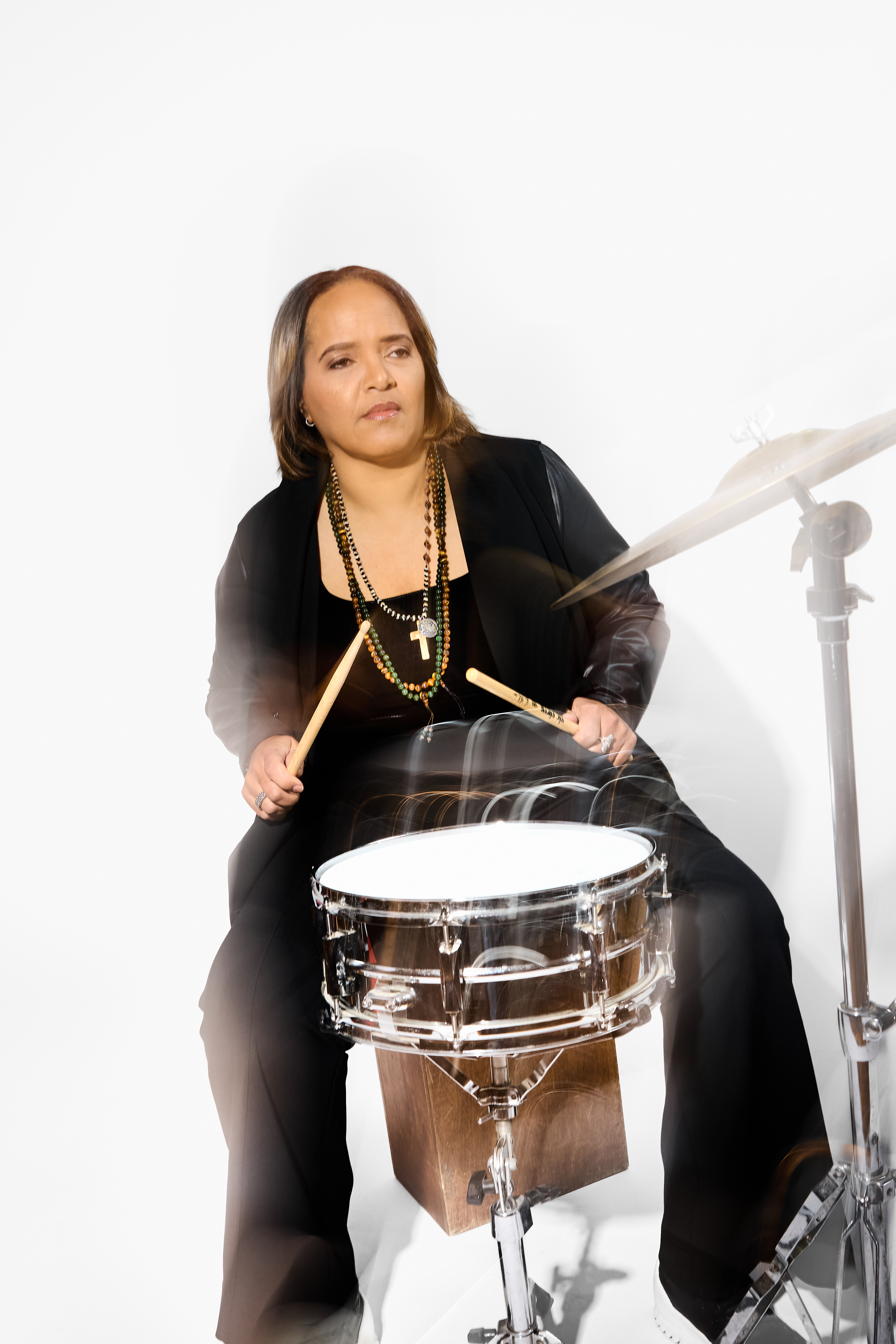
Drummer/Producer/Composer
NEA Jazz Master and four time Grammy award-winner, Terri Lyne Carrington has firmly established herself as one of this era’s preeminent jazz drummers, while continually reinventing herself by challenging the form and advancing her unabated development of artistic expression as a response to the moment.
While still in her 20’s, Ms. Carrington toured extensively with Wayne Shorter and Herbie Hancock, among others. And in 2013 she released, Money Jungle: Provocative in Blue, which earned a GRAMMY®Award, establishing her as the first woman ever to win in the Best Jazz Instrumental Album category.
To date Ms. Carrington has performed on over 100 recordings and has been a role model and advocate for young women and men internationally. She was granted The Doris Duke Artist Award, a prestigious acknowledgment in recognition of her past and ongoing contributions to jazz music and has received honorary doctorates from Manhattan School of Music, York University, Tufts University and Berklee College of Music, where she currently serves as the Founder and Artistic Director of the Berklee Institute of Jazz and Gender Justice.
Carrington has authored two books; Three of a Kind, a children’s book centered on the making of the Allen Carrington Spalding trio, and the seminal collection, New Standards: 101 Lead Sheets By Women Composers.