

 Apple Podcasts
 Spotify
 YouTube
 Amazon Music
 Castbox
 RSS Feed
 Overcast
 PocketCasts
 Tomeka Reid: The Low Seat, the Long Haul, and 'dance! skip! hop!'
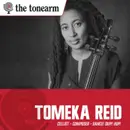
Cellist and composer Tomeka Reid joins the podcast to discuss dance! skip! hop!, the fourth Tomeka Reid Quartet album, and why photographs of her grandmother's Wyoming life keep finding their way onto her record covers.
Today, The Tonearm’s needle drops on cellist and composer Tomeka Reid.
Tomeka Reid has spent the last decade building one of the most distinctive voices in creative music. The New York Times called her a “New Jazz Power Source.” She’s a MacArthur Fellow, a founder of the Chicago Jazz String Summit, and a key collaborator with Anthony Braxton, Roscoe Mitchell, and Craig Taborn, among many others.
Her quartet with guitarist Mary Halvorson, bassist Jason Roebke, and drummer Tomas Fujiwara just released dance! skip! hop! on Out of Your Head Records. It’s their fourth album together, and it shows what twelve years of shared language sounds like: tight, playful, and willing to take chances. She also appears on Dream Archives, Craig Taborn’s ECM debut with this instrumentation, recorded in New Haven, Connecticut, and out earlier this year.
We talked about the cello’s role in jazz, how family history shapes her work, and what it means to lead a band that’s been together long enough to surprise itself.
(The musical excerpts heard in the interview are from The Tomeka Reid Quartet’s album dance! skip! hop!)
Dig Deeper
• Visit Tomeka Reid at tomekareid.com and follow her on Instagram and Facebook
• Purchase The Tomeka Reid Quartet’s dance! skip! hop! from Out Of Your Head Records, Bandcamp, or Qobuz, and listen on your streaming platform of choice
• Out Of Your Head Records — Tomeka’s label for dance! skip! hop!
• Tomeka Reid — MacArthur Foundation Fellow (2022)
Quartet Members:
• Jason Roebke — bass, cassette
• Mary Halvorson — guitar
• Tomas Fujiwara — drums
Related Albums and Projects:
• 3+3 — Tomeka Reid Quartet (Cuneiform, 2024) — the quartet’s previous album
• Dream Archives — Craig Taborn, Tomeka Reid, Ches Smith (ECM, 2026) — Tomeka’s ECM debut
• Hear in Now — co-led trio with Mazz Swift and Silvia Bolognesi
Organizations and Festivals:
• Association for the Advancement of Creative Musicians (AACM) — the Chicago collective central to Tomeka’s artistic development
• Chicago Jazz String Summit — Tomeka’s annual festival, founded 2013, dedicated to improvising string players
Musical References and Influences:
• Abdul Wadud — jazz cellist and major influence on Tomeka’s approach to the instrument
• Stuff Smith — pioneering jazz violinist; referenced in discussion of CJSS repertoire
• Ginger Smock — jazz violinist mentioned in the context of overlooked string player composers
• Diedre Murray — jazz cellist and composer; referenced alongside Stuff Smith
Historical References:
• Rock Springs massacre (1885) — the violent attack on Chinese miners in Rock Springs, Wyoming, which Tomeka mentions in the context of her grandmother’s family history in the region
• Fred Anderson — Chicago jazz saxophonist and founder of the Velvet Lounge, where Tomeka met mentor Clarence James
• The Velvet Lounge, Chicago — legendary South Side jazz venue where Tomeka came up
Educational Institutions:
• Duke Ellington School of the Arts — Washington, D.C. performing arts high school attended briefly by Tomeka
• Levine School of Music — Washington, D.C., where Tomeka received early instruction
• DePaul University School of Music — where Tomeka earned her Master of Music in classical cello performance (2002)
• University of Illinois Urbana-Champaign School of Music — where Tomeka earned her Doctor of Musical Arts in Jazz Studies (2017)
• University of Chicago Laboratory Schools — where Tomeka directed the string program for several years
(This transcript has been lightly edited for clarity.)
Lawrence Peryer: I've been enjoying the new record very much—it's been on repeat a lot the last few days. I wanted to start by asking you about the evolution of the compositions. If I'm reading the material correctly, maybe you didn't set out with the intention of making songs that were so suitable for dancing, but you realized after the fact that they were very danceable. Am I in the right neighborhood with that?
Tomeka Reid: Yeah. I always try to give myself some kind of prompt or idea to work with. I think oftentimes people think of the cello as having long, sustained lines or things like that, so I wanted to inhabit a different kind of space. And I like to dance, so I wanted some of that energy to be in there. I didn't know specifically how that was going to happen, but that was just something floating around in my mind. But then once the composition came into being, I was like, oh yeah—for me, it was like I was enjoying bouncing around to the ideas I was coming up with.
Lawrence: In one very limited view of the cello, it may not come across as an instrument that involves a lot of bodily movement, although it obviously is a physical machine. (laughter) I'm curious about the relationship between body and instrument, the ability to express yourself through movement and physicality. How much of that do you think about? How much of that do you take away? How much is that part of your experience with your instrument?
Tomeka: I guess it's a big part of it. I feel like cello players often have trouble with their backs, shoulders, and necks, just because of the nature of carrying the instrument—especially when you're on tour, hauling it around in its case. And then you want to make sure you have good posture when you're playing; that's what you're told. But I find myself sometimes looking at pictures and thinking, oh—because I'm engaged in listening to what's happening around me while I'm improvising, I will curve over a little bit more than maybe is good for my neck or shoulders later. So it is a very physical instrument.
The older I get, I just realize how we're all musical athletes, and I wish some of that had been addressed earlier in our training. Maybe some teachers get that, but we're using all these small muscles really intensively from a very young age, depending on when we start playing. I do think about my body—especially because that's how I get sound, using my relaxed shoulders and relaxed arms to pull the sound out instead of pressing it out. And just how you need strong back muscles because you're working with these little muscles.
I do think about those things when I'm playing and how to play with the most relaxed body, with less tension. But when you're improvising, sometimes that goes out the window because you're just trying to grab that idea or make that sound. So you might do something that's quote-unquote not "cellistic." (laughter) I don't know if that's a word, but you might do something that maybe isn't in the best form because you're trying to accomplish that sound or idea you have in your mind.
Lawrence: Do you have to train or maintain your body in specific ways as a cellist? Are you aware of that as it's evolved as you've gotten older, or is there a physical practice related to your life outside of just sitting at the cello?
Tomeka: Yes, I try, but it's just hard to have the discipline when you're touring. Stretching—I say to all musicians: stretching is so important because I think our bodies just kind of lose some elasticity. So it's just good to stretch. I carry rubber bands around to stretch. I know horn players who have those finger-gripper things you can squeeze just to keep the fingers strengthened. Because I always thought, well, I'm hauling this cello around and I'm playing, so clearly I must have some upper body strength. But no, I could stand to do more. So when I do have time, I try to stretch and go to the gym.
Lawrence: Given that dance! skip! hop! is the fourth record with this quartet, I wonder if what you're able to ask of the band members is different from what you were able to ask or expect of them in 2015.
Tomeka: I think it's not so much that—it's more like I know what to ask, because I have more experience. I know what I like, what sounds I like. Now I can be more specific, more intentional, clearer in expressing that. Whereas before, I was just a younger bandleader, and at that point you're like, oh my gosh, I have a band. I have people who are willing to play my music. So you're just happy with that.
But then maybe there are things you want to tweak. For myself, I try to give myself a prompt, I want to improve each time in my own playing, or even in how I think about touring. I try to figure out how I can make it even more comfortable each time, because we are getting older. While we do get to go really wonderful places, it's not an easy job. So I'm always trying to figure out how to do something better.
I would say we're all growing in our crafts and in what we do, but maybe it's also that I'm able to be clearer—like, that's not exactly the sound I want, or that's not exactly the groove I want. I can express that a little more clearly now that I just have more experience playing in bands, playing my music, and developing clearer language around that.
Lawrence: When you are beginning a new set of compositions, are you sitting down to compose specifically for this quartet? Is it project-based, writing for those voices? Or do you just have these compositions and, when you have the opportunity to make a record, go through your repertoire and choose? What's that process like?
Tomeka: I'm definitely thinking about my bandmates in any project. I'm really sensitive to that. For example, early on especially, I wrote a lot of ostinatos—I love vamps. So I've tried to figure out how to stretch things, because I don't want anyone to get bored. And I'm also trying to figure out how to shift roles within the ensemble, so that maybe there's an instance where I can be the bass player and Jason can play a counter-melody or another type of figure, or I can play a guitar figure or ostinato so that Mary can do something different.
I'm always trying to figure out how to shift roles within the ensemble as much as possible. Maybe Tomas is a little bit more fixed as far as providing groove, but I try to give comping and groove figures to everyone so that we're all kind of being drummers in the ensemble. I have some ideas about what I want to do for the next record in regards to Tomas—giving him more melody. He gets some melody now; he'll accent some of the melody. But maybe there's something more I can do with that so that we're really trying to shift all the roles.
They're just such great players, so I want to create something interesting and engaging, because if we go on tour, we're going to be playing this material night after night. So I want to create, to the best of my ability, music that can loosen up and open up. Of course I like hearing what I wrote, but I also want it to go places and not be too fixed—to have space to go other places. I definitely think about the settings and want everyone to shine. And I love them—they're really great musicians and people, so I want to create something that makes everyone shine in some way.
Lawrence: There are a few things you said in there I wanted to double-click on. One was the notion of the shifting roles. It's interesting to me because as a listener, I perceive that, especially as it relates to you and Jason. There were moments listening to the record where I was like, I can't quite tell what's going on at the low end—who's playing what role? So it's interesting that that's something in your mind while it's happening, because it comes across in the music.
And the other is the musicality of the players. It's a fine ensemble, a really good band. It must be an exciting privilege to know what these people can do now, where to push them, how to push them, how they interact. It's something of a privilege in creative music, right? To be able to revisit the same people over time.
Tomeka: Yeah, I feel of course very grateful for that—that we've been together twelve years now. Even when I was in high school, I didn't know what type of band I'd have, or that I would really go into jazz, because I was definitely listening to other kinds of music—punk rock, rock music. But I always wanted to be in a band. And so I feel like sometimes people are looking for what's your next thing? And it's like, yeah, I like doing other things, but I think there's something to be said for having a band and a band sound.
And it also makes rehearsing go smoother sometimes, because we know how we work and we're all so busy. We can do a really concentrated amount of time and get the material to where it needs to be a little bit quicker, because we're not figuring each other out. It's not so comfortable that we know everything—it's not like that—but we can just get to work right away.
I really value a band sound, that notion of just being together and working together, traveling together, eating together, even going on a little vacation together—just knowing each other's energy and vibe. I hope it translates to the music at least.
Lawrence: Do you think you'd be able to articulate what it is that the cello allows you to do, maybe harmonically or rhythmically, that is unique to the cello in a jazz context? What does the cello allow for that a more standard or traditional jazz combo can't do?
Tomeka: I think it just allows for endless possibilities (laughter) because it can have so many different roles. I'm sure I haven't explored all of them—I try to explore as much as I can, but there are others exploring it in their own way, and there's no one path. There are a lot of wonderful cellists in this space doing great things in their own way and contributing in their own way. So there are just a lot of possibilities: it can function as a bass, it can double with a bass, it can be like a horn. If you have a combo, it can fill that function—like a trombone. It can comp because it can play chords. And then you have the bow, arco, and pizzicato. Maybe you want to add some electronics or preparations—even a pencil, paper clips, or something like that.
There are so many possibilities, and every player is going to be so unique and different. I think that's true of any instrument, but I'd say it's definitely really special to the cello. And if you're transcribing and getting influences from different instruments, that's language you're bringing into it. I guess endless possibilities is what I would say.
Lawrence: Before I ask you more about the new record, I'm curious about what your seduction with the cello was like. When you met the cello, were you drawn to it? Did you have to be convinced? Was it love at first sight? How would you describe your initial relationship with the cello and then how you became immersed in it?
Tomeka: Well, my mom put me in a French immersion school when I was in fourth grade, and that's when everyone in Montgomery County, Maryland, was able to pick an instrument. I just remember a lot of the girls were picking flute and violin, and I was definitely more of a tomboy at the time. Me and this girl, Lena Mendez, were like, we're going to play cello. I had never really heard the cello before—I was like, yeah, it looked cool, it was big. And I don't know why I had this idea, because I was new to the school and I got picked on a lot, that maybe if I picked this instrument, they would think I was cool. I don't know why I thought playing the cello would make someone think I was cool, because then it was just like, forever—
Lawrence: Aw.
Tomeka: That thing is almost as big as you are. Or, is there a dead body in that case? You just hear the endless jokes forever. But yeah, it wasn't like I heard someone play it, that I can recall. For a long time I really wanted to play the piano. I thought Scott Joplin's "The Entertainer"—if I could play that piece, everyone would think I was so cool. I don't know why I thought that, but when you're a kid, you have these weird ideas.
But playing in the orchestra, playing with the other kids—up until that point I'd changed schools every year. So I think I just wanted to be a part of a club or a thing, to do something with other kids, because I felt kind of by myself a lot. And so I liked the fact that, oh my gosh, I can play with these other kids and make this bigger sound. If I play these notes on this page and they're playing these notes, we can make music, which I definitely did love.
Even when I was younger, I was always really interested in music. And sometimes I think maybe that's why I really like collaboration, because I've always been into this idea of: oh my gosh, if you do this thing and we do this thing and we work together, we can make this bigger thing. At that age, I wasn't thinking about collaboration explicitly, but essentially that's really what it was.
And I think I liked my role in the ensemble too—the cello—that it was the low sound, the underpinning, the glue, the carpet, the thing kind of holding things together. I feel that way even now. I don't have to play the melody. Sometimes people say, oh, you should put yourself more in that space, and I have done that and I do like playing melody. But I was never like, I have to be the first-violin energy—that's what I'm getting at. I'm definitely more like a bass player energy for the cello. I like being a part of helping things sound good or solid. I like being the glue, and then maybe there's a moment where you pop out, but you're just kind of always there, helping the sound be warm and round.
And I'm so grateful I picked the cello, because I really didn't know all of its possibilities. It was a little frustrating at the beginning trying to get a sound out of it. And yeah, it's a big instrument, so I'm carrying this thing around—I thought, maybe I should have picked the violin or the flute. But I think I definitely made the right choice.
Lawrence: It's really interesting to hear what you say there, because it ties so directly into the comment you made about the idea of being in a band—you always liked that idea, and there's something bubbling in your comments that has to do with teamwork, camaraderie, knowing how to play your position and support other people. It's all of a piece.
Tomeka: Yeah.
Lawrence: I'm sorry—I'm playing armchair psychologist.
Tomeka: No, no. (laughter)
Lawrence: While I'm in psychologist mode—
Tomeka: I was thinking, isn't it like teamwork makes the dream work? (laughter)
Lawrence: Yeah. There you go.
Tomeka: Honestly, it's like that in our lives too. If we could just kind of work together, we could accomplish so much more. Or just—I don't know, be a better society. You don't even have to do that much. Even a little bit of listening and a little bit of empathy go a long way. I think about my husband—it's so great to be in a team together, to figure out how to go through this path of life together, figuring out things big and small. Having that input from other people—especially if it's good input—just makes things really better, I think.
Lawrence: Could you tell me about the various ways that family and family history run through this record? It seems like there are some very overt ways, like the use of photographs, but what were some of the experiences that brought the notion of family into this project?
Tomeka: It's interesting—it wasn't intentional with that either. My very first record, I had my friend Damon Locks do the art. He's a really great musician and artist as well. The photo he used kind of looked—it's not me, but it looks like me when I was in junior high school, and she's running. And then for my next record I was trying to figure out what images I wanted to use.
I was starting to get closer with my paternal side of the family, particularly my grandmother and her sister, Aunt CeCe—Sara Green. When I went and visited them in Wyoming, my grandmother grew up in southwestern Wyoming. They were one of maybe four Black families that grew up in that part of southwestern Wyoming; her stepfather worked in the mines, which is why they ended up there. But when I went to visit, my grandma and her brothers and sisters still kept the house their parents had lived in. And in that house was basically a museum of photos on the walls—that's your great-great-grandmother, your great-grandmother—and I was like, whoa. I never even thought I would know my father, let alone his family or that part of the family.
I was just taking pictures of everything, because I was like, oh my gosh, this is amazing—you have this history. Unfortunately, on my maternal side we don't have that. I don't have those kinds of photos at all. And they were so beautiful. And because it's Wyoming, you don't often think of Black people in Wyoming, or Black people in the West. When I saw these photos, I was like, I have to use them.
My grandmother was a very fashionable woman—she loved getting her hair done, she was always put together. She has a fur coat on in Green River, Wyoming. The juxtaposition of that image was just very striking to me.
For Old New, I have a picture of her and the twin boys. My biological father is a twin. On the cover I have the two of them walking their dog—it's just an image I don't see regularly, two Black boys just walking their dog. Maybe that exists somewhere, but I hadn't seen it. So I was like, I want these pictures to be seen. They're so beautiful and I want them to live on.
So I kind of had that idea with the second record. And then for the third one, I had my husband do the artwork. I felt like it was in conversation with the first record—more like drawings and not photos.
So when I was thinking of this record and packing some items and photos, I came across those photo booth pictures and was like, I love these so much. And thinking again about how do these live on—it's not like people haven't seen Black people in photo booth pictures. But for me it's like, who do I give these to? I don't have children, so how do they live on? They're beautiful and I just want other people to see them. And so that's when I thought, oh, it'd be cool to have them on the record. That's kind of in conversation with the second album.
The picture on the vinyl or on the CD is my grandmother and her sister back to back. I just love that image. They went in to do a photo shoot just for fun, in their swimsuits—they wanted to do kind of a Hollywood-type thing, and I thought it was so cute. It brought me a lot of joy. I kept thinking I would love to see that image twirling around on the vinyl while the music is playing.
And then there's an image of me taken by Tony Smith, where I'm up against a brick wall holding my cello—people have used it a lot for promoting my concerts. How that came about was me and two of my girlfriends just deciding, let's go to Tony's house and take pictures. Which is not something I think of doing. I take selfies with my friends, but they were like, yeah, let's go to his house and just take pictures, and bring your cello. It kind of came about the same way the picture with my grandma and her sister came about—they were just like, yeah, let's just have fun and take photos.
I like things to have connections or meaning. So it's kind of in conversation with another photo of myself from a shoot I did not know would have so many legs. It's funny—this photo from 2015 is still being used.
Lawrence: It's really interesting, because when you point to some specific examples—like the photo of the two boys with the dog, or your grandmother and your aunt doing the swimsuit photos—there are all these little moments that feel really unencumbered.
Tomeka: Yeah.
Lawrence: The weight of the world's not there, no concerns—it's just people living in a very unencumbered way. I think a lot of times we don't get images of Black people just living their lives in a way where the context of the photo isn't weighted with things they maybe don't deserve to carry in every photo that exists of them.
Tomeka: Exactly. And that's the joy part. They're just walking a dog. They're just cute girls taking a photo. Sometimes I think that's a social injustice—that we can't just have more moments like that. Can't we just be hanging out like anybody else?
And these are old pictures of people just hanging out in the fifties or sixties—or even the forties. The sisters are ten years apart, actually. I think one is thirty-one and the other is twenty-one in that picture. That would have probably been around 1956 or so.
Lawrence: Yeah. That's even more interesting, right? Because it's a time we think of as so tumultuous in the Black experience. And it's like, some people had days where they were just living life.
Tomeka: Yeah. My grandma would tell me—I would ask her, what was it like living in Wyoming? There aren't a lot of Black people there. What was racism like? She said, baby, she didn't really experience it until white southerners came up to work in the mines. They would use some language, but then she said everybody would just beat them up, because they just didn't—she climbed trees. She said it was actually very diverse. She was like, I grew up around Japanese people and Mexican people. There were a lot of different people because everybody just came to work in the mines.
And yeah, I've learned through this—in Rock Springs there was a significant Chinese community that worked there. It's sad; there was a Rock Springs massacre that happened. But she said it wasn't really until she left—when she went to Manhattan, Kansas—that she learned that being Black and dark-skinned was a problem. She said, we were just riding horses and going to the movies and climbing trees. She always talks about how she was climbing trees.
Lawrence: That's great. Well, along those lines, could you tell me about the track "a(ways) for CC and CeCe"?
Tomeka: So I feel like I'm terrible with track names. As I already said, my grandmother's sister is Sara Green, but she goes by CeCe, so I call her Aunt CeCe.
During the pandemic, I became my grandmother's caregiver, which was a lot—but when I look back on it, I realize how blessed and lucky I was to have that experience and that time with her, even though she had Alzheimer's. I'm just sad I didn't get more years of her being coherent, I guess is what I'm trying to say.
I would reach out to Aunt CeCe—if you ever need anything, just reach out to me. There were just moments I was like, I don't know what to do. I need to get a family lawyer, deal with all this stuff, figure out how to find a home for her. And it's a pandemic, so it's not like I could just take her to the hospital and go with her. I couldn't get a geriatric doctor forever. It was just a lot. So I would talk to Aunt CeCe a lot—I just needed her help.
Going back, there was a gentleman who used to come to Fred Anderson's Velvet Lounge in Chicago all the time—he would go to all the jazz sets. His name was Clarence James, but he went by CeCe. So for a long time, CeCe—that name, that sound—was him, from when I first met him, probably around 2002, until he passed in April 2018.
He was always so encouraging. I would go to his house in Hyde Park, on the south side of Chicago, and he would just play a bunch of jazz, because I was still learning about the spectrum of jazz music. He knew all the guys in the Art Ensemble—he hung around all those musicians and went to all the sets. So he just knew all these people and would be like, oh, you should check this out, you should check this out. I remember us watching—I can't remember what it's called, but that Cecil Taylor film, the one where he's playing in all white—watching that together, watching a Sun Ra film together. He was always supportive, always saying, just keep going. He'd always say, play loud. (laughter)
So he was CC to me. And when I was thinking about naming these tunes, I was like, wow—he transitioned, but the creator put another CC in my life: my Aunt CeCe. I just didn't really make the connection until last year. Even though that CC is gone, I have my Aunt CeCe. And that's how they both spelled their nicknames. So "a(ways)"—there are different ways. I'm pretty bad with these, but you have the two letter C's and then you have CEC.
Lawrence: When you were talking about CC, the musical mentor—not your aunt—it reminded me that I wanted to ask you about your journey into jazz, because it does seem like a very deliberate, specific motion toward this music, away from where you came from or where your studies were. Could you talk a little bit about what caused you to walk down that road?
Tomeka: Well, I didn't intentionally think, oh, I'm going to play free jazz now. I feel like, again, it was kind of organic. I was trying to learn standards and tunes, and I didn't find a lot of people in Chicago at that time who were interested in doing that. I played in groups where if you quoted something, they would just musically bomb you on the stage. So I was like, okay. And I didn't know a lot of licks and quotes at that time anyway.
And then being part of the AACM, being around those musicians and eventually joining—it was very much like, find your own voice, create your own sound, do your own thing. Which was cool. I guess it helped me develop my own language, even though I was like, I still don't really know what I'm doing. But they encouraged me to just try to figure it out. And sometimes I do wish I had done a little bit more of that tune stuff—but I still work on it now.
And I think it's funny, because some people would say, oh, you improvise in a very free way, but you write very melodic stuff. So I guess it's all in there somehow, coming out in my own way. But yeah, I thought I would probably play tunes—I always liked going to a jam session. But because I kind of fell in with this AACM crowd, I didn't do that so much. I was just learning from different people without even thinking about it then.
I feel really blessed with my path because it wasn't something I totally set out to do—it just kind of happened. Oh yeah, I guess I'm learning—I'm playing with Nicole Mitchell's Black Earth Ensemble, so I'm learning how she composes. Or I'm playing with Maia, I'm learning how she composes. Or I'm playing with Dee Alexander, I'm seeing how she composes. Playing with Douglas. Eventually I'm playing with Anthony Braxton or with Roscoe Mitchell, and I'm seeing how they put things together. Even people like Keith Jackson—I'm seeing how they're leading bands, booking tours, dealing with all kinds of different things.
I think I also just really liked it because it was just open. When I was starting out, people would look at me and say, oh, you don't know jazz language? And I'm like, well, I do play the cello, and that's not really part of our regular training. So I'm here and I'm curious—let's just move from there. I feel like the folks in the AACM world were definitely more welcoming. They were just like, come on, you'll hear it. And I'm like, what will I hear? But they just had faith in me. Maybe some idea I had didn't come off, and I wasn't super confident about it. But they'd say, you have ideas, and what you're doing is not wrong. Maybe you want to make a different choice another time, but it sounds fine—maybe you want to be more confident, more committed to the idea, but you're hearing something, just go with that.
So I felt welcomed. And as I said, I always wanted to play in a band, so this was an opportunity to play in bands. I started getting asked to play in lots of different projects in Chicago, and that definitely was and has been a dream. Now I realize I have to be more mindful, because I don't have the same energy I did in my twenties to play in all these different bands. But I'm still like, oh yeah, that's cool, I want to try that, those people are great. I like playing in bands and projects.
Lawrence: How do you carry yourself differently, if at all, when you're a leader versus when you're a side person? And what does being in someone else's band ask of you that leading doesn't? Leading has its own maybe somewhat obvious responsibilities, but it's slightly less clear to me what the responsibilities are of being a side person.
Tomeka: I will say, I think to be a good leader, it's helpful to have been a side person at some point—and a good side person. I like to believe I'm a good bandleader because I've been a side person for so long, and there have been things where I'm like, hmm, I would do that differently, or how I want to be treated, or whatever. So I try to carry that with me when I'm leading.
I feel like I can be a little more relaxed as a side person, because I'm not thinking about—as my friend Dee Alexander would say—fifteen things. I'm just thinking about how I can be the most supportive in this ensemble. How can I just bring it to wherever it needs to go whenever we're playing or recording or whatever.
Usually I'm playing with my friends, and I'm like, yeah, I believe in this person—whether it's Angélica Negrón or Tomas Fujiwara. They're great and I want this to be great. I'm going to try to be as supportive as I can, and I can just focus on that.
In my own projects, I try to think about that too. But you're also thinking about, is everyone comfortable? Did I write the charts? Are the charts clear enough for everybody? There's a lot of other noise going on that I'm still like, okay, I need to also focus on the music—which I do, but there's a little bit more taking up space in my brain. Like, I want to make sure the tour schedule is comfortable and that we don't have too many super-early mornings, that we have enough time to get there and eat. There are all these things you want to consider that just take up mental space.
Also, I feel like—with the music I'm writing, I would say the last two records: in my first two records, I was like, oh, I need to show that the cello is a vital voice in this jazz music. Even though you have wonderful players like Eric Friedlander, Erica Dankwa, and Akua Dixon—they've been doing it, it's not like it hasn't been done. But I felt I still wanted to show that this is a vital voice in this space. So I felt like, oh, I'm going to write a blues and write all these different kinds of tunes.
But for the last two records, I was like, you know what, I want to write in keys that are comfortable for me so I can really make use of my open strings. Going back to your first question—I'm also learning to write better for myself. Horns are in B-flat or whatever, and I always thought, oh, I have to write pieces in B-flat. But they're writing in the keys that are comfortable for them. Why shouldn't I do that for myself? I did that more starting with 3+3 and kept that idea in mind for dance! skip! hop!. So I can just not worry about, why'd you write this in five flats? Just write music that you can really—as my great cello teacher at undergrad, Ms. Elling, would say—just sing. Kind of like CC's "play loud." But she would say, just go out there and sing.
Lawrence: You sort of did the segue for me. I wanted to ask you a little bit about your experience with educational institutions, both as a student and a teacher. What's your honest read on what those environments are and are not good for?
Tomeka: Because this was a while ago now—gosh, I guess I did my defense around ten years ago, in 2016. That's crazy.
Lawrence: It's crazy that 2016 is that long ago. I can't even really dimensionalize that.
Tomeka: Yeah, I definitely feel like—for example, I wanted to do my thesis on Abdullah Ibrahim, and my advisor was like, who's that? And I was like, oh no. And then, for me, it just wasn't the right institution. They were very much stuck in a certain realm of jazz. I remember I had various professors who were like, do you even listen to jazz? And I was like, what? My listening is in a specific sound world within jazz, but yes, I listen to jazz. I just thought that was such a weird question.
And then it was kind of like, why don't you write about how to play like John Coltrane on the cello? And I was like, I don't want to do that. (laughter) So the compromise we had was that I did transcriptions throughout the years and talked about the bow and how you might phrase some of those transcriptions on the cello to sound more like that specific era. I don't know how successful that was, but that's what I ended up doing.
It was just very not open to who I was—didn't really take advantage of who I was or what I could bring. I was definitely one of those cases of, yeah, you don't listen to jazz. It's like, okay, but again, I'm here. I'm signed up, I'm taking the classes, because I feel like there's stuff I don't know—so why don't you just teach me instead of giving me that vibe?
For my master's, I did it in classical cello. I did tell my teacher that I definitely wanted to play jazz, and I know he couldn't totally help me with that—not because he wasn't willing, just because that's not his sound world. He was a classical player and a very talented one. But that was a challenge because I came to studying cello professionally quite late. And I remember a lot of times it was like, well, I had that trouble when I was twelve—and it's like, that doesn't help me now.
For undergrad, Ms. Elling was very helpful in getting me to learn technique on the instrument, because I was quote-unquote behind—I didn't even really have a grasp of fourth position, which typically, if you're going to study as a cellist, you'll know before undergrad.
I guess I gained something at every place, but undergrad was challenging because I just had so much to learn. People in my studio had come from Manhattan, Juilliard, and Curtis—and then there was me. It was a lot. Very challenging, but also awesome. I learned a lot about the cello just from listening to my peers and learning the repertoire, because I hadn't heard the Beethoven sonatas before. I knew the Bach suites, but there was a lot of cello repertoire I wasn't familiar with. So that was really good training.
Perhaps I was just a challenging student to teach. There's still not a lot of institutions where—if you want to be a jazz cello major, where do you go? Maybe at Berklee—I think Eugene Friesen is still teaching cello there, and maybe Mike Block is there too. But it's still quite limited. So I can't always fault the institution. But it would've been nice if, especially in my doctoral program, they had been more open, because clearly I was trying to figure something out.
I feel like with my own teaching—even when I was the middle school and high school orchestra director at the University of Chicago Laboratory Schools for eight years—I tried to be the orchestra teacher I always wished I had. I made sure that my students, even when they were fifth graders, knew Abdul Wadud and Pablo Casals. I try to arrange things for them. I try to be the teacher I wish I had: sharing real stuff and making sure they know not just the Western canon, but the Black music that's happening, the other things that are happening. Because it's often the music they're kind of hearing anyway.
Lawrence: In education, or maybe specifically in your work with the Chicago Jazz String Summit, how do you think about issues around access—access to the opportunity for participants, as musicians? How do you make the educational and performance opportunities available? How do you reach people to participate?
Tomeka: We try to highlight—CJSS wants to highlight particularly violin, viola, and cello players. Sometimes I get guitar and bass players who are interested, but those instruments have traditionally been in jazz contexts, so that's why I focus on the orchestral strings. I try to look for individuals who are improvisers and write their own material.
There are a lot of great ensembles out there, but I love me some Earth, Wind & Fire—that's just not what this is for. If you're going to do a cover, then maybe you're doing a cover of a Ginger Smock tune or a Stuff Smith composition, or even a Diedre Murray piece or something like that. Because at jam sessions, whenever anyone calls anything, it's always a Miles Davis tune, a John Coltrane tune, a Wayne Shorter tune—and those are great compositions. But it's never something by a string player. Wouldn't it be cool if these string players write really great compositions? What if you go and call a Zach Brock tune, or a Sarah Caswell tune, or a Chris Hoffman piece that you like?
Jazz, for me, is music where improvisation is a huge part of it. So sometimes it leans a little more experimental, and I wanted to make sure that's offered and displayed. There are a lot of string festivals with fiddling and bluegrass and those types of music, and those are great—nothing against that. But I was like, where's the space for us? Us more avant-garde types. Where is that space? So that's really where I'm coming from. Violin, viola, cello—writing your own original music, leading the ensemble. Maybe you're a little left of center or maybe you're more straight ahead, but improvisation is definitely a key element.
And then I also added strings of diaspora, because there are wonderful gángan players out there, erhu, koto—I wanted to make space for that too, as much as I can. And I try to make sure I have a Chicago musician—or someone from the region at least—on every event, because it's in Chicago. I don't want it to suddenly become New York-centered. There are a lot more players in New York, and I don't want it to be all New York musicians playing in Chicago. I want Chicago people doing it.