

 Apple Podcasts

 Spotify

 YouTube

 Amazon Music

 Castbox

 RSS Feed

 Overcast

 PocketCasts
Fling ii: Modular Synths, Pedal Steel, and Michigan Motorik
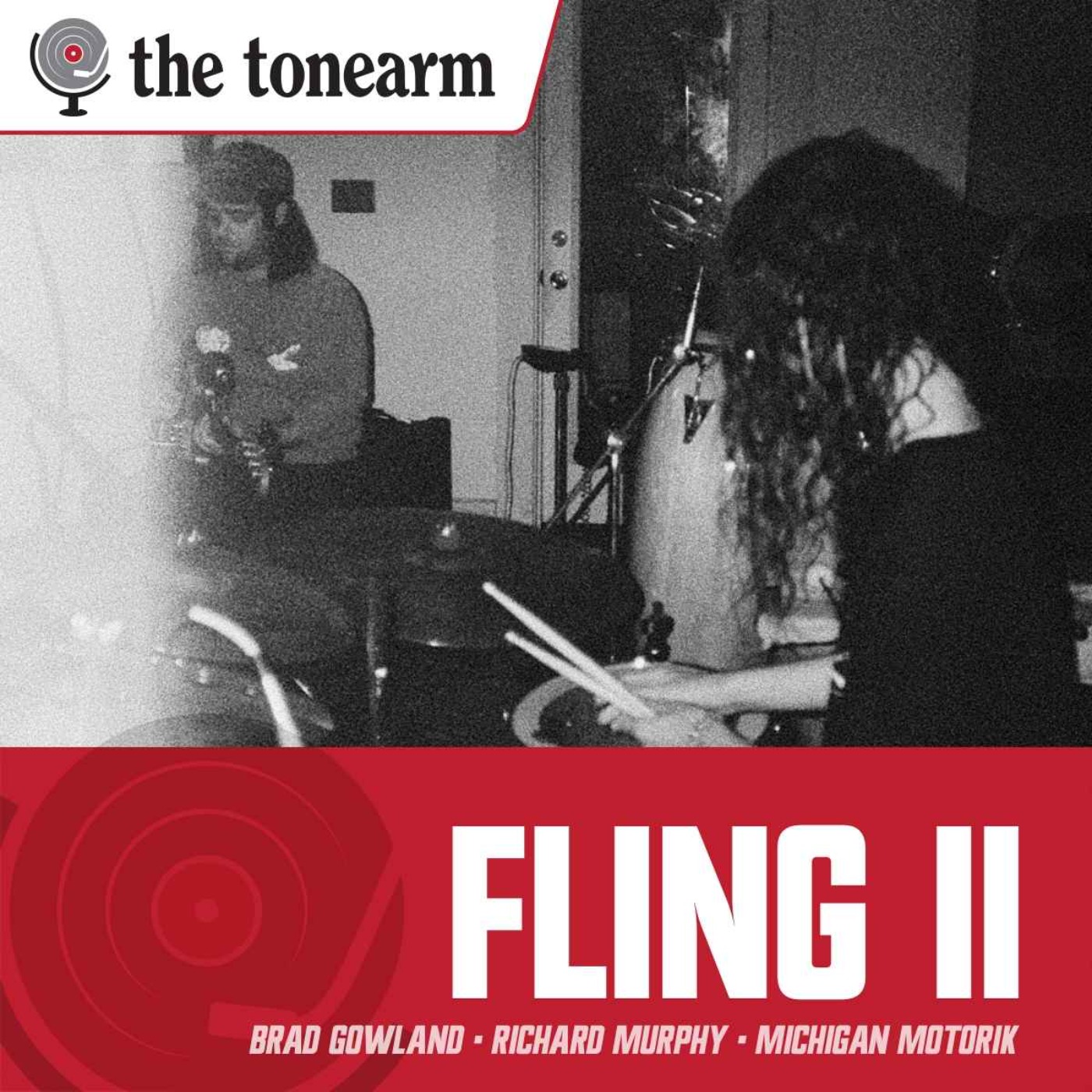
Seven players, four cities, and no rehearsals: Fling ii's Brad Gowland and Richard Murphy describe a recording method that turns a weekend of continuous tape into a six-track album.
This week we’re putting The Tonearm’s needle on Ann Arbor kosmische band Fling ii.
I sat down with drummer and synthesist Brad Gowland, and guitarist Richard Murphy, to chat about their third album, 3, which is out now on We Are Busy Bodies. It’s six tracks cut down from hours of studio jamming.
We talk about Richard’s path from ambient guitar to doom metal, Brad finding four minutes inside a fifty-minute take, and how a Magic: The Gathering card — and a commune breakup — inspired the band’s name.
(The musical excerpts heard in the interview are from Fling ii’s 3)
Dig Deeper
• Visit Fling ii on Bandcamp, where the full catalog lives
• Purchase 3 from We Are Busy Bodies, Bandcamp, or Qobuz, and listen on your streaming platform of choice.
• 2 (2024), the record that introduced Dave Van Dusen’s pedal steel — Bandcamp
• The self-titled debut (2022), seven tracks from the band’s first weekend at Willis Sound — Bandcamp
• The debut’s 2024 vinyl reissue on Italy’s Black Sweat Records, distributed by Forced Exposure
The Studio and the Label:
• Willis Sound — the converted church in Willis, Michigan where every Fling ii record has been made
• We Are Busy Bodies, the Toronto label behind 3 — and Exclaim!’s interview with founder Eric Warner on the label’s first twenty years
• The label’s roster on Bandcamp
Elsewhere in the Band:
• Sif, Richard Murphy’s instrumental doom project, which Brad Gowland produces and programs drums for
Musical References:
• Neu!’s “Hallogallo” — the track Richard played Brad in high school, and the founding reference point for the band
• Earth’s The Bees Made Honey in the Lion’s Skull (Southern Lord, 2008), the ambient half of Brad’s original pitch — also on Bandcamp
• Elder, the stoner-metal band whose turn to unqualified krautrock Richard cites
• Blood Incantation’s Timewave Zero, the synth record Brad keeps returning to
• Water Damage, the Austin group whose In E the live show came to resemble
• Amon Düül II, whose split from their parent commune gave the band its name
• Osees, whose cover art set the visual template
Scenes and Support:
• R. Solomon, the goth synth-pop act who shared the Ann Arbor bill
• Ryan Spencer, the Detroit DJ and producer whose new project closed the show
• New Orleans Synth Cult, the collective Richard describes playing laundromats — also on Instagram
Read More:
• RetroFuturista’s August 2026 interview with Brad Gowland, on motorik, pedal steel, and recording at Willis Sound
• Fifteen Questions: Fling ii about krautrock
Elsewhere on The Tonearm:
• Suzanne Ciani: The Buchla’s Orchestral Homecoming — the episode Brad name-checks at the close, and its companion article, Speaking the Word of the Buchla
(This transcript has been lightly edited for clarity.)
Lawrence Peryer: Are you guys both in Ann Arbor?
Brad Gowland: No, just me. Richard's in New Orleans.
Richard Murphy: Yep.
Brad: A couple of the guys from the band—Dave, who's the pedal steel player, he lives in New York, we met when we were in grad school—and Adam, who plays keyboards, and Tony, who plays drums. Richard and I know them from high school, but they also live in New York now. And then we've got two other guys who live in Detroit: Sam, who plays bass, and Matt, who plays EWI and sax. So we're kind of all over the place. Whenever I meet people who I like playing music with, I start calling them up for these gigs and stuff.
Lawrence: You recruit them to the merry band?
Brad: Yeah, exactly.
Lawrence: I'm very intrigued with Ann Arbor. I've never been. I've been a lot of places, but I haven't been there. The closest I came was ten or eleven years ago—I was in Detroit for Kraftwerk, actually, at the Masonic Temple. It felt very important to me to see Kraftwerk in Detroit, and it did not disappoint. What do I need to know about Ann Arbor as a music fan, as an art fan? If I told you I was coming to Ann Arbor, what would you tell me?
Brad: I guess the cool thing about living here for me has been two things. One sounds almost like I'm slighting Ann Arbor, but it was really important for me that when I lived in New York, I didn't make that much music, because it was just logistically really hard. I played drums—that was my first instrument, before I got into synthesis. I had some synthesizers in my room there, but to play drums, I lived in Harlem and I shared a space with a bunch of people way out in East Williamsburg, which took me an hour to get to. So when I moved back to Michigan, just having my drums in my basement and having all of my synthesizers—that's where I'm talking from now. I'm in a room in my basement where I have all my synthesizers and stuff. Moving anywhere that I had space, just to be happy in my house and not want to leave, to have room to play, was really big.
But what's been cool for me about the music scene since moving back to Ann Arbor is—like, you went to Detroit to see Kraftwerk and you were like, there's something cool about this. If you're in America and you want to see electronic music, one of the cool places to do it is Detroit. And I think people still think a lot about techno, and more broadly about electronic, as being sort of a local thing that you should be into if you live around here.
When I do my more experimental, solo synth stuff, I've played a lot of really small shows, or I'll just play at a bar or a coffee shop that'll have someone in to play almost background music. It's not a show. I'm just in there playing. And I think people have a higher tolerance for that kind of thing around here, or more of an interest in it. Random people around here will come out to a totally anonymous amateur bill of electronic musicians on a Thursday night or a Wednesday just to see what's happening.
I think that was really cool, to make me a little braver. Fling ii is the first time I've ever made music that I feel like I was durably proud of—that I didn't listen to six months later and think, man, that's really embarrassing. And I think part of that is that I got a little braver. I'd go out and see people play and I'd talk to them after their set, at the bar or something, and I'd be like, hey, that was a great set. And they'd say, thank you, I've never done this before. And I was like, I should be one of these people. There's no way that I shouldn't.
Lawrence: Richard, what about New Orleans? Is there an electronic music scene at all? Because obviously I don't think that's the first thing that comes to mind for people.
Richard: There is, yeah. It's not as strong as some other places, and I can't say I'm super deep in the electronic music scene here. In my regular day, I actually play a lot of metal music, so I'm a bit more into that side of the New Orleans scene. There's this group called the New Orleans Synth Cult that do things. I saw they had a show at a laundromat three blocks down from my house, which was really cool, and they incorporate a lot of water sounds and stuff like that. So there's some going on. I can't say I'm as deep into it as Brad is in the Detroit–Ann Arbor scene, but it's around.
Lawrence: Where was the gig you all converged on? Where did you all meet up for last week's?
Brad: It wasn't all of us. It was our bass player, Sam; the winds player, Matt; and Tony, from Brooklyn. And we played in downtown Ann Arbor.
Lawrence: Nice.
Brad: I picked the place because I knew the booker from other smaller shows that I'd played, but we had some other really cool local guys share the bill with us. A goth synth-pop guy called R. Solomon—I actually played with him at his last album release show, which is why I called him. And then there's this guy Ryan Spencer, a DJ who does everything around Detroit. He throws parties, he works in venues. Ryan's new project closed out for us, which was cool, because if he's into what you're doing, more people hear about you. So that was very cool for the show, that he wanted to come hang out with us. He's a really good guy.
Lawrence: Is there a bare minimum number of you that have to be there for the band to be Fling ii?
Brad: No. I'll play alone and use that name.
Richard: There's the one—I think it's probably apocryphal—but the guy from The Fall, the UK punk band. There's the quote where it's, if it's me and your gran on bongos, it's The Fall. That's kind of how Fling ii is. It's Brad and your mom, it's Fling ii.
Lawrence: That's funny. What's the story with the band name?
Brad: There was this Magic: The Gathering card that had great art of a giant throwing a goblin or an orc, and we were like, that looks like it should be an Osees cover, or a psych band album cover. And then we were like, yeah, we should name the band after that. But Fling is already a very used word for bands and albums and songs. Amon Düül couldn't be Amon Düül anymore. They were just like, we're Amon Düül II now. And I was like, we should just do that. We're not Fling anymore, we're Fling ii. That was the whole bit.
Lawrence: I mean, that is a pretty ballsy thing to do. It'd be kind of cool if, yeah, if Lars Ulrich left Metallica and it was like, no, I'm just Metallica II. (laughter)
Richard: The scourge of sequels.
Lawrence: It's totally fine. I like that.
Brad: The story I heard was, again, maybe apocryphal, that Amon Düül was the commune that the band was living in, and there was kind of a principle to the commune. They started playing some shows, and the commune band is going to play these shows. There was a little bit of a rift, that some of them were just people from the commune and some of them were pretty special musicians. When they started getting booked for bigger gigs, or the idea of, what if we got money from a record label to go record—they were like, okay, can we bring just the people who know how to play music when we go to play these shows and when we go to the studio? Then the rest of the commune was like, no, if you want to be the Amon Düül band, that means there's no exclusion. We're all in the band Amon Düül. And they were like, fine. Well, we're Amon Düül II then, and we're going to go play shows.
Lawrence: It feels like the Grateful Dead might have come perilously close to something similar, in terms of everybody going everywhere—the stories of them going to Egypt and taking everybody with them. You may not have been on stage, but you were definitely part of the pack.
Brad: Yeah. Well, and there's the whole thing that I love The Dead, and even when you'd go to see Dead and Company, it was this big mashup. People want to hear Jerry Garcia Band songs and they want to hear Bobby songs. Obviously Jerry's not even there, but people would want to hear JGB stuff if you went to see Dead and Co.
Lawrence: Did you see them at the Sphere?
Brad: No. I thought about going, but I don't have money like that.
Lawrence: Somebody actually gave me a ticket for my birthday a couple of years ago. It was something else.
Lawrence: Are you playing drums in this band?
Brad: Sometimes, yeah. We kind of rotate around, because a lot of people can play a couple of things. I play drums and synth. On our latest recording session, not out yet, I play some guitar and bass. Tony can play anything—Tony's a wild musician—so Tony plays a lot of the drums on 3, on our new record. Tony's going to play some vibraphone on our next recording coming out.
The way that songs sort of come together in the studio usually is, I either have a track that I record at my home studio here with my synths and stuff. I'll play some sketches through an amp or a speaker in the live room and be like, what do we think of this one? Do you guys feel anything with this one? And if people like it—or maybe I'll patch something up on the modular and be like, how do we like the sound of this?—we start putting together the basis of a jam. We don't start totally cold.
And sometimes it's just wherever people wander in the room. If Tony wants to play keys on something, I'll be like, cool, I'll just go sit at the kit. Or I start playing something and Tony wants to go sit down and play kit, and I'll find something else to do. So we rotate around. On 3, I think Tony plays drums on everything except for "ilia," where I think I'm playing drums, but I'm not sure.
Richard: You were tired of just setting up a patch and letting it go, and then you had to go play drums. You actually wanted to do a little bit with the modular sounds, which you hadn't been able to do until we had Tony and some other drummers coming in and doing it that way. So you jumped at the opportunity to be like, oh, thank God I don't have to play drums anymore. I can go play with my toys.
Brad: Yeah, it's cool though to get to do both, because modular is really interesting in that it feels different than playing every other instrument I know how to play. Whereas with drumming, especially if you're the drummer and you drop out of a song, that's a statement moment in the song. You're really doing it for impact. So I'm very used to that kind of playing, where your whole body is involved. You can't stop. And there's something really cool about that—almost like a walking meditation. It's not dangerous to stop playing drums, but you also can't do it while you're playing a song. There's enough stimulation that I can't think about other stuff, and I have to be involved with my body. It keeps you really physically engaged with yourself.
But modular is a totally curiosity-based activity. You don't have to do anything. You can just sit there and look at it. So it's a cool thing to get to do both of those things when we're in the studio. Like Richie was saying, I think the cool sound with 3 is that with Tony playing drums—I played all the drums on the first two records—so with Tony playing drums, I got to sit with the modular more, and you can hear the modular respond more to the rest of the room on this record, I think.
It can also just get really confusing and really maddening, and I'm like, I want to play an instrument that doesn't go out of tune, where wires aren't all laying on top of each other. I just want to play drums. I just want to play rock music.
Lawrence: Richard, tell me a little bit about the overlap in your musical interests. You mentioned metal, and that always makes my ears perk up, because many moons ago I was a young metalhead. I think a lot of listeners don't always appreciate the fact that the artists they like don't just listen to that kind of music. Most music lovers like lots of different kinds of music, including people who make music. But I'm really curious about working musicians who travel between different worlds. Do the different musics have a dialogue? How do those experiences transfer for you and inform each other?
Richard: Yeah, it's a good question. It's fair, because you hear the stuff that I do, I trade mostly in doom metal. Pretty heavy, slow stuff. I first started making music on my own, and it was improvised ambient guitar stuff—get a lot of pedals and set up a lot of loops and do a lot of that, just to see where it goes, in a very similar way to how the Fling ii stuff happens, where you just set it and see where it goes and take what you like and you put that out. So I did a couple of records that way. And then I got more interested in—there were just a couple of snippets of the ambient music I was making where I was incorporating a little more, some more riffs, some more distinct guitar lines, which then evolved into what I do now, which is doom metal, sludge metal.
If you look at the actual genealogy of the two types of music—our type, the krautrocks, and then your doom metals or whatever—they're only very distant cousins. You've got to go way back. But I think both forms of music get accused of being repetitive. You're kind of doing the same thing a lot, but where you find the interest, where you try not to be boring, is the evolution of those core ideas across eight, nine, ten, however long minutes. That's where I find a lot of interest.
So I'm the most technically limited member of Fling ii. I only play guitar. I'm the only person who really only plays one instrument. I could play bass, but I play bass like a guitarist playing bass, which is to say not very well. I focus a lot on going back to my ambient guitar roots of setting up big sonic soundscapes, drones, working on those, and then incorporating some more distinct guitar lines. So on the surface, the two types of music don't sound incredibly similar, but you look under the hood a little bit and there's some commonality there. It's a lot of fun to be able to stretch those muscles and do two different kinds of things.
Lawrence: The overlap to me as a listener would be in the areas of sonic texture and slow movement, the subtle variation over time, how tones change. So to hear you articulate it, the relationship actually doesn't sound as far away. It's almost exploring sound and texture just with different configurations, or from different pads, but the exploration itself is kind of the same.
Richard: Yeah, that's a good way to put it.
Brad: From what I remember of the first conversations we had, before we really thought it was going to be a band or even planned to get a record out of it, I was like, man, it'd be cool, Richard, if you and Adam came to Michigan and we booked some time in the studio. I have an idea for a couple of tracks that maybe we could record in a weekend. You were like, cool, what would I do? What are we going for?
I think the original hook that I gave you to draw you in was, I'm thinking of something that's almost like a motorik beat under an Earth song—that droney style of guitar, heavy ambient, but mixed with something a little more hypnotic, a little more of that cosmic kind of groove, instead of the usual metal drumming, which is either very ultra-present, super maximal, or like Earth, which is as minimal as you can get, with so much space in it. I was like, man, what if we had "Hallogallo" by Neu!, but we had The Bees Made Honey in the Lion's Skull by Earth as that ambience in the background? So I think we were talking about metal pretty early on when we came up with the idea.
Richard: Yeah. The other one that we were talking about too is the band Elder, who I'm a huge fan of. They're more on the psych, heavy psych style of stoner metal, doom metal stuff. Their old stuff is huge riffs, and then they put out a record of straight-up, no qualifications krautrock. But it all makes sense within their same kind of oeuvre going on. So we kind of have some inspirations from that, however much that comes through.
Lawrence: And Blood Incantation is like this too?
Brad: Yeah. I don't really like most of their records—they're too heavy for me—but they have a couple of synth records that are right in my zone. So they also think in some kind of similar way about this heavy groove kind of music and slow evolution that we're definitely into.
Lawrence: All of those different strands that you guys bring together in the music—one of the things that struck me listening to the new record is that it's very well engineered, and by that I mean the acoustic instruments and the electronic instruments don't get in each other's way. Everybody seems to have their sonic space, even if you don't necessarily know what the instrument is that's making any specific sound, which is always fun too. Could you talk a little bit about that? I would guess that requires some work and some effort, if not outright intention, to make sure everything's preserved that way, that you can get everything across without it becoming muddy or stepping on each other's timbres. What goes into the engineering?
Brad: I was just talking to Matt, our EWI and winds guy, about this exactly, when we were getting ready for our live show. The way that I think about space in a lot of Fling ii tracks is—especially when I'm doing work on synthesizer, and when Richard is doing really textural guitar stuff, and we also have Adam playing keys—those textures are super similar. The two ways you can deal with that are, okay, make space for everyone individually: we need to parcel out some space for you to take a solo, and then I'll take a turn, and then I'll pass it. Or what I really go for when I mix the music down is for everything to share that spot as one morphing sound, where the interest comes from as a listener.
You're not listening to it and thinking, I think I'm hearing three people play on top of each other. You hear it more as, there's a very strange morphing texture that sits at the middle of this song that holds my interest. Like it's one instrument, but it's the interplay of three instruments that are all completely mangled to the point that they're unrecognizable, as a single timbre.
And that's work that I do—although I should give everyone credit, it's something that comes across in the studio. If you're standing in the room, you would hear it like that. But it's also something that I think a lot about when I take the record home and I mix it. I do all the engineering and stuff at home.
When I took my hard drive home from our last recording session, it was like 250 gigs of audio, from a weekend of doing hours and hours of takes with 24 tracks and the whole board patched up. I take that home and I listen through it, and some stuff just comes out that way. Like the last track of 3, "mago"—that was mostly how that song sounded when we played it in the room. But then there are some, like "ilia," that are super assembled from scraps. That's really a collage. If you were in the room when we played the takes that became that track—they happened on different days. Some of them are different people's takes from completely different tracks. I don't think this guitar work fit in the song where it was recorded, but I also think it's really cool, so I'm going to find some other place to slap that in.
A lot of that fitting textures together is something that I do in post. I'll label up all the takes: this is 120 BPM, it is in C Dorian. And then if I'm working on another song and there's empty space in here that I don't know what to do with and I need something new, I'll look through all the labeled takes for something I'm not using that's in the BPM. And I'm a terrible keyboard player, so we only play in a few keys that I like. We play in the easy piano keys and the easy guitar keys. A lot of the stuff we record ends up being in similar keys, so I can do this kind of collage work in post.
But that's how those textures come together. Sometimes it'll be, literally, I sit there and I'm like, oh man, I wish Adam played Wurlitzer on this track, but he didn't—he was playing the Juno, or he was playing guitar, because he's also a sick guitar player. He played the Wurlitzer, like 200, E; in this key, at this tempo, on a different track. I'm just going to pilfer that and slot it in here.
Lawrence: That's fun.
Brad: Yeah, it's really fun.
Lawrence: And so Richard, when you hear it, when it comes back to you and the other people involved, it's pretty new?
Richard: It's a new experience for me. The first time I listened to the record I was like, man, wow, can't remember doing that one quite like that. You could view some of what we do—a good half of it is setting up a pretty elaborate boutique sample library for Brad, in a certain way. It is very exciting getting back the first mixes and things. It's just like, okay, you actually get to see what it ends up like. It's pretty exciting.
Brad: There are always a few moments, though, that come through—
Richard: Yeah, of course.
Brad: —moments that we know in the studio, like, that'll make the record. That'll just be the way that one went. We stuck the landing on it. And there are always tracks that we listen to where I'm like, this didn't turn out like we hoped in the studio. Or even takes that I walk out of thinking, I was not good, I'm not happy with how I played—but I'll listen back to it later and maybe it turns out that I liked that take, because a lot of times I listen back to the stuff that I distinctly remember being mad about and it's not actually bad.
A lot of times I listen to tracks where I think, this doesn't hang together well, but there's still really cool playing in here, so we'll just strip this one for parts, and I'll figure out a different way to jigsaw the cool elements that I liked back together, from maybe a few different tracks, or maybe even just super rearranging or recontextualizing.
This was from our second record. We had a track that I really didn't like my drumming on, and just putting it with a drum machine, putting it with a little samba on a CR-78—I was like, wow, this unlocks how great the bass playing is on this track. My drumming was too busy and it was all over the bass. But when I dropped that drum take and I put in just a smaller drum machine loop, it gives the bass a little more room to be the leader of the rhythm section. I was like, wow, this song's actually one of my favorites on the record. That was "scry," off of our second record.
Lawrence: Tell me a little bit about the process. Is it that you converge, or you convene, to record for a few days? Is it a rule that you always record together, or is there ever any remote recording? Do you ever feel like you didn't get what you need? How does the actual recording process work?
Brad: The reason the band exists is for doing the recording, because the first time we did it, I just wanted Richard and Adam to come hang out with me. I was like, a cool thing we could do is try to find a studio and just go hang out in there for the weekend and we'll play. We'll have some tape afterward. Maybe it'll be good enough to listen to. The intent of making an album was not there at all when we were in the studio. I was super surprised how much good tape we got afterwards. And the process of what I was just talking about—collaging songs together, pulling the different stems apart from what we jammed on in the studio and assembling a song that way—was something I kind of came up with as we did the first record. It was not how I thought it would go.
But still, the point when we get together to record is that all of my friends who don't live here come out to hang out with me for a few days. Adam is a dad and Dave's a dad, so it's a little harder now to get ahold of people and be like, hey, can I steal you away from your life for a weekend? Can you come to Michigan in January to hang out with me?
But the studio that we go to is really cool. It's an old church, and they have a little house next door that was the parsonage, where the clergy lived. So we also rent the house and we stay right by the studio. Everyone's there for the whole weekend. And the guy who runs the place, Joe, is great, and he knows us, so he'll even let us keep the key and have a few beers and go in there later at night and just jam with the mics not on—or he's come over and turned the mics on once. The tape from that was awful. It's amazing.
Getting together is the point of it. I find that I get frustrated when I record at home alone. I'll listen to a lot of stuff that I come up with when I record by myself and I'm like, this is nothing, I'm not interested in hearing this again. But boxing it in to using tape that we get when I'm in the studio—I think that's a good constraint to put on the project, because then I don't get frustrated about, man, this song is missing something. What if I just punch in and add a couple of layers on my modular here at home? Or what if I get out my guitar and punch in and add something here at home? I think if I finick with it like that, I would just fidget forever and never finish any of our tracks.
I think it's really helpful to say, there is a massive amount of material that we got from this recording session. I'm simply not allowed to go outside of that. That's the boundaries of what's going to go into the record. I've been nervous leaving sessions, honestly, thinking, oh man, I don't know if we got enough tape, I don't know if I can do it again. But now that we've done it three times, I'm not that worried about it. I just think it'll work.
Lawrence: Richard, when you get the recording, are you allowed to make comments? Or is it like you get what you get and this is what's coming out? (laughter)
Richard: Well, I'm allowed to, but a lot of work went into it already. I haven't really done too much, let's-go-through-it-line-by-line here. We give little notes and stuff here and there, but generally this is Brad's baby.
And on the part you mentioned—were there any specific rules or whatever when we go into recording? There aren't any specific rules. We didn't sit down and describe what we're going to do. But stuff that we've evolved to do, what felt natural to us, was—I don't think we've ever done a take of a song more than three times. The stuff that we talk about when prepping each song is pretty limited to, here's what the general loop is going to be. What do you guys think? Where do you want to go? And then you do it two or three times, and that's what it is. And it usually works out okay. This is mostly very improvised music.
That's what it looks like: we're all just getting in one big room. Like Brad said, Willis Sound, the name of the studio, is one big church room. You set the lights to a cool color and you vibe it out, you see where it goes. That's the process of it. And then Brad takes a couple of months to go hide away and do it on his own. He'll come to us for tips and pointers, or what do we think about this. But that's how it goes. So it's ultra-improvised at the beginning, and then Brad melts it down into what it ends up being, which is a way less improvisational process.
Lawrence: I'm really intrigued by that post-production part of the process, or the post-recording part specifically. The notion of time—have you gotten better and faster at this across the three records, or does it just take what it takes? And the other question is the one around finding the moments. I would imagine there are as many different ways they reveal themselves as there are songs, but you mentioned that sometimes, in real time, this material's going into the record. That's a lot of music to listen to. Do you identify at all on the first pass, or does it take months just to find the tunes? What's going on there?
Brad: Do I think I've gotten better at it? Definitely. But getting faster, I don't think, is really possible, just because of the volume of it, and because listening to music is a linear time experience. There's no way to get through all of the tape without just getting through all of the tape.
The way the process starts: when we leave the studio, I drive people back to the airport, they leave, and I usually don't touch it for a couple of weeks, because I'm a little overwhelmed after being in the studio, and I sometimes listen to my playing differently. I say my playing because I usually love what everyone else does, and I'm listening to what I do and I'm like, that's just not it.
I let it rest for a little while, and then I start assembling the library of different stems. I'm looking for a Wurlitzer take that's roughly this BPM and in this key—labeling what all of the tape is that I got from the studio. Just that takes a long time, and I'll listen to it as I do that to jog my memory: okay, this song, I'm going to look for this moment. Or, I don't remember doing this at all, so I'll listen through this one and see what we were up to.
I don't think there's a way that it can go faster, because so much of it is just, I'm going to listen to this a few times, and if there's a moment that I have some attachment to, I'll keep it. Sometimes I need to say, I really enjoyed this moment. This take is 50 minutes long and I'm 25 minutes into it, but I think this is a really great passage, and honestly I just need to drop it. I just need to say, this is the part that I'm going to work with—because this whole thing, I could spend the entire year on. I try to get it done in a year-ish. I could spend the entire year looking through just this one 55-minute take of one track that we did, if I don't at some point say, this is uniformly cool for X minutes and I found a part that I really like there. There's almost another layer of luck or improvisation in it, that this is the part of the tape I listened to when I felt really attached. This is the part that I'm going to zoom in on for this track.
Lawrence: What happens to the unused material? Is there a notion that it's locked away in the hard drive wall, or is it raw material for a future project, or you don't have to make that decision yet? How do you think about that?
Brad: Oh, I've totally put in takes from older recording sessions on later records. This has happened a bunch of times. During our recording session for our fourth album, Adam had to miss the session to be present at the birth of his first child.
Lawrence: Not very professional. (laughter)
Brad: He had a very good reason to not be with us. I've taken some of his old takes and layered him in with the new tracks. I'm going to go record with him in New York to get some new tape to work with of him. It couldn't be a Fling ii record without him. I also already have some of his old stuff woven in.
The way that we play—it's not that each record isn't different, but there are themes and there are tendencies of everyone who plays in the band. I know that with your playing style, if I get you on this instrument, this is the kind of stuff that I'm going to get to work with.
This goes back to what you asked Richard about—how much say does everyone have in what the final mix sounds like. They have almost no say in what the final mix sounds like. There's a very dictatorial portion of the legal system of the band, and then there's a very democratic portion of our legal system, which is when we're in the studio. I try to be really trusting of everyone, because I want it to be really fun. I don't want it to be me marching around the studio like Captain Beefheart, emotionally abusing everyone until they play something cool. I want it to be, I trust you, and I called you to be here because I think you're my buddy and I think your intuitions are cool.
So we're going to play a song. I'm going to give you the general idea of what I want to get out of this. And I'll tell people stuff like—it's usually just, can you play less? Because there are like seven of us in here and I just need everyone to be a little clean and simple. As specific as I get with an idea is, can you palm mute and play something rhythmic, Richard? That's about as specific as it gets. And then other than that, it's just, have fun. We're going to roll mics for a half hour, or three times on this idea. I don't seriously think we could play for an hour and a half and get nothing we enjoy. That part of it is, everyone can feel a lot of freedom to play whatever they want, and I try to be super hands-off.
But then when I'm mixing—I feel like if I also sent all the mixes around to seven people after I did them and said, hey, round of edits, everyone get back to me with how you feel about these tracks. And before you cut down an album, to say, we're going to fit this onto two vinyl sides of 20 minutes. I might have 10 songs that are candidates for a record. I can't ask everyone their opinion on everything. So at a certain point, when we get into editing, I'm going to give you what you get. But when we're in the studio, that's when I try to say, this is everybody's band. Do whatever you want.
Lawrence: Richard, what's it like for you, being part of a vision that is arguably someone else's? Is that freeing to you—you get to come in and play a role—or are you like, oh man?
Richard: No, it's very freeing. In a small system like this, where there's a lot of high trust and we've all known each other for, in Brad's and my case, more than half of our lives, there's a lot of benefits to a strong executive. I don't need to be worried about the details. I'm a little bit more just get-it-out with my creative endeavors. When I'm making my own music, I'm like, a couple of things, here we go, we're not making Thriller here, get it out. Brad, you're much more deliberate and detailed, in a good way, and it shows in the end product.
So I very much enjoy being just the soldier in this type of deal. We view it as, our input is helping develop the base—what's a house built on? A strong foundation, right? And so we get to build that. It goes a little bit into a black box, but then it's pretty great to see it come out the other side.
Lawrence: I think Brad's the Donald Fagen of krautrock. That's the realization I'm having. (laughter)
Brad: I said this last time we were in the studio, when I called Tony in to play drums. I called Tony and he was like, yeah, I'd love to play, man, but you play drums in the band—what are you going to do? And I was like, don't worry about me, I'm going to walk around and do my Donald Fagen thing. I want to appear on the record as little as possible so I have space to set the thing up—to put together the Hot Wheels track and then watch the car rip on it.
Lawrence: I would love to hear from each of you about your experience with the live part of this band. It's built on these improvisations or soundscape explorations, so there's that piece that gets cut down into a track, but then there's the assembly work. What are you playing live? Are you just riffing off themes from the songs, or is everybody going away and relearning parts? I'm so intrigued by that part of it.
Brad: We just played a show this last weekend, and it was drums, bass, EWI—a synthesized wind instrument—and I was playing a couple of different synthesizers. The way that we did it was that I sketched out the arc of what the show would be: we're going to play some of the synth sequences from these. I think we played through seven tracks, and some of them have multiple sequences that I put into just one of my modular setups. We would start with those, then link them by asking, okay, what is a pivot note that we can use to get from this key to the key of the next sequence, so that we could blend the whole thing together.
In that way, I wanted to set up a frame: there will be a familiar sequence, you have jammed with it before when we made the recording that percolated down into this track, and we're just going to shoot for that same experience. You don't have to learn riffs that you played on the record. If there are transitional moments or more composed, choreographed stuff that I end up doing in post—which is honestly quite rare—we would just skip all that. It was like, here's the bass riff from "misk" that I'm going to program into my modular, or here's the 6/8 arp from "mago" that sits underneath that entire track.
The way that I was playing along, I was doing kind of a Robert Fripp, Frippertronics thing, where I just have a loop pedal running real long and the loops fade out over a long time, so that we'd have this big wash of ambient-ish synth, and the more rhythmic portion that might be familiar to the song. Matt on EWI was kind of the soloist. Arguably Tony on drums was kind of the soloist. He's wonderful at playing against a click. He and Matt, I guess, are the two really trained musicians in the band—not that the others aren't wonderful, but Tony can play against a click like crazy. We just kind of jammed, and I would signal to people, I want volume up or volume down, or just cut whenever you feel comfortable.
I think it went really great. We played for an hour, an hour ten, and I didn't talk until the end, just to introduce the band. It was more live and more raw and more aggressive than when we're in the studio. I was thinking about how the live show that we just played will affect what we record next. It was heavier and more aggressive—less like Neu! and more like Water Damage or something—while we were just playing. But it was super fun, to use the different songs, the different sequences that we had, as different sections of one long jam. That was kind of what I was going for.
Lawrence: What's the prep like for you, Richard, from your point of view?
Richard: Well, it's funny, because I'm—Brad, correct me if I'm wrong—I'm the only person outside of you that's been at all of the recording sessions thus far.
Brad: Yeah.
Richard: But I have not actually played with this band live. I live in New Orleans, and the live stuff takes place up north. It'll happen eventually, but I've not done that quite yet. So we'll get there.
Lawrence: That's really interesting.
Brad: It was a real puzzle for me to figure out how I was going to play this stuff live, because when we recorded the first two albums, when we were in the room, I was playing drums. The sequenced synthesizer stuff I didn't really touch while we were recording for the first two records. I might have recorded the synths at home—if you can hear them swelling and changing and reacting, that's either how I patched it or I recorded that ahead of time—and then I played drums when we were recording. So I was like, even if everybody lived down the street from me, I don't know how we would have played this live.
And then when we recorded 3 and I was playing the synths, improvising and reacting live, sitting down in the room with my modular in front of me, or with the Moog Matriarch and the Farfisa, the other keyboard I was playing—I was like, okay, well, I could maybe do some of that live. But playing the modular is fairly unpredictable. Recreating those exact takes is not something I could do. I could make something that used the same sequence but would be completely different sonically.
Lawrence: And you don't bring stems with you.
Brad: No, I don't like doing that. I've played like that a bunch of times. I feel like I said that really fast—I'm not saying I have some sort of ethical opposition, like, no, I'd never play stems. I just didn't think it was that fun playing along to the stems, because the point of the band—and I think what feels cool when you listen to our albums—is that there's a lot of good feeling in it. If you tell someone, isn't it cool to listen to music where there are some mistakes in it, don't you like listening to music that's rough around the edges, I feel like most people would say, yeah, I totally do. Most music is not like that. It does get sanded down. And I try, when I put our tracks together, not to totally sand the edges off of it, so you can hear that this is people making stuff up.
A lot of the really cool moments that happen—like in "mago," there's this really great part in "mago" where we are playing D Dorian for most of the song, and then there's this buildup, and Dave rips into this kind of twangy, messy country solo, and he's moved into D Mixolydian. He's just bumped up the third to make it a more major sound. That moment is so cool. Adam follows Dave perfectly there, and I follow Dave. That just happened. I don't think I could have—if I wrote that, it would have been difficult, and I think we would have screwed it up a bunch of times, and then I would have said, this is not worth the effort, let's not do this. But it's a cool moment that just happened by accident.
And playing live, I felt like when I played the stems, that defeats the whole purpose of this band. You don't want to go hear a Fling ii track play exactly back to you. You want to go hear us get up there and see if we can pull it off again, see if something cool happens. So that's what I tried to recreate.
Lawrence: What's the next record? My understanding—tell me if I'm wrong—is that these first three records are a collection together. Say it better than I am, please.
Brad: I think I was trying to be funny when I wrote the press release. They're really nothing. They're just three albums. The fourth one will just be the fourth. And maybe in the press release I'll say that that's the fourth in a collected series. (laughter)
Richard: Look forward to the fourth one whenever that comes out, featuring Tony on vibraphone. That's the cool new addition that brings a whole new flavor. Teasing a record that doesn't exist yet.
Brad: There's a lot of cool new stuff.
Richard: There's some neat textures to play with.
Lawrence: But the sessions are done, huh?
Brad: Yeah. The fourth session we had seven or eight months ago now.
Richard: It was in January.
Brad: I think we'll keep having recording sessions. It's a little less than every year—maybe every 14 months we get back together to record another one. The reason that we do it is to get everyone together and get everyone back in the room: me and Richard and Tony and Adam, and Sam too, who plays bass. We all grew up in the same hometown. When you're a teenager and you have a functionally limitless amount of time to kill, we would just play music together. That's why I do it, for the band.
The records are cool. I'm very grateful to Eric at Busy Bodies for putting this one out—holding the vinyl is super special. But the reason that we do the recording sessions is to get together and play, so we'll keep having records as long as I can get everyone out to do it. We've got three records out. We had a fourth recording session. The fifth one, I don't know—I'll send out the invite soon. I bet it'll be this spring.
Lawrence: That's great. Well, thank you both for making time this afternoon. It's great to talk to you. I really love the record, so thank you.
Brad: Oh man, I super appreciate it. I love your show. I listened to the Suzanne Ciani episode and I was like, how am I going to be on a podcast that Suzanne Ciani was on? That's crazy. She's wonderful.
Lawrence: She's wonderful. She was really wonderful.
Brad: She's amazing.
Lawrence: Thank you both.
Richard: Thank you, Lawrence. This has been really good. Thanks.
Brad: Yeah, thank you, man. This was awesome.